
Additive manufacturing opens up new design possibilities in toolmaking that are difficult or impossible to achieve with conventional methods. Even today, many toolmaking companies still use conventional manufacturing processes - often associated with geometric limitations, high tool weight, and suboptimal cooling. The consequences are longer production times and lower component quality.
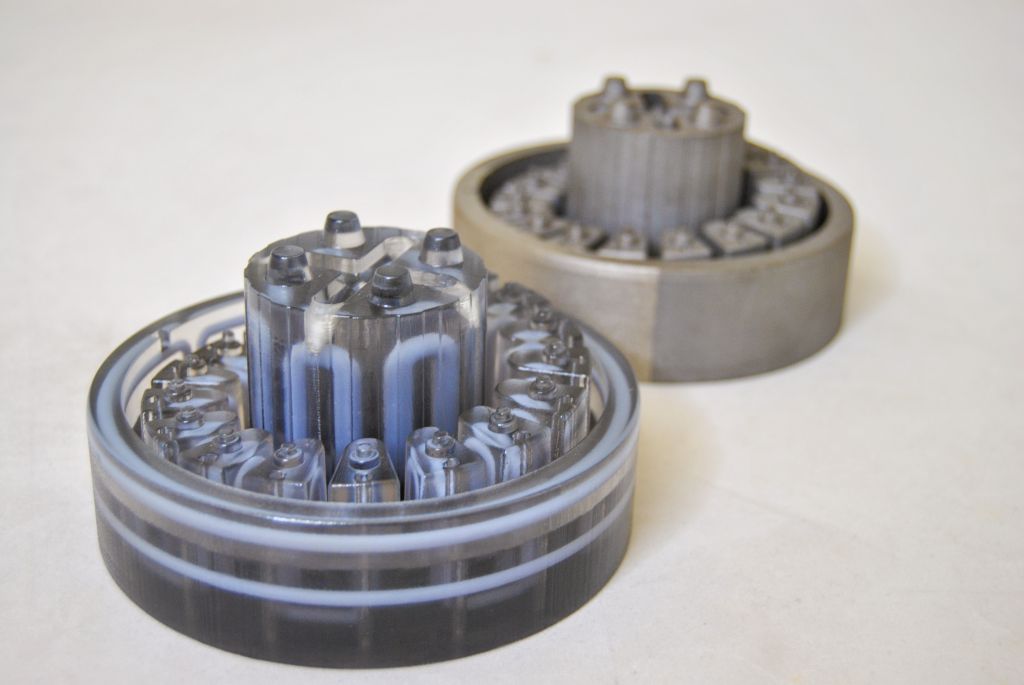
With additively manufactured tool inserts, cooling channels can be routed directly along the component geometry - for optimal heat dissipation exactly where it is needed. The result: shorter cycle times, higher part quality, and greater design freedom.
Custom manufacturing for inserts and complete molds
Speedpart offers solutions for both individual tool inserts and complete mold construction including injection molded parts. Tool inserts are manufactured as needed in tool steel MS1 (1.2709, unhardened up to 37 HRC, hardened up to 54 HRC) or stainless steel 316L (1.4404, hardness up to 89 HRB). This material variety can meet specific requirements for load capacity, corrosion resistance, and temperature behavior. The additively manufactured inserts are equally suitable for prototype manufacturing as well as series production.
In addition, Speedpart offers hybrid manufacturing solutions, where milled components are specifically combined with additively manufactured elements. This allows for targeted optimizations in mechanical load capacity and cooling, as well as flexible adaptation of tools to specific requirements.
Technical advantages of additive manufacturing in toolmaking
Additive manufacturing opens up new possibilities for toolmaking that significantly enhance both design freedom and production quality. Additively manufactured tool inserts allow cooling channels to be routed directly along the component geometry - exactly where heat dissipation is needed. Thanks to this contour-adjacent cooling, a uniform tool wall temperature is achieved, pressure losses are minimized, and even hard-to-reach surfaces can be optimally cooled. The result is significantly shorter cycle times, higher component quality with improved surface appearance and reduced warping, as well as increased flexibility in design thanks to AM-appropriate engineering.
Speedpart provides complete in-house solutions - from individual tool inserts to complete mold construction including injection molded parts. The technical conditions of manufacturing are impressive: layer thicknesses of up to 20 µm, wall thicknesses starting from 0.4 mm, and maximum component sizes of 250 × 250 × 320 mm ensure that even the smallest details and functionally relevant structures can be reliably represented.
With these technologies, additive toolmaking positions itself as a forward-looking solution for efficient, precise, and economical production processes - both for prototypes and for small and series production. For specific project inquiries or further technical information, Speedpart is available as a competent contact.
Contact: