
The aerospace industry is experiencing a boom. New launch vehicles, more satellite launches, and increasing demands in aerospace and the defense sector mean that companies must realign their production. MT Aerospace is also facing this development. The company, headquartered in Augsburg, develops and manufactures, among other things, tanks and structural components for the European launch vehicle Ariane 6 as well as components for satellites, aviation, and the defense sector. With the growth of the industry, the demands on production are also increasing. A manufacturing process with comparatively small quantities is gradually transforming into an industrial production with significantly higher output.
For Tobias Hannen, engineer for digitalization of industrial processes / project manager Space International at MTA, it is clear that this change cannot be managed solely with new machines. 'In the past, we produced rather small series. Today we are talking about several thousand components per year. This completely changes the requirements. Processes need to become more transparent, and our employees must always know what tasks are upcoming and how they can prepare for them.' To create this transparency, MT Aerospace opted for the Manufacturing Execution System COSERA from GROB – and this despite the fact that not a single machine from the Mindelheim machine manufacturer is in use at the company.
A system that fits production
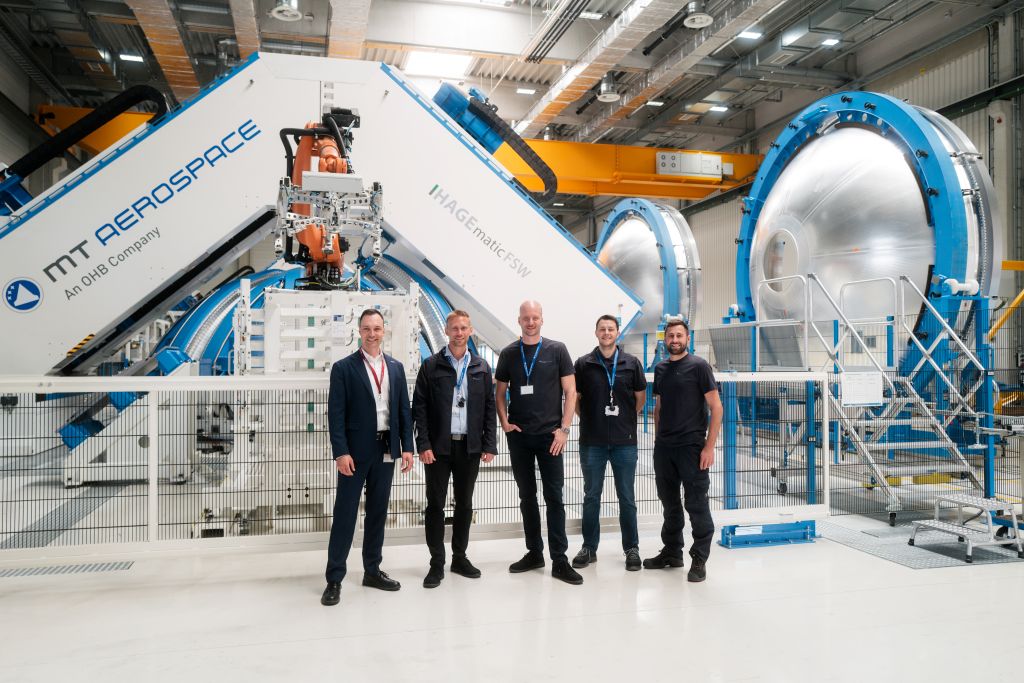
When MT Aerospace was looking for a successor system for its existing MES, several providers were available. The existing system no longer met the demands of the growing production. Therefore, a solution was sought that would seamlessly integrate into the existing system landscape while also providing enough flexibility for future requirements. 'We looked at several providers,' recalls Tobias Hannen. 'In the end, it was crucial for us that GROB quickly understood our processes. In the discussions, we didn't have to explain for long what challenges we faced. You could immediately tell that there was manufacturing know-how present there.'
Another advantage was the close integration with SAP. Changes to workstations or additional work steps are directly adopted without the need for information to be maintained multiple times. 'That's exactly what we wanted to achieve. If something changes in SAP, that information should reach the worker immediately. It saves time and prevents misunderstandings,' says Hannen.
The fact that GROB uses the software in its own production and that reference customers could also be visited gave the project team at MTA further confidence. 'It was important for us not just to see the system in a presentation. At the reference customer, we could talk to the users and experience how COSERA is used in everyday life. These insights were very valuable for our decision,' says Hannen.
Traceability is not an option, but a requirement
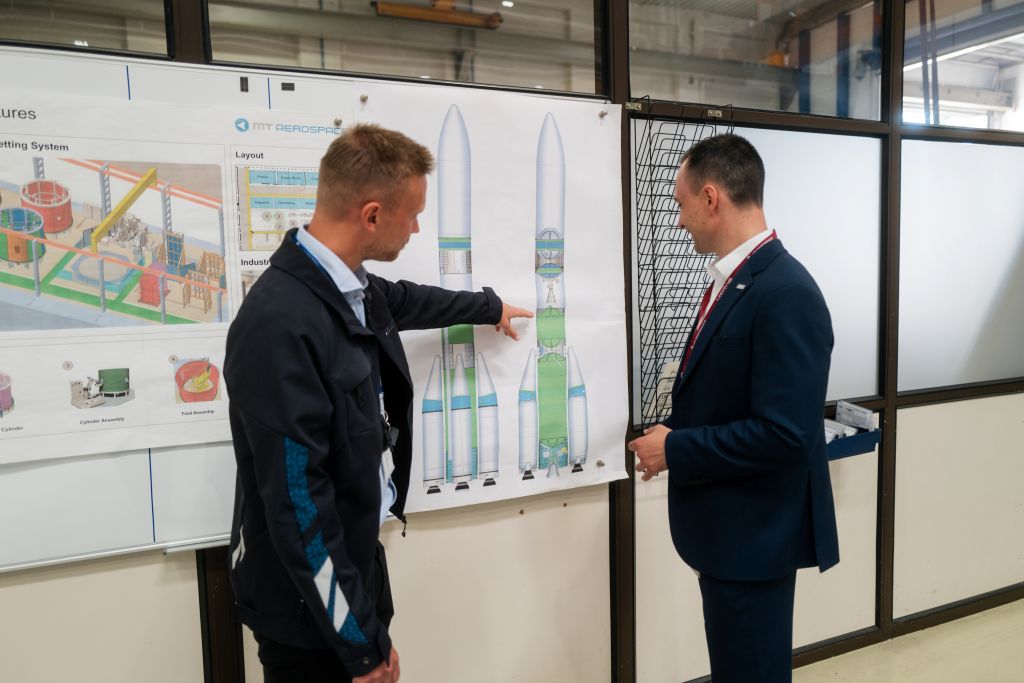
In aerospace, the highest demands are placed on quality and documentation. Almost every manufactured component at MT Aerospace has a unique serial number. Every processing step must be fully traceable. 'Our customers expect complete traceability,' explains Hannen. 'We must always be able to say which employee worked on which component and where this component was later used.'
Exactly this transparency could be provided by GROB. With COSERA, all information is centrally available for MTA. 'Today we can see at a glance where an order is located and whether there are any delays. In the past, we had to search through paper routing cards for that,' recalls Hannen.
From gut feeling to real-time data
With increasing production numbers at MT Aerospace, it is no longer sufficient to track the production status via paper routing cards or individual feedback.
Today, a glance at the production monitoring of COSERA is enough. 'We see in real-time where our products are, what status they have, and whether any deviations occur. This allows us to react much faster,' says Alexander Müller, Production Manager Large Tank Manufacturing at MTA.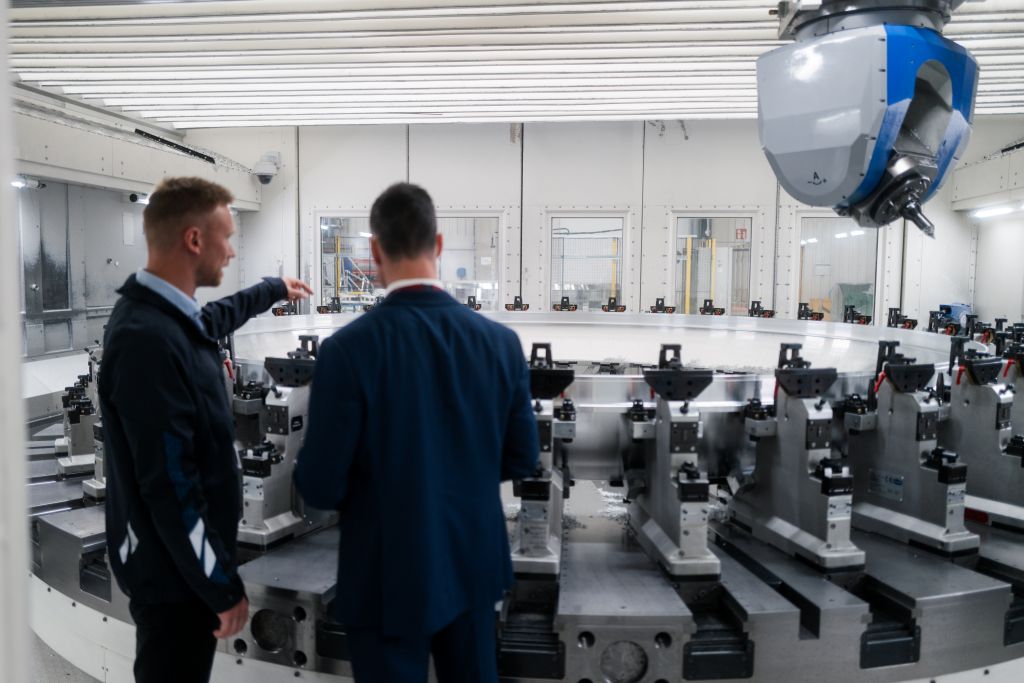
Downtimes between individual work processes can now also be evaluated precisely. This allows MT Aerospace to recognize early when bottlenecks develop or individual areas begin to backlog. 'We see very clearly where products are stuck and at which facility a bottleneck is developing. This allows us to counteract before delays affect the entire production,' says Müller.
Information where it is needed
Digitalization benefits not only the production managers but especially the employees at the machines. In the past, they often had to switch between different programs to access drawings, bills of materials, or measurement data. Today, COSERA consolidates all information directly at the order.
Marco Diener, machine operator FSW welding system at MTA describes the difference from his daily work like this: 'When I arrive at the machine in the morning, I immediately see what work is pending and which components are to be processed next. Drawings and work instructions are directly attached. In the past, you had to open several systems for that.'
Feedback can also be recorded much faster thanks to COSERA.
'I now book machine times or setup times with just a few clicks. It saves time and makes the work easier,' says Diener.
Monitoring machines instead of waiting for disruptions
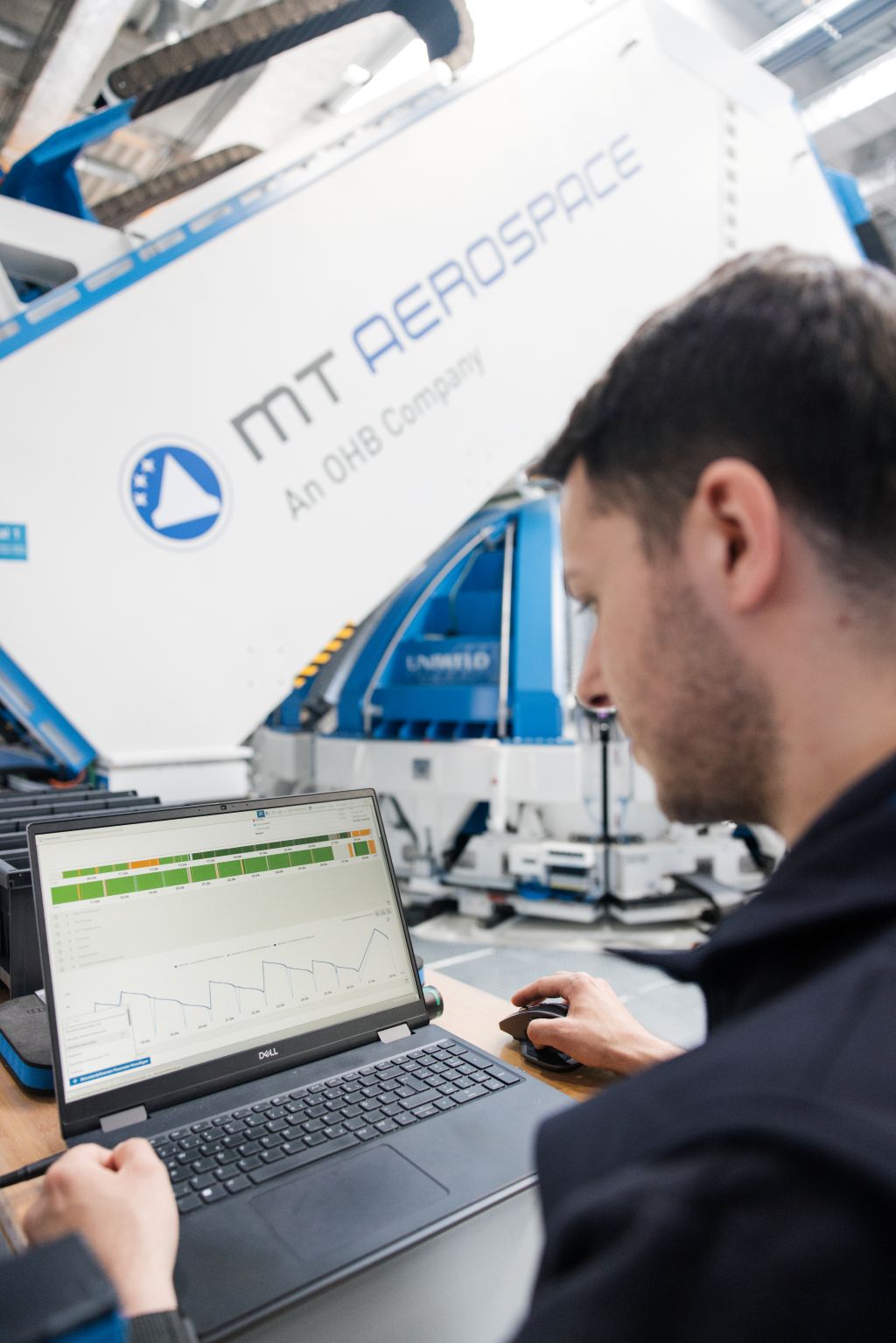
In addition to production control, MT Aerospace also uses the machine data collection from GROB. This provides the status and performance data of the machines at any time. Programs can be analyzed, feed reductions detected, and downtimes reported automatically. This brings significant advantages, especially with unmanned machines. 'If a machine stops at night, the responsible employee automatically receives a message on their phone. This allows us to react immediately and not just hours later,' says Patrick Thurner, Sales & Operations Planner at MTA.
The company was also able to improve its processes in the field of additive manufacturing. Sensors, for example, monitor fill levels and trigger timely notifications before material runs out or a machine stoppage occurs. 'In the past, we often only noticed that a machine had stopped when someone happened to walk by. Today, everything happens automatically,' summarizes Thurner.
Developed together instead of off the shelf
For the introduction of the new system, MT Aerospace originally planned about two and a half years. Just three weeks after the project started, COSERA was already running on the company's servers. 'We were able to show the system to the employees very early on. That was important to us because we wanted to involve them in the project from the beginning,' emphasizes Hannen.
After a pilot project in additive manufacturing, the rollout in the other production areas followed step by step. Throughout the entire introduction, the project teams from MT Aerospace and GROB worked closely together. 'We had regular workshops and could discuss our requirements directly. Many topics concerned not only the MES but also SAP or our quality management. This openness in collaboration has helped us a lot,' recalls Hannen.
Software that works independently of the machine fleet
The project shows that GROB's digital manufacturing solutions are not tied to a specific machine manufacturer. MT Aerospace operates a heterogeneous machine landscape from various manufacturers. COSERA connects these systems and creates a common data basis.
For GROB, this is no longer a one-off case. More and more companies are facing the challenge of aligning their production from single or small series to higher quantities. It doesn't matter which machines are already in place. What matters is transparency across all processes.
Optimally positioned for the future
For Tobias Hannen, the project was never just about introducing new software. It was about preparing production for future requirements in the long term. 'Anyone choosing an MES system today should not only look at current problems. Much more important is the question of where the company wants to be in five or ten years. That is exactly how one should choose the solution,' Hannen concludes.
Contact: