
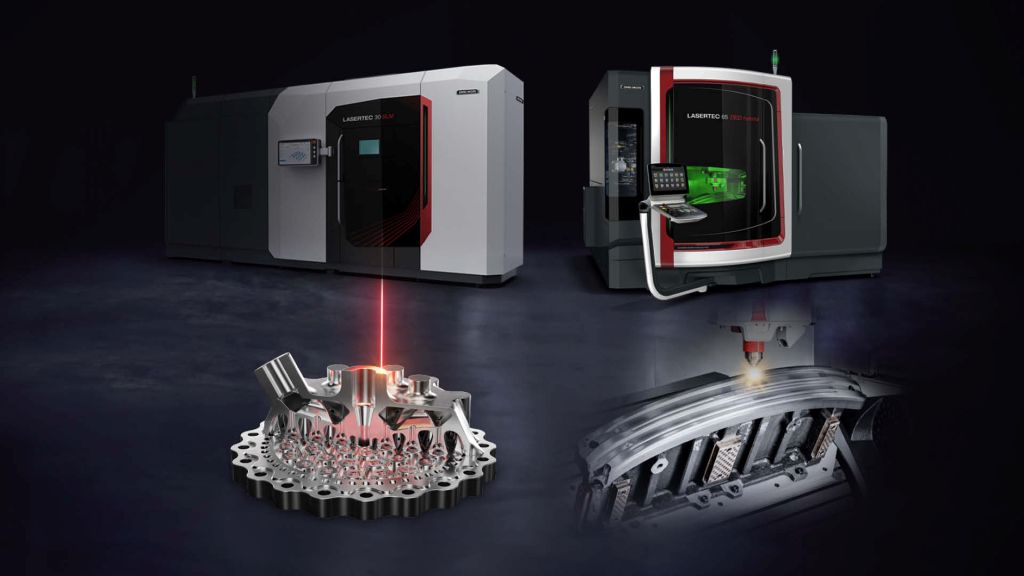
With future-oriented solutions and holistic processes, the machine tool manufacturer ensures that additive manufacturing can also set new benchmarks in series production – both in laser cladding on the LASERTEC DED hybrid models and with the powder bed machines of the LASERTEC SLM series. This underscores DMG MORI's role as an innovation leader and provides a glimpse into the future share of Additive Manufacturing in Machining Transformation (MX).
6-in-1 Process for Efficient Series Production
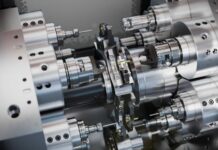
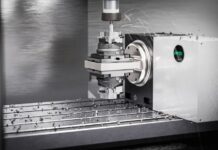
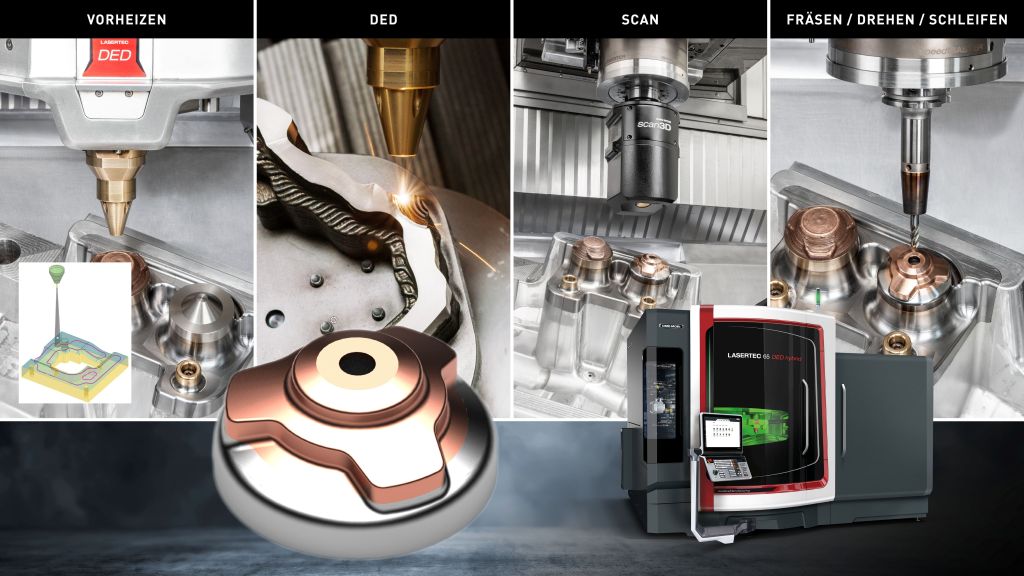
DMG MORI implements series-capable production on the LASERTEC DED hybrid machines with a holistic 6-in-1 process. It includes milling, turning, and grinding on one side, as well as preheating, additive manufacturing using powder nozzles, and a 3D scan on the other side. This allows DMG MORI to consistently focus on process integration in a single setup as part of its Machining Transformation (MX). This reduces lead times because components do not need to be cast, transported, and reworked. The advantages are clear:
The switch between subtractive and additive technologies allows for the construction of complex geometries, and multi-material applications can be equipped with tailored properties, such as better wear or corrosion protection and increased resistance to chemicals. Furthermore, for example, tool inserts can be cost-effectively repaired. Additively manufactured components often have a longer lifespan and reduced maintenance times, significantly increasing their availability. At the same time, lead times are massively shortened.
As the newest part of this process chain, preheating minimizes stresses and prevents cracks between base and weld material, improving mechanical properties. A tool-changeable 3D laser scanner enables contactless capture and precise quality control through false color representation. The optional use of blue lasers expands the material spectrum to highly reflective metals like copper and allows graded material transitions for highly functional components. At the end of the process chain is the precise finishing on the same machine. All steps – from preheating to scanning and material application to machining – can be flexibly combined and repeated as needed. This transforms a complex multi-step process into a continuous, highly automated workflow that proves the series capability of hybrid manufacturing in practice.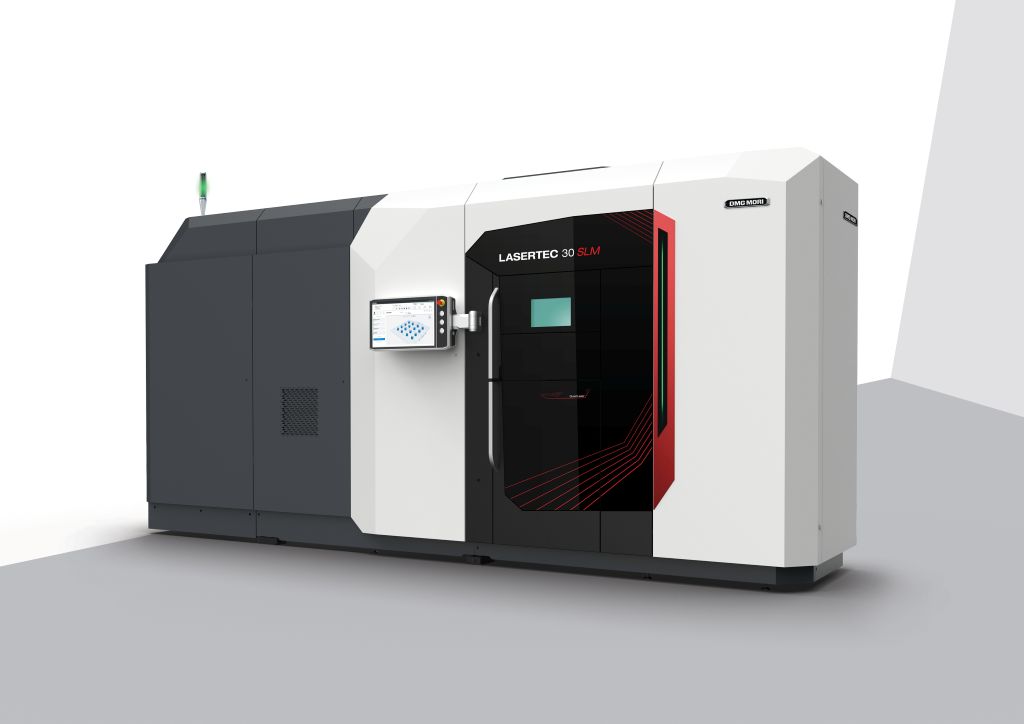
Continuous Productivity in the Powder Bed
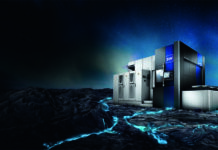
In the field of powder bed machines, DMG MORI sets new benchmarks in efficiency, precision, and productivity with the LASERTEC 30 SLM 3rd Generation. A central innovation is the interchangeable build container, which eliminates one of the biggest bottlenecks in metallic 3D printing: the long cooling times after build jobs. Finished containers can be removed without waiting after completion and replaced with prepared containers – the machine remains productive with almost no interruption.
Setup times are also significantly reduced, as the preparation of the build plates will now take place externally. This not only eliminates the need to repeatedly flood the chamber with inert gas, but also significantly reduces the consumption of protective gas. An integrated lid system additionally increases safety and maintains the protective atmosphere between two jobs, allowing powder management and material handling under inert gas conditions. Furthermore, the machine impresses with its robust construction. The stable cast frame reduces thermal influences as does the floating process chamber. An active Z-axis compensation stabilizes the layer height, while up to four fully overlapping lasers ensure uniform and productive material processing. With a build space expanded to 325 × 325 × 400 mm, larger or multiple components can be manufactured in parallel, making the machine attractive for series production.
At Formnext, DMG MORI also presents the new rePLUG FLEX, a simplified version of the proven rePLUG powder module. This variant does not include the closed powder circuit within the machine. Instead, material changes can be carried out without an additional powder module – an economical solution especially for materials that are only used in smaller quantities.
The LASERTEC 30 SLM 3rd Generation
A camera monitoring of the powder bed also ensures high component quality while minimizing process interruptions. After each layer, the surface is scanned and analyzed for anomalies. A heat map visualizes possible defects, and a rating system assigns an 'Anomaly Score' to each layer, whose graphical representation allows for an immediate review of all previously built layers at a glance.
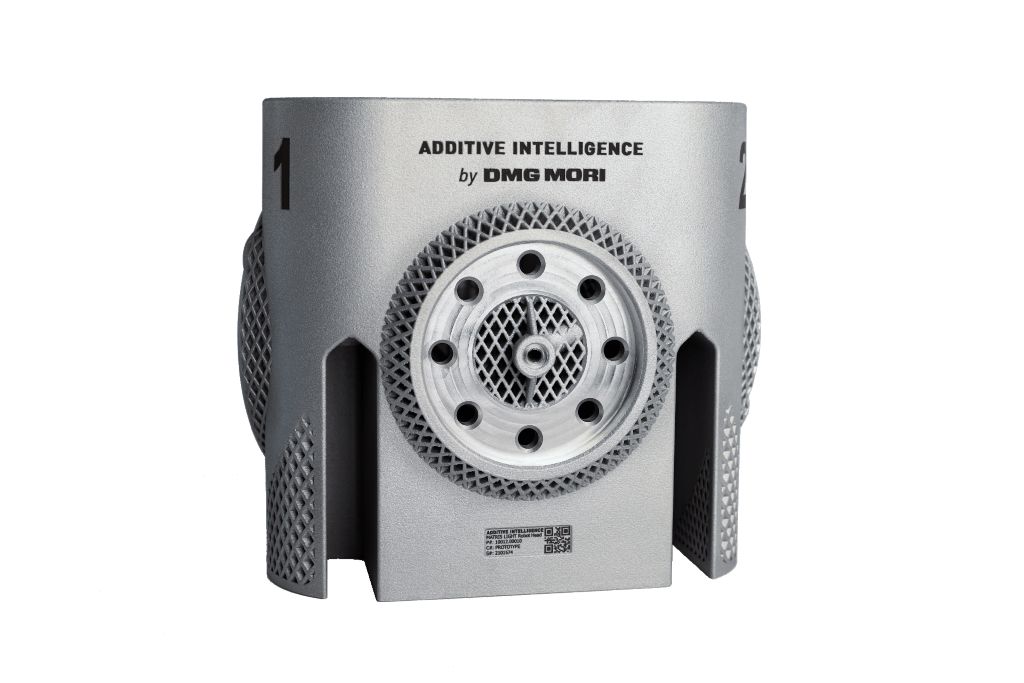
New is the function to project layer data of the workpiece onto the respective camera image. This makes it easier to assess whether a detected defect actually affects the component or is limited to non-critical areas. With this combination of stability, productivity, and digitalization, the LASERTEC 30 SLM 3rd Generation marks a significant step towards industrially scalable powder bed manufacturing. Using the example of a robot head from MATRIS light, DMG MORI demonstrates such a manufacturing process at Formnext.
Exploiting the Potential of Additive Manufacturing
Recent development examples show: DMG MORI realizes innovative processes around additive manufacturing on both a technological and economic level. The consulting unit ADDITIVE INTELLIGENCE facilitates entry into this topic with in-house experts. They advise and support customers in fully exploiting the potential of AM – from the first idea to design and series production. In combination with the latest machine developments, hybrid process chains, and digital tools, a comprehensive package is created that provides companies with a real competitive advantage. The production of customer parts can also be implemented in this unit. Today, over 3,000 components are already produced annually for use in corporate machines. DMG MORI thus emphasizes its role as a partner on the path to the future of manufacturing – and as a driver of a sustainable Machining Transformation (MX) that leads additive technologies from the pioneering phase into industrial reality.
Contact: