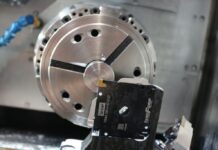

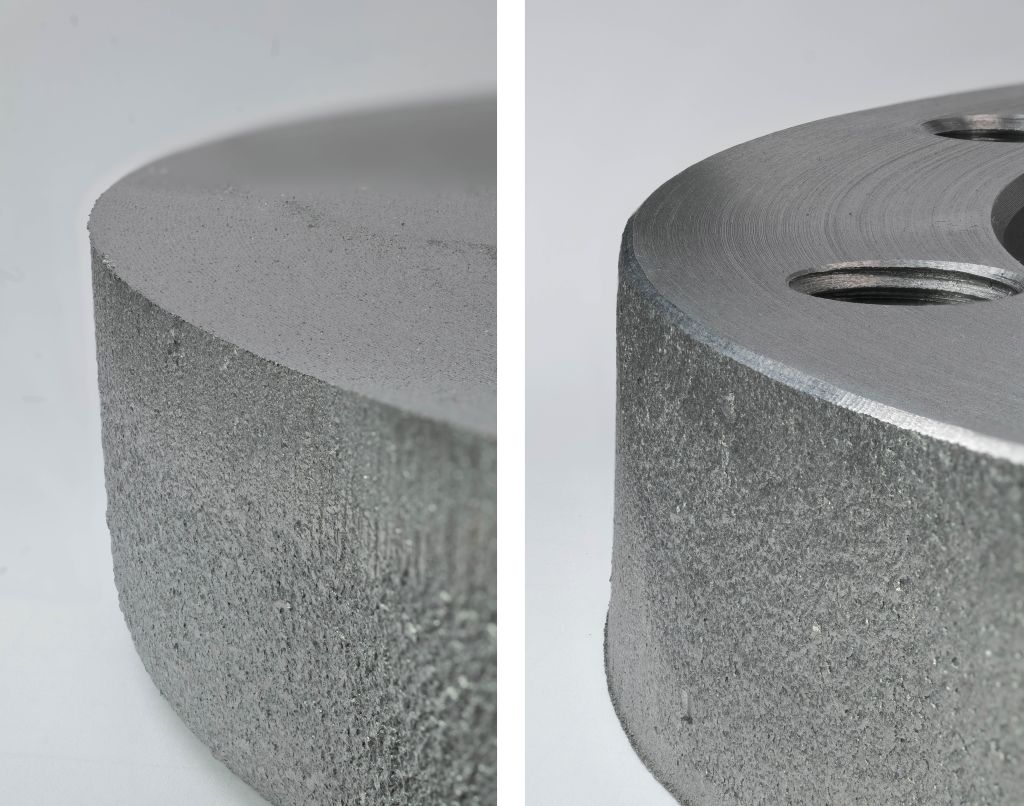
In practice, the automation of deburring processes sometimes fails not due to the machining strategy, but simply due to the available space conditions in the machine. For this challenge, the deburring specialist KEMPF has further developed its proven ibex into a particularly compact XS variant. At BAILER CNC GmbH & Co. KG from Burladingen, the short design now enables the mechanical deburring of cast parts directly in the lathe – a process step that could previously only be carried out manually.
The history of BAILER CNC dates back to 1980. What began as a small turning operation in the home of company founder Ottmar Bailer has developed over the decades into a modern manufacturing company with around 70 employees. Today, the company produces high-quality precision turned and milled parts for customers in the fields of hydraulics, scale construction, food and logistics technology, as well as mechanical engineering. The production of quality products in small and medium series has always been at the center of the company's philosophy.
Manual deburring as a necessary work step
The manufactured components also include flanges made of GGG40, which must be reliably deburred after machining. Until now, this particular work step posed a challenge. Due to the cramped space conditions in the lathes used and the fluctuating casting contour, it was not possible to deburr the components directly on the machine. Due to the limited swivel range of the tool turret, the previous ibex compensator from KEMPF was also too long. Therefore, these parts had to be manually deburred with pneumatic grinders after machining. This additional work step not only increased personnel costs but also complicated further automation of production. At the same time, the quality of the deburring was heavily dependent on manual processing.
Compact design creates new possibilities for mechanical deburring in lathes
In search of a more economical solution, KEMPF's ibex deburring system came into focus. Wherever undefined edges need to be deburred, the innovative compensator is used and demonstrates its strengths. Due to its high flexibility and the ability to deburr in the larger standard version with tension and pressure compensation, the clamped milling cutter can adapt to any component geometry and thus deburr edges with high dimensional variations – such as in a cast part – very quickly, cleanly, reliably, and uniformly.
However, it soon became apparent that the installation situation in the lathe did not allow the use of the standard tool with 140 mm or the ibex FLEX with 145 mm length. Only with the development of the new ibex XS could the application be realized by the technical field service of KEMPF, Thomas Welte. With its particularly short design of just 81.5 mm total length (without cutter), the tool can also be used where space conditions previously did not allow for mechanical deburring. This advantage was decisive for BAILER CNC. The ibex XS can be directly integrated into the existing machining process and now performs the deburring directly on the machine. The previously necessary manual rework is completely eliminated, and a consistently high quality is achieved – regardless of operator influence or manual rework. Another advantage is seen in machine operation, as the integration of deburring allows employees to supervise multiple machines simultaneously, making production overall more efficient and economical.
With the ibex XS, KEMPF specifically expands the application possibilities of the proven deburring technology for applications with limited installation space. Standard tools often reach their limits on lathes, even though automation potential exists. Experiences at BAILER CNC show that often it is not the deburring task itself that presents the challenge, but the available installation situation. In this regard, the compact design of the ibex XS enables the automation of applications that previously had to be processed manually. Due to the numerous advantages, BAILER CNC plans to use the new ibex XS deburring system or the standard variant on several lathes and milling machines for further processing. Due to positive experiences, new components are also being fundamentally checked to see if complete deburring directly in the machine with this system is possible.
Contact: