

In April 2025, the independent initiative Climate TRACE reported that global emissions in the first two months of 2025 totaled 10.32 billion tons of CO2 equivalent. A major contributor to these emissions is industrial waste, which mostly ends up in landfills. And although recycling helps, it is not a comprehensive solution. Patrik Eurenius, Head of Sustainability and EHS (Environment, Health and Safety) at Sandvik Coromant, explains below how the refurbishment of tools is a valuable addition.
The global amount of waste is increasing rapidly. The UN estimates that the amount of municipal waste will rise to 3.8 billion tons by 2050, of which about 50 percent currently comes from industry. To prevent such waste forecasts from coming true and to stop global emissions from rising further, a significant reduction in industrial waste is essential.
In industries such as aerospace, automotive manufacturing, and the oil and gas industry, cutting tools are indispensable. The tools are exposed to extreme conditions such as high pressure, great heat, and abrasive materials. They inevitably wear out, which is why some companies are inclined to replace them prematurely to avoid downtime.
However, a proven refurbishment strategy can significantly extend the life of a tool, allowing it to be used effectively several more times.
Complex refurbishment

The refurbishment of tools is much more than just simple resharpening. It is a precise, multi-stage process that restores a worn tool to its original geometry. By leveraging the full potential of modern tool technologies, manufacturers can extend the life of the tools and minimize their dependence on raw materials.
In a first step, the worn tool undergoes a comprehensive inspection. Using modern measuring devices, wear patterns and structural integrity are assessed. Defects such as flank wear and pitting wear, as well as breakouts, are also detected. This step is crucial as it identifies the areas that need to be refurbished and determines whether the tool is suitable for refurbishment.
If the tool is suitable for refurbishment, the resharpening begins. Modern CNC machines are used to restore the cutting edges and the geometric profile of the tool to within a few micrometers. In this phase, special attention is paid to controlling thermal stresses and precisely aligning the cutting edge and the center axis of the tool body. This ensures that the structural core of the tool is not compromised.
Subsequently, a new coating is applied to enhance the tool's resistance to heat, wear, and chemical degradation. Using highly precise methods such as physical (PVD) or chemical (CVD) vapor deposition, a uniform coating with optimal adhesion is achieved. PVD methods are generally preferred for high-precision tools as they operate at lower temperatures, thus avoiding thermal deformations.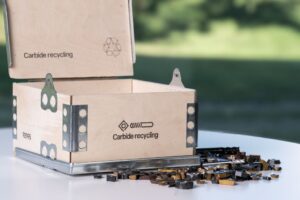
After resharpening and coating, the refurbished tool undergoes a rigorous performance test. This includes analyzing edge integrity, assessing coating adhesion, scratch tests, and performance comparisons with new tools. These tests correspond to those performed on new tools and are intended to ensure that the refurbished tool meets the original manufacturing standards regarding performance, quality, and precision.
Once the tools are completed, they are cleaned and packaged in protective packaging to avoid transport damage. They are then returned to the customer and are ready for high-precision and efficient re-use.
Refurbishment and more
Sandvik Coromant offers a comprehensive, seamless refurbishment service through its global network of refurbishment centers. These centers contribute beyond mere tool performance to drive a comprehensive change in manufacturing practices.
In addition to the refurbishment centers, Sandvik Coromant also has its own recycling program for carbide tools that are so worn out that refurbishment is no longer possible. In a recycling facility in Austria, the worn tools are collected and processed into new products. Important resources such as tungsten are also recovered.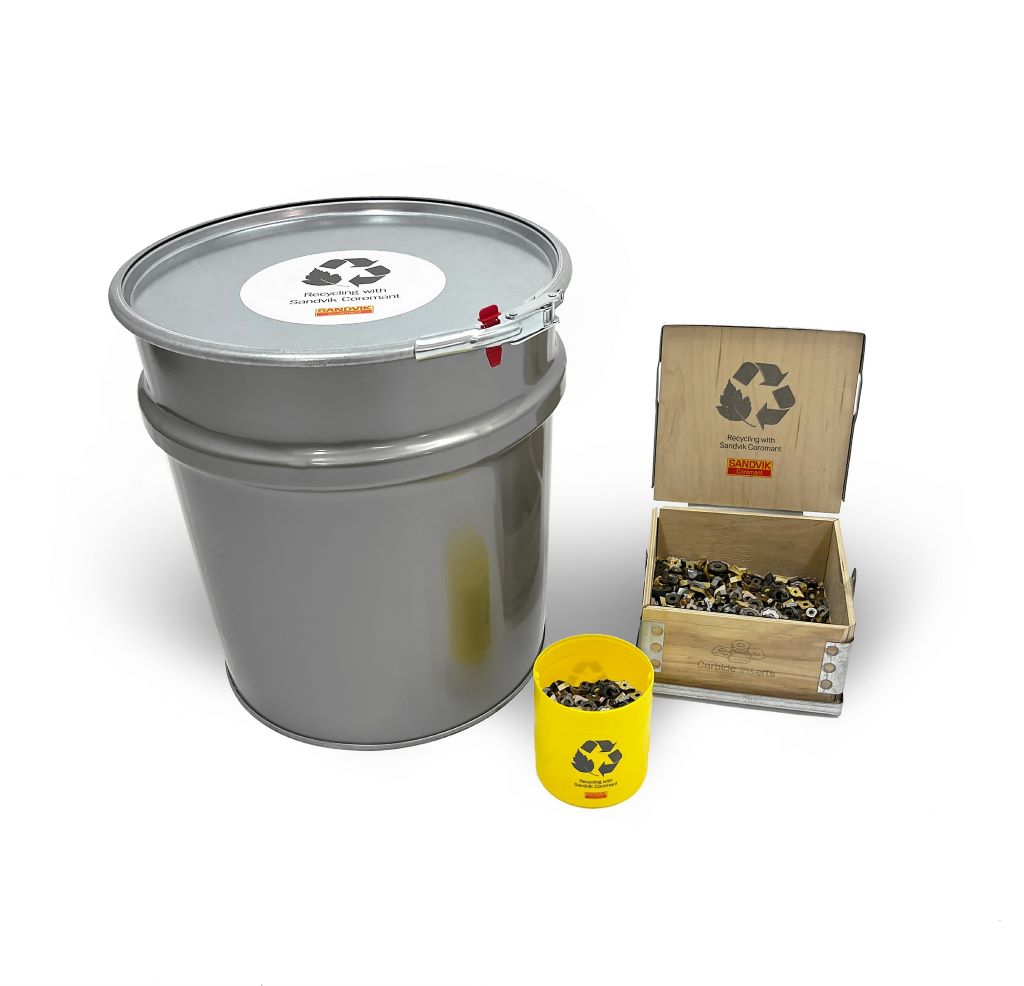
Due to its high melting point, strength, and wear resistance, tungsten is an important material for cutting tools, especially for high-performance alloys. These are increasingly used in aerospace and automotive industries. However, the remaining tungsten reserves on Earth amount to only about seven million tons, which corresponds to a consumption of 100 years. Sandvik Coromant's recovery process is therefore crucial for reducing the CO2 footprint and maintaining production.
Conclusion
To achieve climate goals and limit emissions, it is essential to reduce industrial waste. The refurbishment of tools helps manufacturing companies optimize their waste management and move away from conventional consumption practices. In this way, they contribute to a world that is more resource-efficient and environmentally friendly.
Contact: