

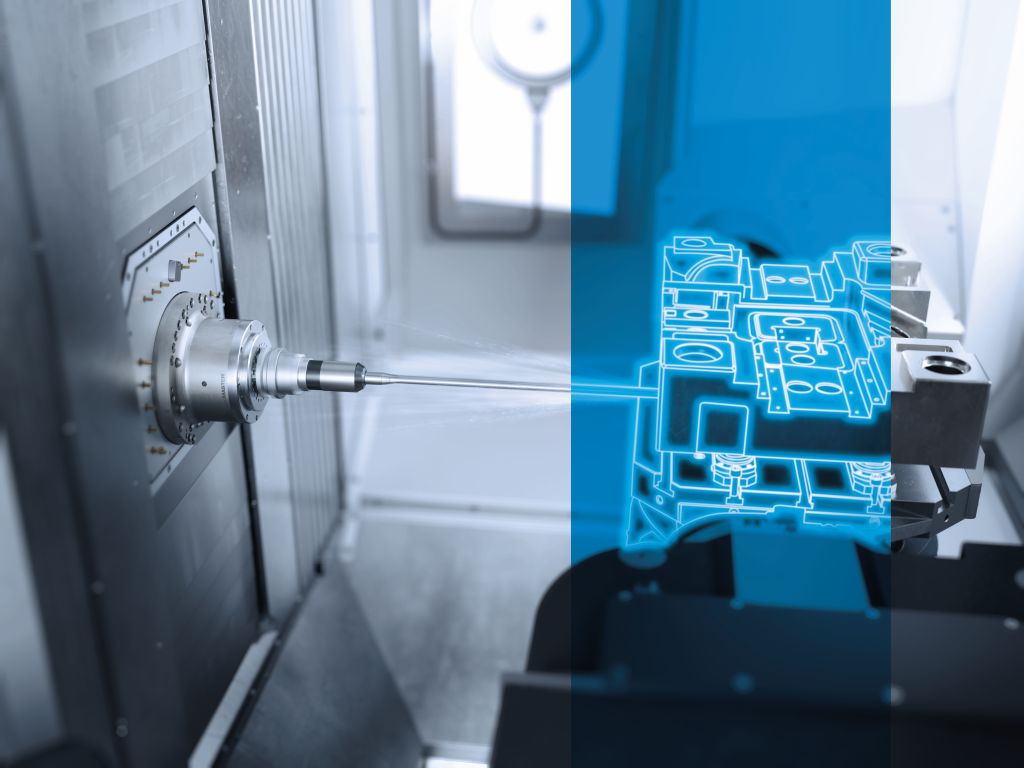
Especially deep hole drilling or gun drilling places high demands on the operator and the machine. This technology makes the process controllable. ADC turns a previously experience-based complex technology into an actively regulated and monitored drilling process – with measurable standards for process safety, increased quality and tool life, ease of operation, process monitoring, and energy efficiency.
From a critical special case to a regulated standard procedure
Deep hole drilling is one of the most critical machining steps in chip removal manufacturing. Chip accumulation, misaligned holes, cross-drilling, or tool breakage not only result in scrap but also jeopardize delivery deadlines and customer relationships – especially for components with high value-added depth such as crankshafts, injection systems, turbine components, or medical implants.
With the increasing shift of specialized deep hole drilling tasks to universal machining centers, responsibilities are changing: highly specific requirements increasingly meet manufacturing environments where not every operator possesses deep drilling-specific expert knowledge. Classic cycles operate with rigid parameters. As soon as material, tool condition, or coolant deviate from the ideal, the process risk increases dramatically. DMG MORI's Adaptive Drilling Control addresses exactly this weakness. The process is no longer just set but actively and adaptively controlled. Sensors for pressure, flow, and load continuously provide status information that the ADC cycle uses to manage coolant supply and machining strategy in a closed control loop.
One cycle for all drilling applications
ADC further consolidates standard drilling, deep hole drilling, and complex gun drill applications into a continuous technology cycle with three scalable modes:
- Standard drilling: The operator only needs the basic parameters (position/pattern, drilling data). Additional parameters for coolant pressure or flow rate are eliminated – the cycle ensures optimal flow, which in practice increases the robustness and safety of the process.
- Deep hole drilling: A few additional input fields for classic deep hole drilling complement the above information.
- ADC Advanced (gun drill/deep hole drilling): Additional options for complex requirements such as cross-drilling, offset to the pilot hole, and adaptive feed adjustment can be dialog-driven and easily added here.
ADC automatically adjusts the coolant pressure and flow without manual intervention based on material, tool, and process phase. The result is stable flow profiles that vary through continuous pressure adjustment to chip accumulation, cross-drilling, and drilling depth. This technology achieves increased process safety and quality as well as a tool life increase of up to 30 percent. Energy savings of up to 30 percent are an additional positive side effect, facilitating the machine's equipment with special coolants for pressures exceeding 80 bar. In this way, a complex process can be designed as a standard process.
Technology meets partner competence
The ADC technology cycle was developed in close collaboration with leading partners in the DMG MORI Qualified Products Network (DMQP) to achieve the best results in conjunction with DMG MORI machines. The tool specialists
botek Precision Drilling Technology, Gühring, Kennametal, and Walter developed coordinated adaptive process control together with DMG MORI. FUCHS lubricants provide coolant formulations that ensure stable properties over a wide pressure and flow range. This partnership makes ADC a complete solution.
Economics and auditability
ADC addresses the cost drivers of deep hole drilling in two dimensions: With regulated chip removal, reduced load peaks, and defined reaction logic, the likelihood of tool breakage and scrap is massively reduced. At the same time, the adaptive coolant supply reduces energy consumption and extends tool life through more stable temperature management. Another important aspect is the improvement of quality, such as the course of the hole or surface, which can also lead to scrap. All process data is automatically recorded and available for monitoring, quality documentation, and integration into CELOS X and factory IT systems. Industries with high documentation requirements – aerospace, medical technology, automotive – benefit from standardized cycles and a complete process history for each drilling.
Availability and Machining Transformation (MX)
At launch, ADC is available on the monoBLOCK, duoBLOCK, DMC H monoBLOCK, DMC 55 H TWIN series, as well as portal and gantry machines. Siemens and HEIDENHAIN controls are supported. DMG MORI sees ADC as a strategic component of Machining Transformation (MX). Sensors, control, software, and partner ecosystem are intelligently bundled to process demanding components more efficiently.
Contact: