
Based on this, these tool solutions are modified according to requirements to support an increase in productivity for customers. Success stories from various market segments demonstrate how well this works.
Productivity is increased when the same effect is achieved with less effort or when a higher yield is achieved with the same input. If more is achieved with lower input, one is in the elite class of productivity enhancement: maximum effect with minimal effort. This could involve using fewer tools to produce higher quantities within the same time frame.
Customized solutions for hydraulics
In the fluid technology market segment, MAPAL can, for example, rely on a sample process for machining the slider bore in hydraulic valve housings. This bore is always designed similarly in hydraulic systems for construction machinery, agricultural machines, and others. To control various oil circuits via the position of the slider, the bore in which it moves must be very precise. Essentially, MAPAL initially pilots this bore with a solid carbide drill and subsequently prepares it with a reaming tool for finishing.
Three-edged for high feeds
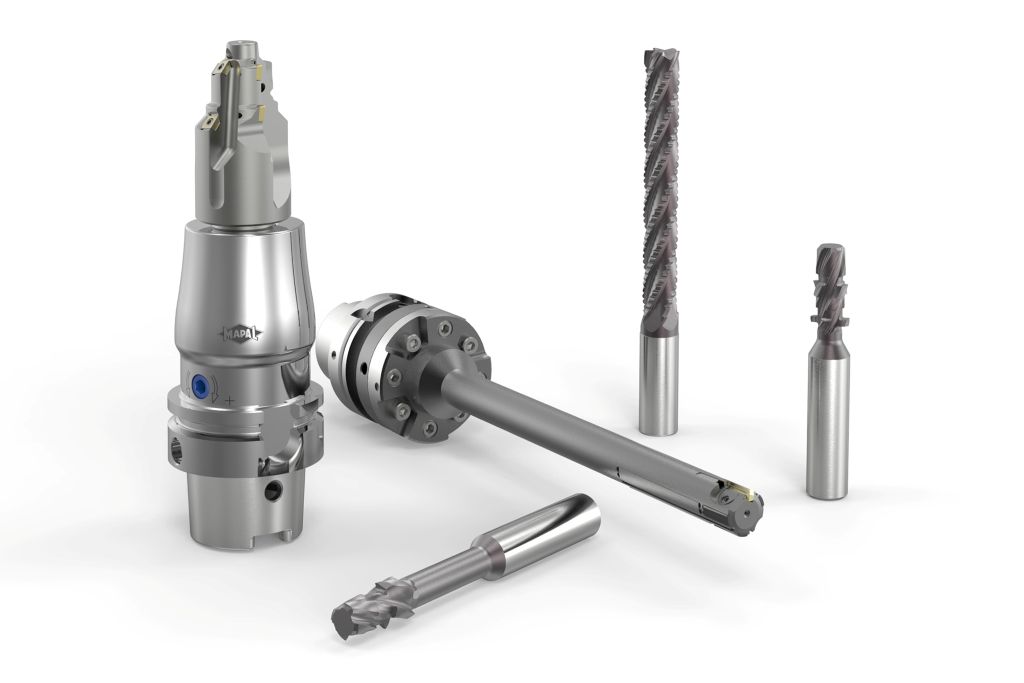
In doing so, MAPAL not only offers a specific solution but also adapts the tool selection to the respective conditions. For the hydraulic control of the drive for an excavator, for example, a three-edged pilot drill was chosen, which allowed for a high feed in the given casting material GG25. The equally three-edged solid carbide reaming tool then efficiently performs the roughing and finishing in one operation, thereby reducing process costs.
With the transition from the previously used tools of another manufacturer to the MAPAL process, the customer was able to reduce the machining time from 70 to under ten seconds. With 3,000 components per month, this saves over 50 hours of machining time – a significantly higher productivity without using more tools.
Productivity gain with existing machinery
The adaptation of the process to the existing machine configuration was the focus of another project from hydraulics, which also dealt with slider bores. Here, the customer repeatedly faced larger production volumes, for whose efficient manufacturing higher productivity would be required. However, an investment in new machines was not an option due to the volatile economic situation. Therefore, the challenge for MAPAL was to achieve a productivity gain even on its existing machine. The goal was a secure process with a reduced cycle time.
The sample process could not be applied directly because it requires the use of a special solid carbide drill after a reduction for pre-machining. However, the available machine performance was not sufficient for this drill. Therefore, MAPAL replaced the drilling specified in the standard concept with circular milling, which requires less torque. Subsequently, two more tools are used to circularize the control edges in the slider bore. For finishing, MAPAL's guiding rail technology is employed, which ensures the best roundness and surface quality. Instead of the seven tools that the customer used in their previous process, they now only need five. The cycle time was reduced by 40 percent, resulting in a saving of 1,250 working hours with an annual production volume of 30,000 components. Accordingly, costs have also decreased: the customer saves 14,000 euros annually.
Higher output for electric motors
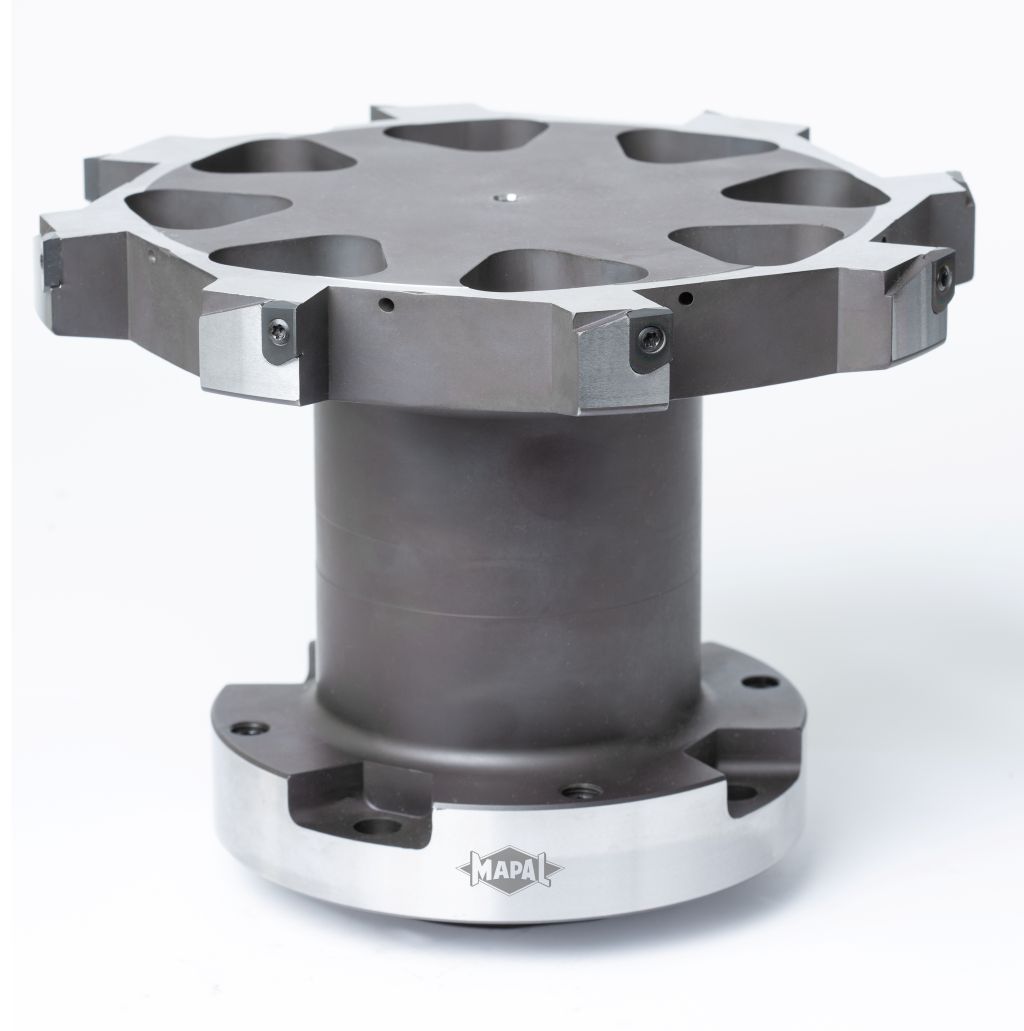
In the wake of emerging electromobility, MAPAL was able to quickly offer a solution for machining the stator housing using the Generic Component approach. The focus of this now well-established process for several years is on high-precision manufacturing with fine drilling tools. As the market matures, the production of motors in higher quantities for mid-range vehicles is increasing. Consequently, the industry's desire for more productivity is also growing. Initially, it is less about the achieved cutting data and more about reducing the setup effort for the tools required for the production of larger series.
MAPAL has responded to the changing requirements and now offers a solution with HPR400 technology for finishing. The tools with PKD cutting edges do not require adjustment. Unlike the cutting edges of a fine drilling tool, they only need to be used and tightened with the correct torque. In addition to the elimination of setup effort, the new solution also features twice the machining speeds, as eight cutting edges are now used instead of the previous four. Overall, the process delivers higher output with less effort, resulting in a significant increase in productivity.
The sample process from MAPAL specifies the use of guiding rail technology for this machining. And this remains justified, as the tolerances prescribed by premium manufacturers for some models cannot be achieved with other methods. Even difficult-to-clamp, thin-walled components require a fine drilling tool that exerts less cutting pressure.
Machining millions of rivet hole drillings with maximum consistency
In the area of final assembly in aircraft construction, both productivity and high quality are equally demanded. When the segments of a commercial aircraft are equipped with millions of holes for rivet connections, the continuous accuracy of the predominantly manual machining processes is a challenge. Depending on the connection, the holes require chamfering, countersinking, or simple deburring.
Spotfacing tools with MAPAL's micro-stop cage essentially serve as a depth stop and ensure that, regardless of the worker, the same result is always achieved. The tool manufacturer takes care of the presetting, so nothing needs to be adjusted in production. With different cutting materials, the spotfacing tools with micro-stop cage are suitable for machining aluminum, CFRP, or titanium. A customer-specific color coding prevents confusion of tools and thus errors in the process. Optionally, dust extraction can occur directly at the tool.
In addition to preparing for riveting, the spotfacing or metallizing of the area around holes on the outer skin of aircraft is a case for spotfacing tools with micro-stop cage. Here, paint is specifically removed to ensure electrical conductivity between the parts and thus protection against lightning strikes. The spotfacing tools with micro-stop cage demonstrate that even with seemingly simple tools, very good effects can be achieved: error prevention in the process also contributes to higher productivity.
Whether in automotive, aerospace, or fluid technology – intelligent solutions and close customer contact often unlock significant productivity potential. As a technology partner, MAPAL offers its customers comprehensive, technology-neutral consulting and support with the goal of exceeding the required results.
Contact: