
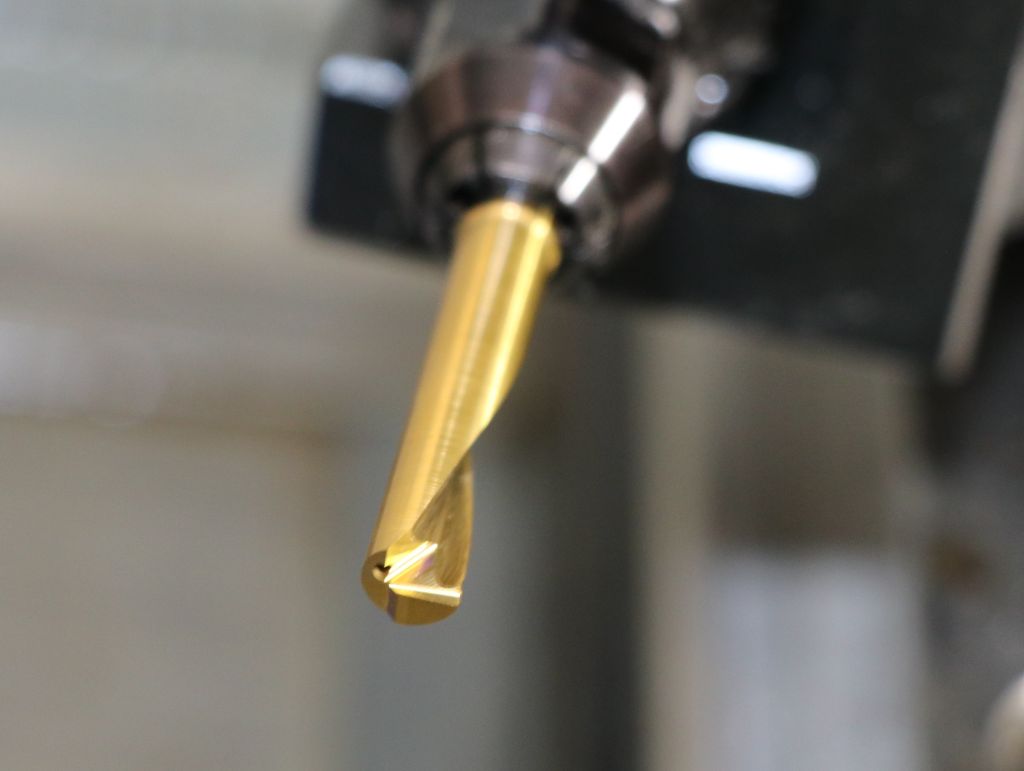
The development of a modular tool system for the internal machining of the smallest holes, consisting of single-edged cutting inserts made of solid carbide and carrier tools, dates back to the mid-1980s – a time when tools for very small hole diameters practically did not exist on the market. What began as a response to a specific customer requirement evolved over decades into a system that is now regarded as an A-product in SIMTEK's portfolio and is cherished by many users in micro-machining as a benchmark for quality and design.
Concrete practical requirement as a stimulus
The impetus for development was the requirement to create a tool for the internal machining of a 6 mm hole. 'At that time, there were no such small tools, or at least hardly any usable solutions for such diameters,' describes Norbert Seifermann, co-founder and board member of SIMTEK, the initial situation. For him, this request provided the opportunity to implement a tool idea that had existed in his mind for a long time.
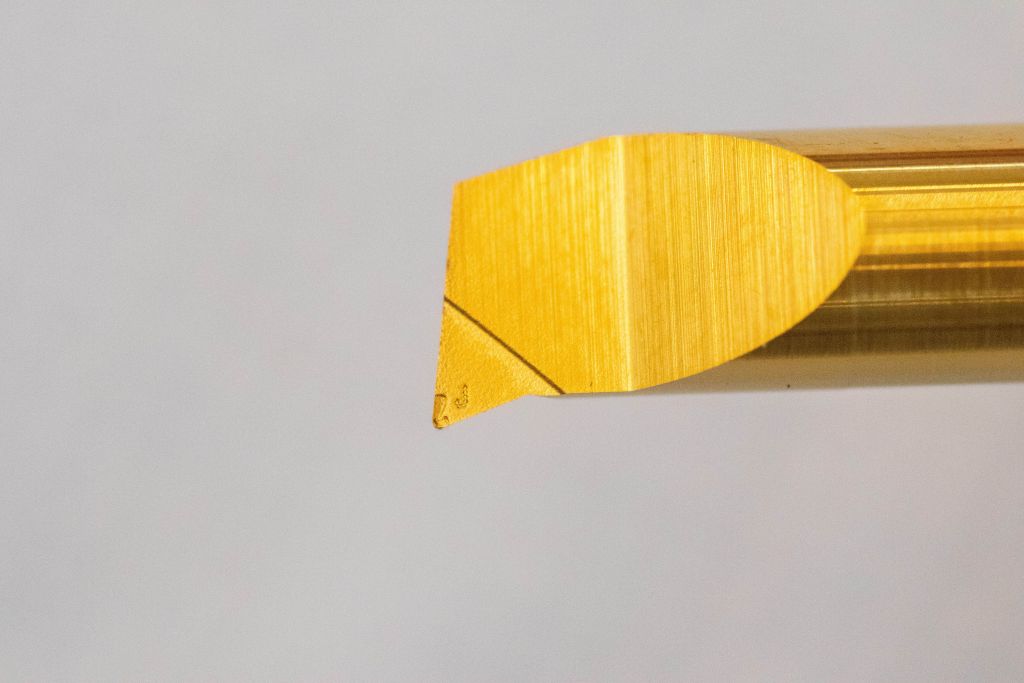
Even before the founding of SIMTEK, the first prototype was created at Seifermann's then-employer on a milling machine: Initially, a droplet-shaped tool shank was produced for clamping in a carrier tool. Subsequently, the tool neck and cutting edge were ground. The standard construction following the prototype, based on a sintered rod with a characteristic droplet shape and a clamping screw from the back, laid the technological foundation for the later evolution of today's AX system from SIMTEK.
Birth of the SIMTEK solution: Realized optimization potential
With increasing market acceptance, the requirements for the new tool type also increased over the years, revealing constructively induced limits. After the founding of SIMTEK in 1994, Seifermann therefore dedicated himself to the consistent further development of the system – again prompted by a specific customer requirement.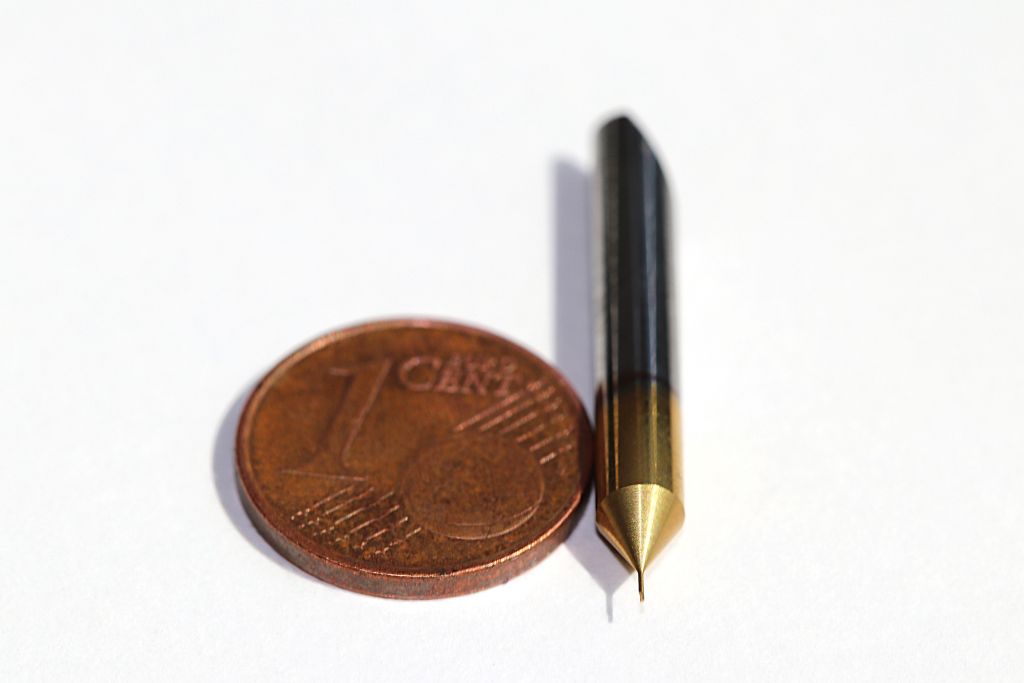
He recognized a central optimization potential in the clamping length: 'We needed a solution where the cutting insert could be installed deep enough in the carrier tool to avoid vibrations and tool breakage at high overhangs,' recalls Seifermann. Therefore, the insertion depth into the carrier tool was chosen accordingly high so that the tool is also stably guided at large overhangs.
Another significant adjustment concerned the shape of the rod: 'Since sintered shapes, which are usually advantageous in terms of manufacturing costs compared to ground systems, are never exactly identical due to manufacturing reasons, they usually require a multi-point support. Such a multi-point support can lead to a significant reduction in the lifespan of the carrier tool and impair the repeat accuracy of the cutting position during tool changes,' explains Seifermann. A tool change could thus have immediate effects on the manufactured dimension.
For this reason, SIMTEK decided to use a cylindrically ground rod in combination with a similarly cylindrical hole in the holder. The resulting large-area support of the cutting insert extends the lifespan of the carrier tools and leads to a significant increase in the repeat accuracy from cutting edge to cutting edge. 'With our current system, the machine operator can remove a tool and insert a new one without significantly affecting the cutting edge height or the radial position,' explains Seifermann.
The SIMTEK principle of repeat accuracy
However, the decisive constructive optimization lies at the rear end of the rod. Instead of a lateral clamping surface, as used in many systems, the rod tapers. This taper takes over the exact alignment of the tool during insertion. 'Due to the beveled backside, the tool practically positions itself. You slide it in, lay it against the stop, and then fix it with the screw,' describes Seifermann the principle.
According to the AX developer, this concept offers a decisive advantage over lateral clamping solutions. Even slight twists or tolerances can affect the position of the tool there. In contrast, with the taper solution, the cutting insert itself takes over the exact alignment, while the screw merely generates the clamping force. The position of the tool thus remains largely independent of the tightening torque.
Market success through repeat accuracy
A significant role in the high market acceptance of the AX system from SIMTEK is, according to Seifermann's assessment, precisely that high repeat accuracy. If this is low, the machine must be reconfigured after each tool change, which costs time and reduces productivity. Seifermann recalls a customer who initially switched to another tool but returned to SIMTEK's AX solution after a few months. 'The customer found that the daily output of the machines decreased. After returning to our AX solution, he reached the usual level again – for us, a clear indication of how strongly repeat accuracy affects productivity,' recalls Seifermann.
Meanwhile, the AX system from SIMTEK has established itself as a pioneering product in terms of quality and process-stabilizing design among many users worldwide. 'In constant exchange with our international distribution partners, we regularly receive very positive feedback on our AX system – and from the most diverse user industries,' reports the SIMTEK founder. Meanwhile, there are also several systems on the market based on a comparable design principle. 'The high number of similar market solutions makes it clear to us that the system works very well with this design. We see this as confirmation of our experiences and convictions,' Seifermann confidently states.
Further development: ME clamping system for carrier tools
Another stage of development is the patented ME clamping system for carrier tools (European Patent No. 2 992 988), which offers enormous stability, especially at high overhangs, thanks to force-locking tool clamping. 'With our ME solution, the clamping nut lays flat over the entire area on the shank, so that the connection behaves as if made from a single piece,' explains Seifermann. The clamping collet is an integral part of the holder; the nut solely takes over the clamping function, without any relative movement between the rod and holder occurring. With this design, according to SIMTEK, machining with overhangs up to ten times the tool neck diameter can be realized in a stress-stable manner.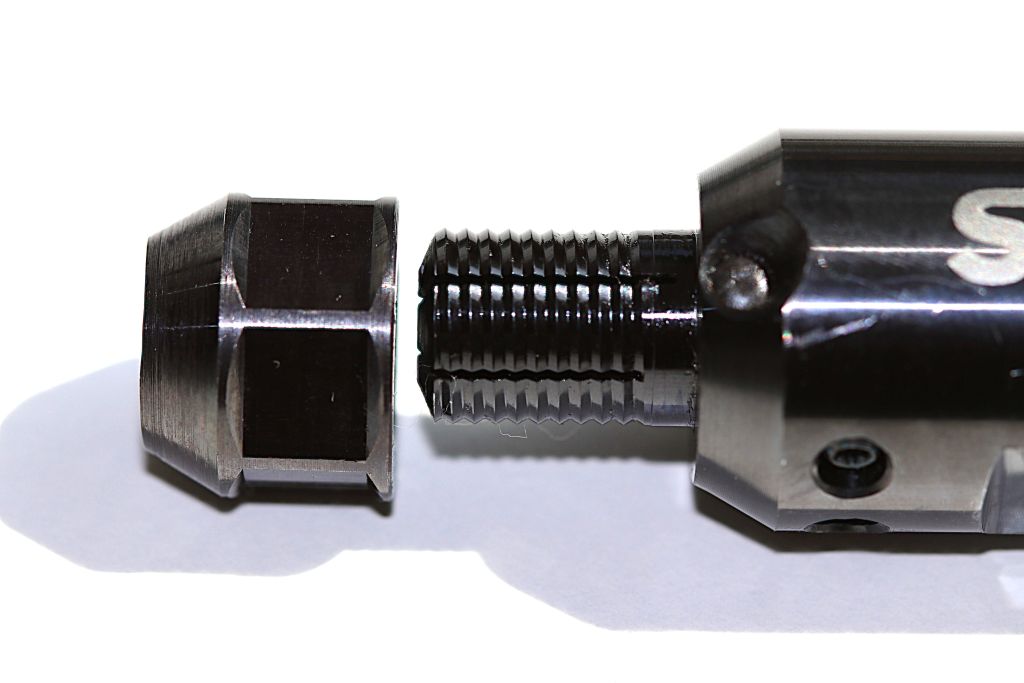
From 6.0 mm to 0.3 mm
What began in 1985 with a tool for machining a 6 mm hole has since developed towards significantly smaller diameters. In SIMTEK's current standard program, the range extends down to a tool for boring holes from a diameter of 0.3 mm. 'The smallest size where we have a 4 mm shank is a world of its own and is actually no longer visible to the naked eye,' says Seifermann.
The driver of this development is the ongoing miniaturization of components in various industries – from hydraulics to pneumatics to applications such as boring injection nozzles, where small cylindrical geometries with tight tolerances are required. The SIMTEK range currently includes nearly 1,500 AX item variants. This also includes CBN tools for hard turning starting from a hole diameter of 1.0 mm or tools with 3D-lasered chip shape geometry.
Laser processing as the next development step
'From a design perspective, the AX system is practically mature today. We see further development potential mainly in cutting edge processing – and especially through laser technology,' says Seifermann. Unlike classical grinding, laser technology can create chip angles around the cutting edge – even where grinding processes reach their limits due to manufacturing conditions.
The background to this development is the increased demands for chip control, for example, due to the increased use of lead-free materials as a result of the REACH regulation or the growing automation of machining processes. The cost pressure to save downstream processes such as reworking or inspections also contributes to this development. 'Our 3D-lasered chip shape geometries address this exactly: increasing process reliability through optimization of chip control,' describes Seifermann the most significant advantage.
Many customers, especially in the area of customized tools, are already relying on laser solutions. The advantages are obvious: the laser process offers virtually countless possibilities to ideally adapt the cutting geometry to the machining process and its specific requirements. 'The results of our lasered tools are so convincing that we have already included the first geometries in our standard range,' Seifermann is pleased about the development. 'However, we are by no means at the end of the development of lasered tools in the standard area.'
Technical evolution instead of revolution
The development history of the AX system shows how a solution can arise through the targeted optimization of performance-determining parameters – such as clamping length, fit quality, and centering – which is valued by numerous users in the market as a benchmark for high performance capability. The combination of a cylindrical rod, enlarged clamping, and self-centering slope enables high repeat accuracy, which pays off especially with frequent tool changes and large overhangs.
With the ME clamping system, the concept has been expanded to include a solution for particularly demanding applications. The interface between tool and holder is unlikely to undergo fundamental changes from today's perspective; future development steps will likely focus more on optimizing the cutting edge geometry, for example, through modern laser processing technologies.
Contact: