
"This will revolutionize hole machining," thought Paul Horn as he closely examined the first prototype of the Supermini. In 1989, the Supermini system was launched and has since become one of the most successful products of Paul Horn GmbH. Over the past 35 years, the tool system has undergone numerous development steps and solved the challenges of various machining tasks worldwide. Horn now presents another milestone in the history of the Supermini with a sintered chip shape geometry for the Supermini type 105. "With a lot of effort, we have managed to economically solve the problems with long chips in the internal machining of small hole diameters," says Managing Director Markus Horn.
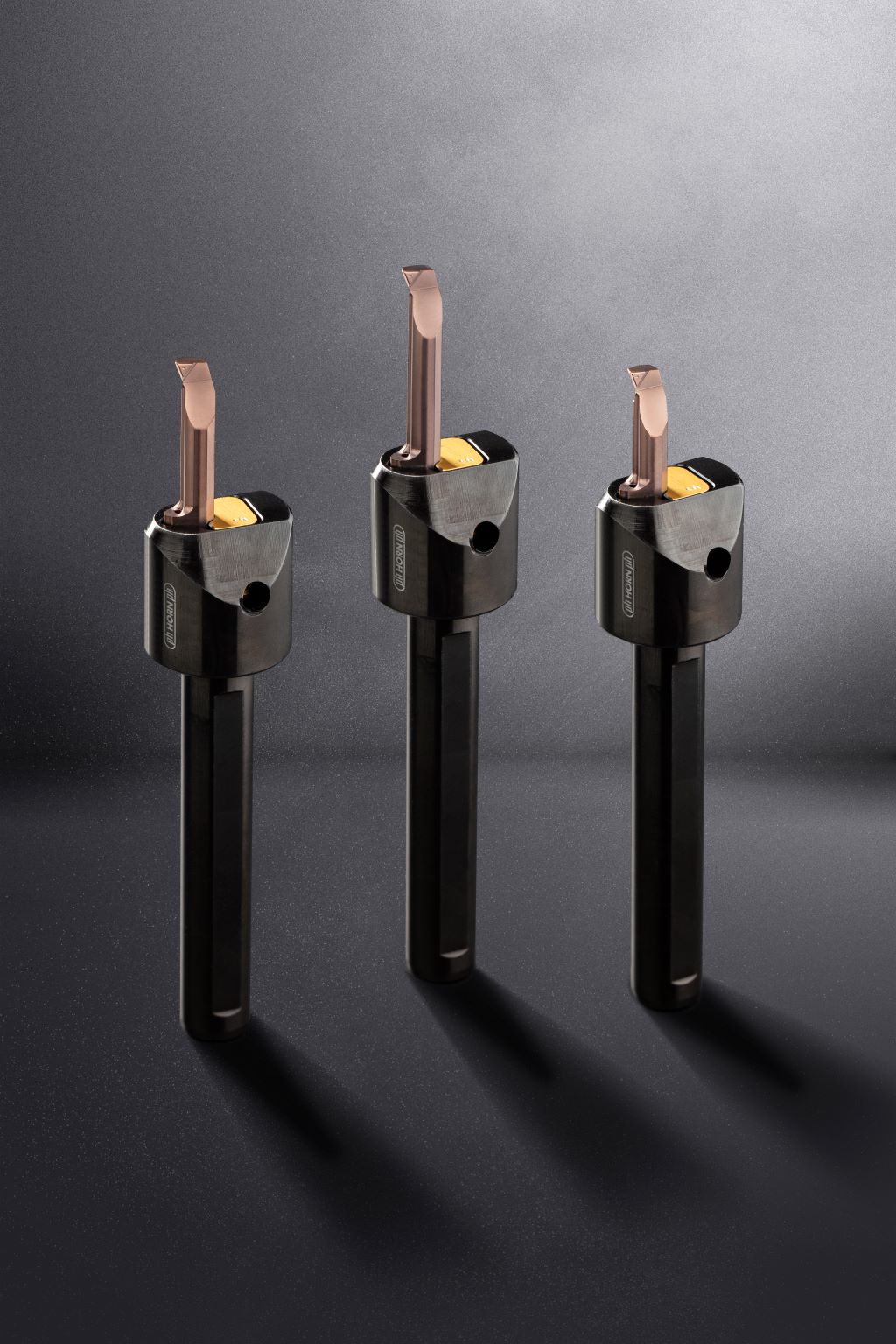
Boring, profile turning, internal grooving, thread turning, chamfering, axial turning, drilling, and slotting. The Supermini tool system can be adapted and used for numerous machining operations. The solid carbide cutting insert is used in hole machining from a diameter of 0.2 mm to about 10 mm. Horn developed the blank of the tool in a droplet shape. This shape allows for precise and large contact surfaces in the tool holder, resulting in higher stiffness of the overall system. Furthermore, the droplet shape prevents the cutting insert from twisting, which leads to a consistently precise positioning of the tool's tip height. For long tool overhangs, it reduces deflections and minimizes vibrations during the turning process. Depending on the application and the diameter to be machined, Horn offers the cutting insert in three different sizes (types 105, 109, and 110) and various blank types. All variants allow for internal coolant supply directly to the working area. The Horn tool portfolio contains around 2,500 different standard variants of the Supermini. Additionally, Horn has solved user tasks with countless special solutions.
Chip problems solved
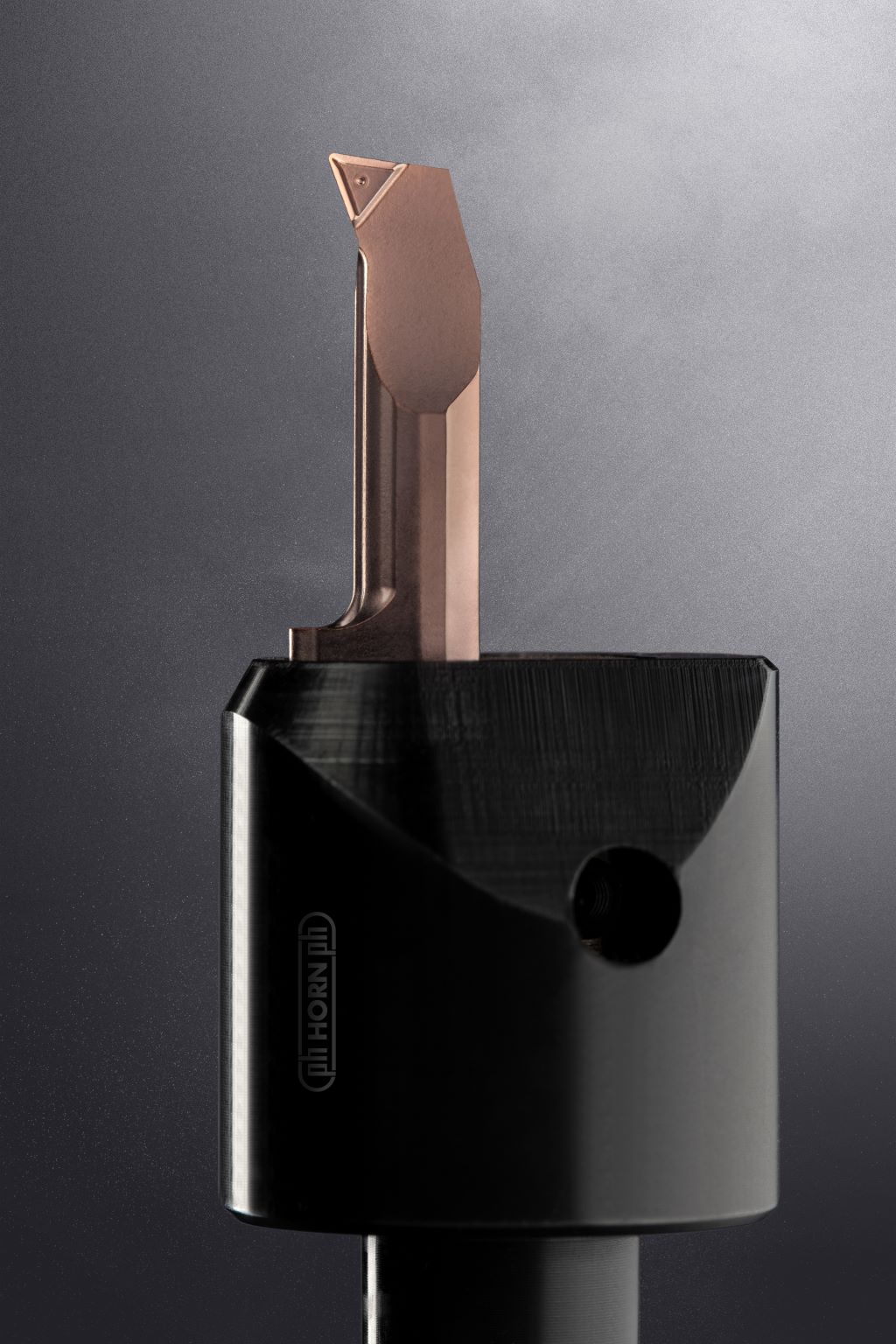
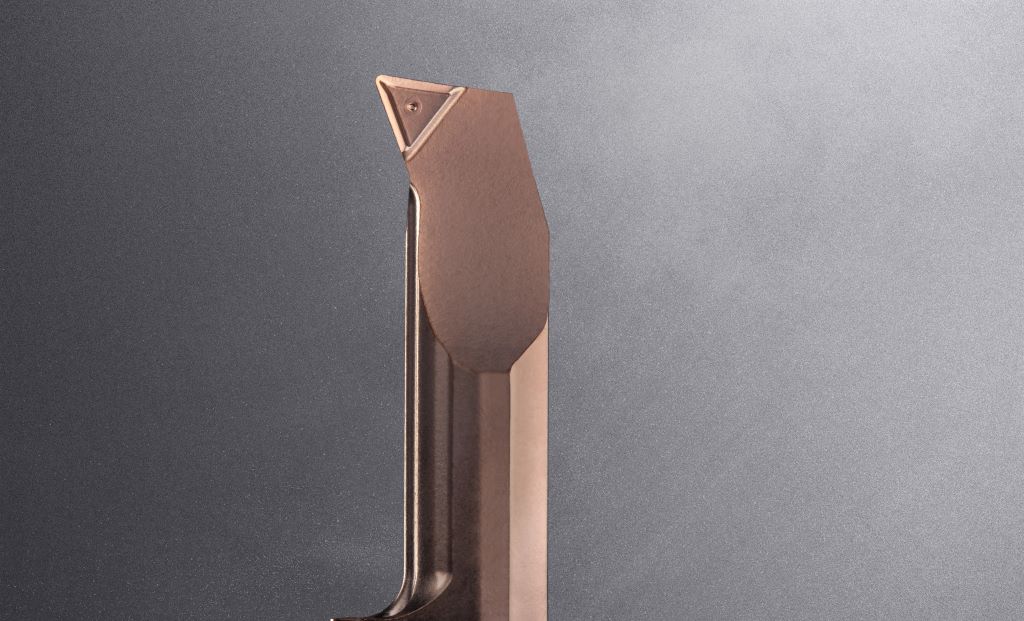
One of the biggest challenges in internal machining is long chips. It doesn't matter what quality the tool used has. Hole machining often leads to long chips, depending on the material. They wrap around the tool, clog holes, or, in the worst case, lead to tool breakage. Here, a chip shape geometry can provide relief. It directs and shapes the chip and causes it to break. Until now, specially laser-cut or ground chip shape geometries were used for this purpose. However, this was associated with a corresponding cost factor for the cutting insert. Horn has managed to develop a universal boring tool with sintered chip shape geometry with the new Supermini type 105. The tool offers high process reliability in use due to good chip control.
The cutting edge geometry extends deep into the corner radius of the cutting insert. This ensures chip control even with small feed rates. The geometry can be universally applied to various material groups and is suitable for internal, flat, copy, and reverse turning.
In addition to the geometry, Horn also optimized the blank of the cutting insert with higher stiffness and an even more stable cutting area. Furthermore, the coolant supply has been revised. The new cutting insert is compatible with numerous clamping holders of type 105. Horn offers the cutting inserts in three lengths (15.0 mm, 20.0 mm, and 25.0 mm) and in grades TH35 and IG35 as standard. The corner radius is 0.2 mm. The tool is suitable for use from a diameter of 6 mm. The wide application range of the cutting inserts is also reflected in their cost-effectiveness. The costs of the new Supermini are in a similar range as the standard cutting insert without geometry. The new Supermini has been available from stock since January 1, 2000.
For the clamping holders, the user can choose the appropriate solution for their machining from a variety of different variants. These include round shank holders, square holders, interface clamping holders, and adjustable clamping holders for different machine manufacturers. For clamping the cutting insert, Horn offers four different solutions. The classic screw clamping via a ball pressure screw, clamping via a face clamping element, and clamping via a lifting element. For tight conditions, Horn also offers a slim clamping system with clamping via a nut.
From practice:
As a supplier, RICH Precision has been working for Horn for several years. The company produces the basic body of the precision interface for the Horn tool system SX.
The cutting head is connected to the contact surface of the tool body via a stable, robust, yet highly precise thread. "The manufacturing of the tool holders was initially a major challenge. The precision requirements from Horn are very high," explains Rich's production manager Wolfram Stiefel. For the Horn component, Stiefel also relies on Horn tools. Critical features for machining include the fitting thread and several very tightly toleranced fits. Additionally, there is a focus on the roundness and flatness of the various contact surfaces.
For the turning operations on the component, several different Horn systems are used. For internal boring of small diameters, Rich fundamentally relies on the Supermini system. In addition to a precision thread, a cone and another fit serve for µ-exact centering of the SX interface. The turning of the cone and the fit is handled by a Supermini type 105. "The turning process of the very tightly toleranced dimensions runs stably. One problem we have always had with internal boring of small diameters was long chips wrapping around the tool. No matter which tool manufacturer, everyone has this problem," explains Wolfgang Rich.
With the new generation of the Supermini type 105, Horn solved the problem that previously could only be managed by specially laser-cut or ground special cutting inserts. The advantages of the new system are evident in use. "The problem with wrapping chips was immediately solved. Where we previously had to manually pull the chips off the tool with the predecessor system, the fine chips are hardly visible in the chip bucket due to the new geometry," says Wolfgang Rich. The tool life is in the same range as cutting inserts without geometry.
Contact: