
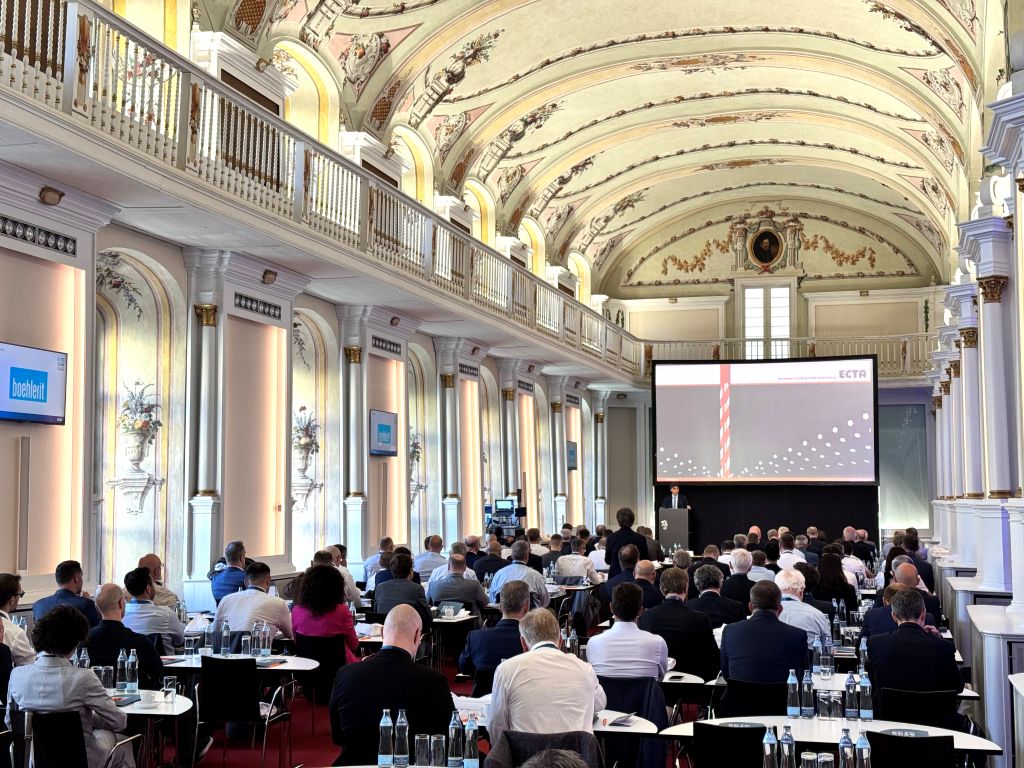
Securing tungsten supply has become a critical challenge for the European metalworking industry. "Recycling is crucial today: The reintegration of tungsten carbide into the European cycle is a central lever for supply security and
competitiveness," stated Federico Costa, President of ECTA – European Cutting Tools Association, at the European Cutting Tools Conference (ECTC) in Graz.
China continues to control more than 80 percent of global tungsten production and processing and increasingly uses export restrictions as a tool of industrial policy. As a result, the European industry is facing not only significant price increases but also growing uncertainty regarding the availability of this critical raw material.
Call for coordinated action along the value chain To strengthen European resilience, ECTA demands a coordinated approach from industry and politics. Companies along the entire value chain must ensure that tungsten-containing waste is systematically reintegrated into European recycling cycles to keep this strategic raw material within the European industry. At the same time, investments in recycling and processing infrastructure must be expanded to increase capacities and meet rising demand.
Recycling systems under increasing pressure
Around 50 percent of the tungsten carbide used in Europe already comes from recycling, highlighting the importance of established circular systems. However, these systems are increasingly under pressure: European processing capacities are reaching their limits while the demand for tungsten scrap continues to grow worldwide. As a result, even a well-functioning circular economy cannot fully meet Europe's needs. Therefore, a broader package of measures is required, including the exploration of additional primary tungsten sources to reduce dependencies and diversify supply.
Competitive framework conditions are necessary to tap recycling potentials
This must be complemented by competitive energy prices as well as less complex and more easily implementable regulations that are applied more uniformly across Europe. Complex regulatory requirements and inconsistent interpretations in practice currently limit the effective utilization of recycling potentials in permitting, classification, and processing.
"For example, it is unjustified to treat high-quality tungsten scrap the same as oil and coolant-contaminated sludges," emphasized Costa. "These material streams differ significantly in their properties and risk profiles and require differentiated handling." While contaminated sludges require specific measures to protect the environment and health, tungsten scrap represents a valuable raw material that can be safely and efficiently reintegrated into the industrial cycle.
There is therefore a need for action to prevent overly complex regulations from leaving recycling potentials untapped – while at the same time significant amounts of scrap leave Europe, further exacerbating the supply situation. Securing tungsten supply is thus a shared responsibility of industry and politics.
Contact: