
A study by Deloitte and The Manufacturing Institute from 2024 predicts that nearly two million jobs in the manufacturing industry could remain unfilled over the next ten years if the existing shortage of skilled workers is not alleviated. Closing this gap will take time, but the industry must already meet the steadily growing demand for increasingly specialized and complex components. In the following article, Nicklas Bylund, Head of Engineering Projects at Sandvik Coromant, presents the component-oriented, structured approach of "Engineering Projects". With this approach, Sandvik Coromant supports manufacturing companies in closing the skills gap and maintaining their capabilities.
In industries such as aerospace, automotive, and general mechanical engineering, applications are becoming increasingly specialized. This leads to rising demands on the components to be processed. Manufacturing companies are therefore expected to achieve tighter tolerances, excellent surface qualities, and consistently high quality under increased cost pressure – both with difficult-to-machine, heat-resistant alloys in aircraft engines and with automotive parts made of steel and aluminum. All of this places higher demands on tool and machining strategies.
As skilled workers, such as experienced machinists, programmers, and engineers, are scarce, many companies have so far relied on trial-and-error methods to optimize their production. However, with increasing complexity, these approaches prove problematic as they lead to efficiency losses, production fluctuations, and additional risks. Furthermore, they are very time-consuming and tie up valuable resources.
In light of these challenges, Deloitte emphasizes in its "2025 Manufacturing Industry Outlook" the need for new approaches and tools that can be used throughout the organization to maximize efficiency, build resilience, and prepare for a possible new phase of development in the industry. To remain competitive, manufacturing companies therefore need solutions tailored to the demands of modern production.
In the context of component processing, this means that these solutions must align tool selection, machining strategies, and process data. This creates a consistent foundation for repeatable, high-quality results – in this area, Sandvik Coromant provides valuable work with its Engineering Projects.
"Engineering Projects" – what exactly does this mean?
With "Engineering Projects", Sandvik Coromant offers a solution that helps manufacturing companies optimize the capability, stability, and performance of their machining processes for critical components.
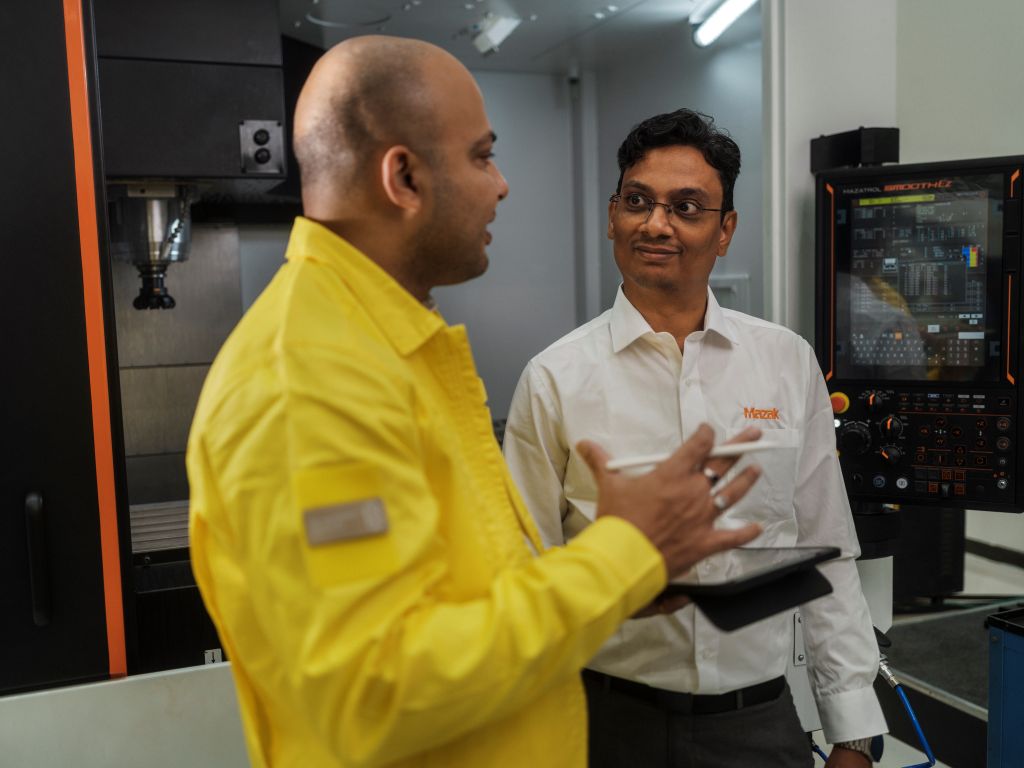
Due to the increasing complexity of components on one hand and the shortage of skilled workers on the other, the engineers of "Engineering Projects" provide structured and comprehensive support that covers all phases of manufacturing. In close collaboration with customer teams, they leverage their knowledge of tools, machining processes, CAM programming, and component manufacturing to deliver a complete, ready-to-use tool package.
The lifecycle of a project
At the beginning of each project, there is a detailed consultation. During this, the Sandvik Coromant engineers work with customer teams to review design drafts, material specifications, tolerances, machining requirements, and production goals. By understanding these parameters early on, it can be determined whether it is best to optimize existing facilities or develop a tailored strategy. This step also takes into account all potential challenges.
In the next step, tool specialists design or select the optimal combination of standard and special tools, adapters, clamping solutions, and CAM software with tool path optimization. For demanding applications, such as aerospace components made from difficult-to-machine materials or automotive parts produced in large quantities, this process often results in tool packages that combine standard solutions with specially developed elements. Due to Sandvik Coromant's company acquisitions, clamping solutions can now also be developed and delivered.
Once the tool strategy is established, CAM programmers implement it into production-ready programs. Using software such as Mastercam, Siemens NX, and Vericut, tool paths, feed rates, and cutting sequences are virtually modeled. This digital verification allows potential collisions to be identified, cutting forces optimized, cycle times predicted, and scrap from failed tool attempts reduced. This enables operators to reliably execute complex processes even without highly specialized internal expertise.
After completion, the complete tool packages can be delivered as precision-balanced and spindle-ready assemblies, including full technical documentation. The Engineering Projects team, together with local customer support and specialists, monitors the initial setups and test cuts. This allows them to provide their expertise in real-time, verify dimensional accuracy and surface integrity, and make any necessary adjustments to optimize the process and ensure consistently high performance.
Only after validation can the workflows be implemented at all production sites worldwide. Thanks to the coordinated approach for cross-border projects, Sandvik Coromant's solution also includes delivery management and ensures clear communication as well as uniform production standards across all markets.
Sustainable value creation
In engineering projects, digitally validated workflows, data-driven insights, and expertise gained from experience with similar components are utilized to increase efficiency, consistency, and productivity. These processes relieve internal teams and operators from repetitive trial-and-error tasks. Instead, they can focus on activities that promote the long-term capability of the company, such as knowledge management, cross-departmental projects, and mentoring colleagues.
Over time, these operational and organizational advantages create sustainable added value. The foundation for this is appropriate projects that enable continuous improvements and a strong organization. With stable and repeatable processes, companies can scale their complex manufacturing processes, maintain high standards, and adapt to future challenges. All these improvements ultimately contribute to achieving "Manufacturing Wellness", a state in which production processes are resilient, operate efficiently, and have a positive impact on people and societies.
Conclusion
The more complex manufacturing becomes and the scarcer qualified skilled workers are, the more the success of approaches depends on ensuring consistency and trust in the manufacturing process itself. With the right tools, expertise, and global reach, Sandvik Coromant supports with its "Engineering Projects" in closing skills gaps and delivering predictable, high-quality results.
Contact: