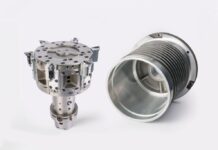

Sufficient cooling is a crucial factor for efficient machining. Thanks to additive manufacturing processes, ISCAR was able to further optimize targeted cooling in a large number of milling heads. Users can achieve higher cutting values and benefit from longer tool life, better chip removal, and greater process reliability.
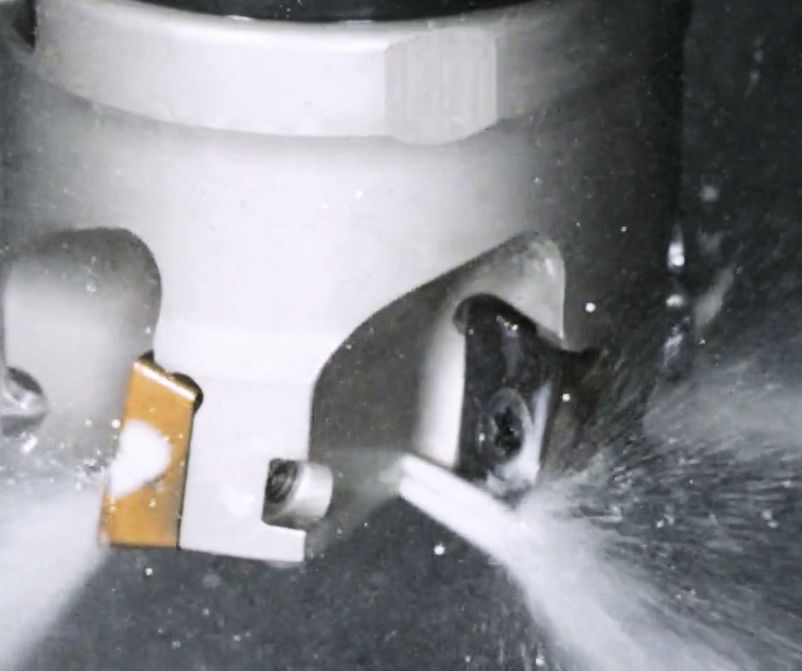
One of the biggest enemies of indexable inserts (WSP) made of carbide is the high temperature generated during machining. Average temperatures of 300 to 900 degrees Celsius are possible. As temperature increases, the tool life of the WSP decreases. Its wear increases, which negatively affects the quality of the workpiece and its machining properties. The heat generated between the tool and the workpiece can change the chip shape and deform the WSP.
"Cooling is a very important factor in the world of metal cutting - thanks to its positive influence on chip shape and temperature during machining, it can improve tool life and reduce manufacturing costs," says Anton Kress, product specialist for milling at ISCAR.
Coolant channels with fewer disturbing contours
High-pressure cooling with targeted coolant supply directly into the cutting zone has proven to be particularly effective. "Our goal is always to cool as close as possible to each individual cutting edge and to bring as much coolant as possible, with maximum pressure, very quickly into the cutting zone," he explains. "Thanks to 3D printing, we were able to further optimize the internal coolant channels in our face and corner mills and further increase coolant pressure, volume, and effectiveness."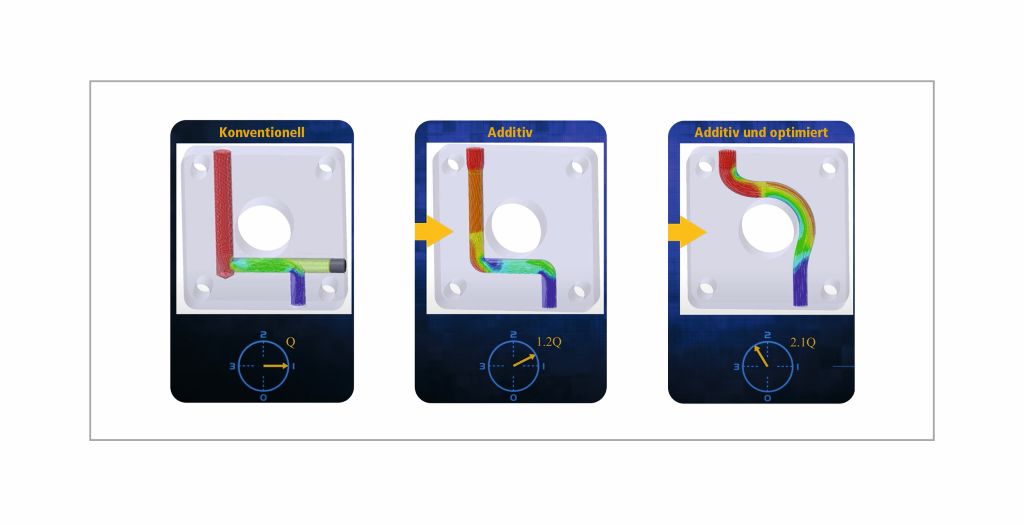
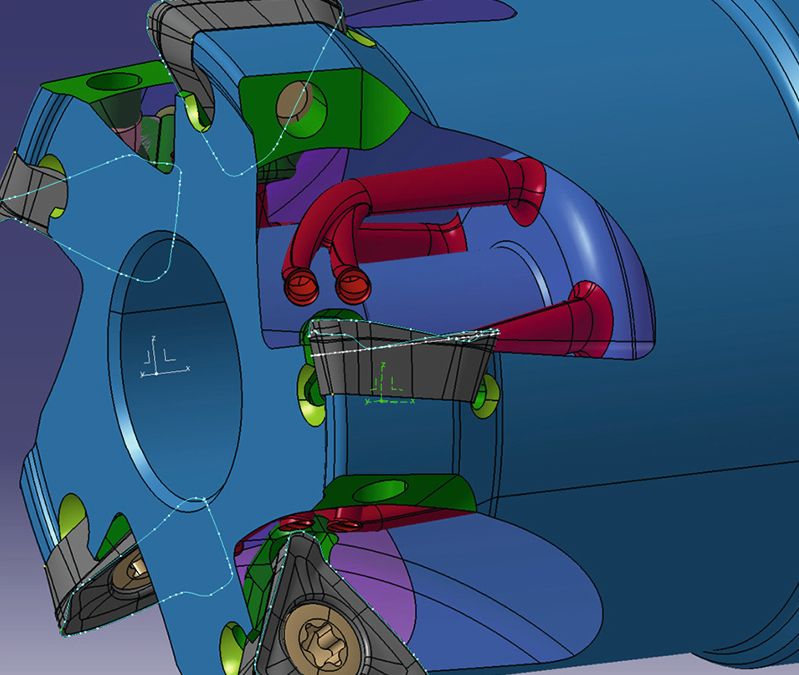
In conventional cooling, the channels branch off perpendicularly from the large coolant channel and bring the coolant to the outlet with a diameter of about 2.5 millimeters, from where coolant flows from above at a distance of ten to twenty millimeters to the WSP. "To incorporate the channels into the conventionally manufactured blanks, an additional drilling was necessary, where the cutting fluid would pool and reduce efficiency," says the product specialist. With 3D printing, ISCAR was able to create the coolant channels directly in the blank.
These lines, which run in small arcs instead of perpendicularly, have significantly fewer disturbing contours, and due to the lack of additional drilling, the cutting fluid can no longer pool. "Compared to conventional cooling, these additively manufactured mills offer 20 percent more flow rate," explains Anton Kress.
Flow optimization doubles the volume
But ISCAR would not be ISCAR if the tool specialist had not further improved cooling - after all, development never stands still: "In the next step, we optimized the coolant channels in the milling heads for flow and further maximized the usable coolant pressure," explains Anton Kress. For a higher exit speed, the central coolant supply is now funnel-shaped and tapers in the transition to the individual coolant channels leading to the cutting edges.
The lines, now only one millimeter in diameter, now run in soft arcs with large radii; straight sections only exist directly before the outlet to transport the cutting fluid precisely to the cutting edge. "This allowed us to double the flow rate and multiply the exit speed and cutting fluid pressure at the cutting edge."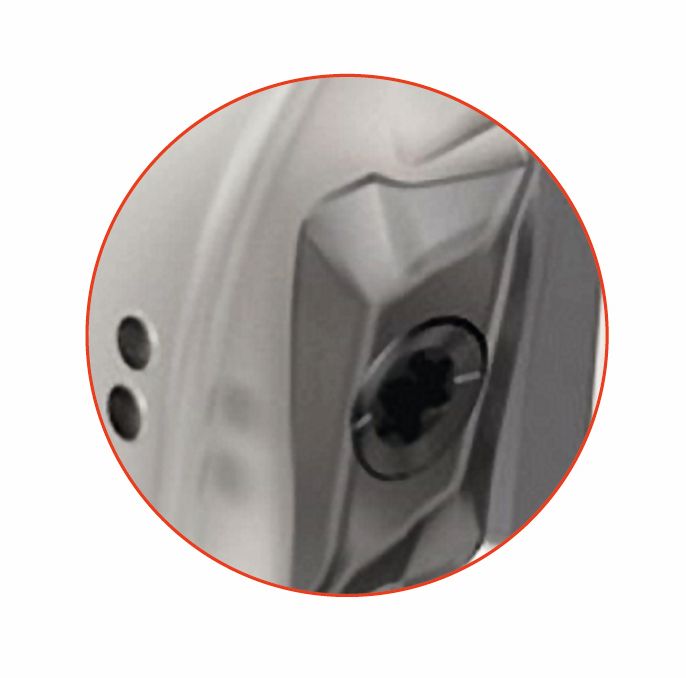
For better cooling performance, ISCAR also relocated the coolant outlet to the side of the chip chamber. Depending on the size of the WSP, two or three holes with a diameter of one millimeter bring the cutting fluid to the cutting edge. "The distance between the outlets and the WSP is now only five to seven millimeters," says the product specialist. "This brings several advantages - the cutting fluid jet is more compact and can be directed more precisely; furthermore, we were able to improve chip formation and chip evacuation."
More process reliability and better chip control
In numerical terms, this means: At a pump pressure of 80 bar and a pump volume of 46 liters per minute, a user achieves a pressure of ten bar at the cutting edge and an exit speed of 37 meters per second, or 132 kilometers per hour, with standard cooling using five coolant outlets with a diameter of 2.5 millimeters. In the same setup, a JHP mill with ten one-millimeter outlets, two per cutting edge, achieves a pressure of 74 bar at the cutting edge and an exit speed of 122 meters per second, or 441 kilometers per hour.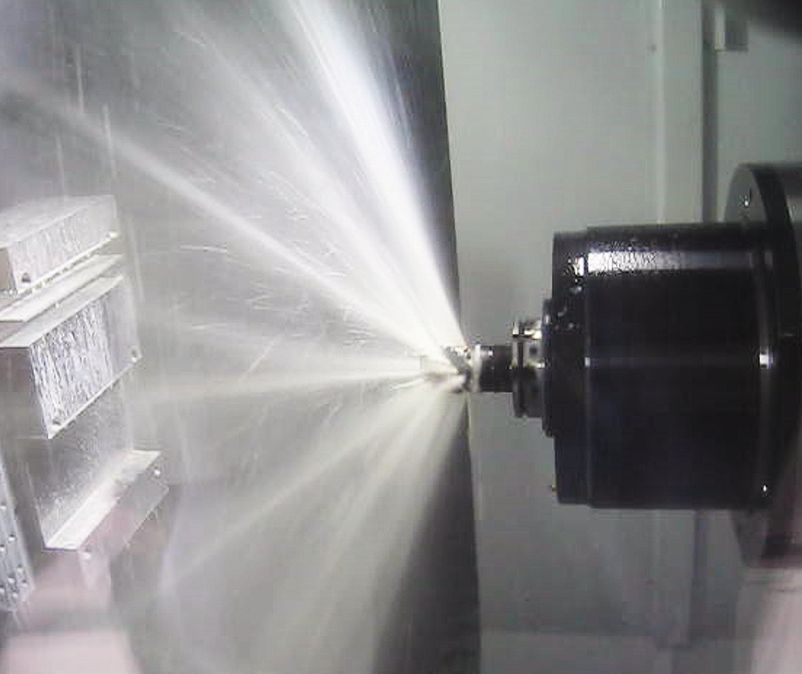
"This means we can bring much more coolant with significantly higher pressure into the cutting zone in a shorter time," emphasizes Kress and lists the advantages: "The user can achieve higher cutting values, longer engagement times are possible, they achieve more process reliability and longer tool life, and fewer built-up edges form." Jet cooling also has a significant impact on chip formation and removal: The high pressure ensures more compact chips that are also practically ejected to the side. This protects the tool and improves surface quality.
"Targeted cooling can be used starting from six bar pressure," says Kress.
"The 3D-printed mills with flow-optimized, targeted cooling are available in the HELI2000, HELIALU, HELI3MILL, HELIQUAD, HELITANG, and XQUAD series - there is the right tool for every milling task."
Contact: