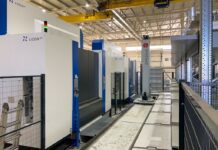

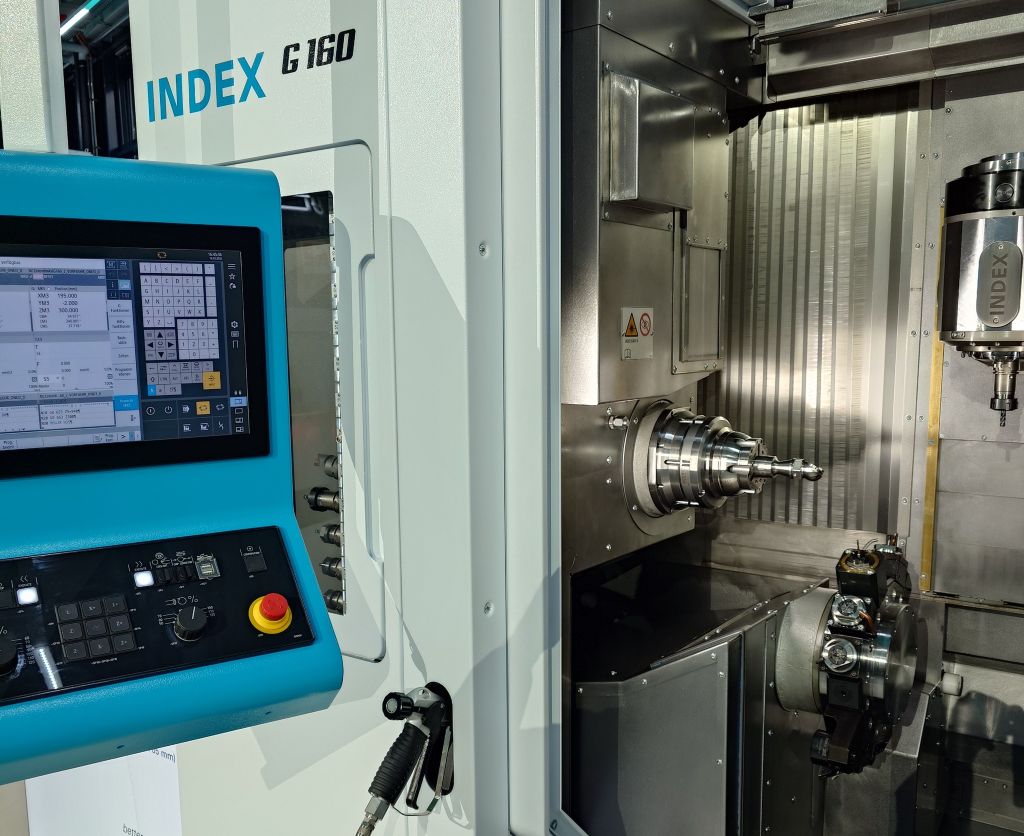
With the turning-milling center G160, which was presented for the first time at the Open House 2026 in the iXperience Center in Deizisau, INDEX rounds off its current G series downwards. The machine is conceptually based on the previous G200.2 and offers many options in terms of equipment.
In recent years, INDEX has redesigned the turning-milling centers of the G series, constructed them anew, and reorganized the models. With the INDEX G160 presented at the Open House 2026, the Esslingen machine manufacturer is now rounding off its range of turning-milling centers downwards. This 'Small' in the program is conceptually based on the previous G200.2 but shows significant improvements in the milling area. A special feature is the wide selection of options regarding spindles, tool holders, and peripherals, allowing each customer to configure a machine tailored to their needs and cost-optimized.
Powerful main and counter spindles
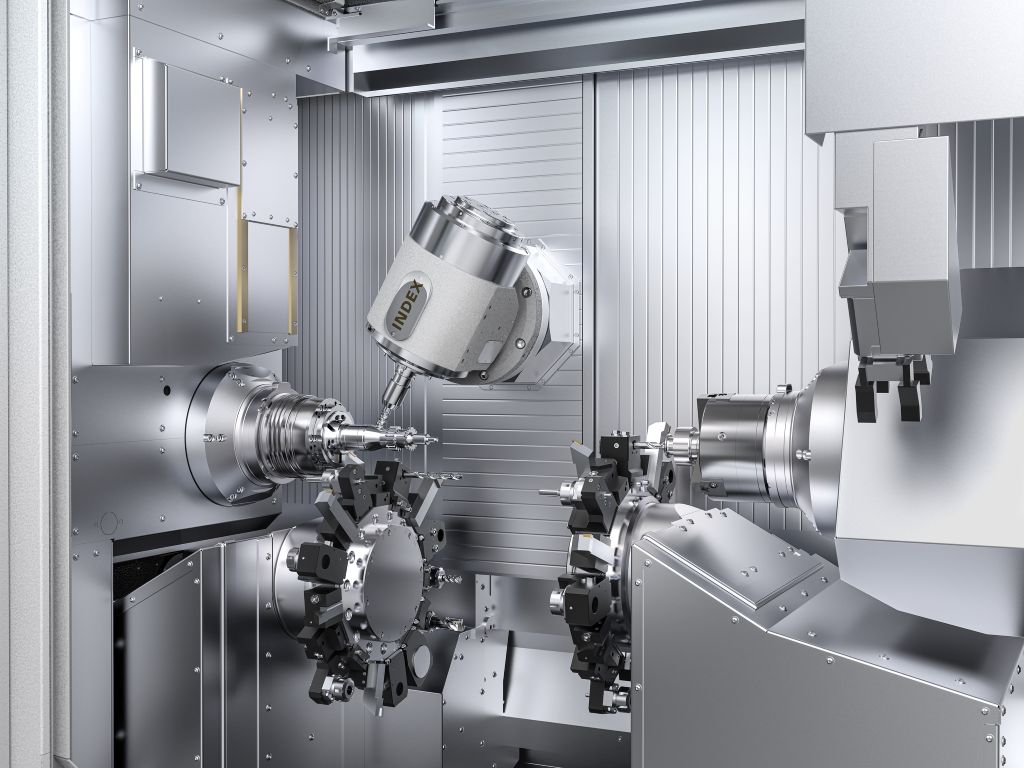
The new turning-milling center INDEX G160 is equipped with a directly driven, highly dynamic main spindle, which is available in two sizes - bar passage 42 mm and 65 mm. Due to the technical data (speed 7,000 / 6,000 min-1, torque 65 / 170 Nm), the 42 mm variant is suitable for smaller, high-speed parts, while the larger one is also suitable for workpieces that fit in the clamping chuck up to 175 mm in size. In the INDEX G160, the counter spindle is identical to the main spindle but has an additional Z-axis.
Extensive tools and tool holders
The INDEX G160 can be equipped with two lower tool holders, which come standard with a Y-axis and can work at both the main and counter spindles. The lower turrets have 15 stations with VDI 25 interface, all driven with up to 7,200 min-1 (7.5 kW and 18.5 Nm at 25% duty cycle). An interesting detail: Only tools that are in engagement are supplied with coolant, contributing to high energy efficiency.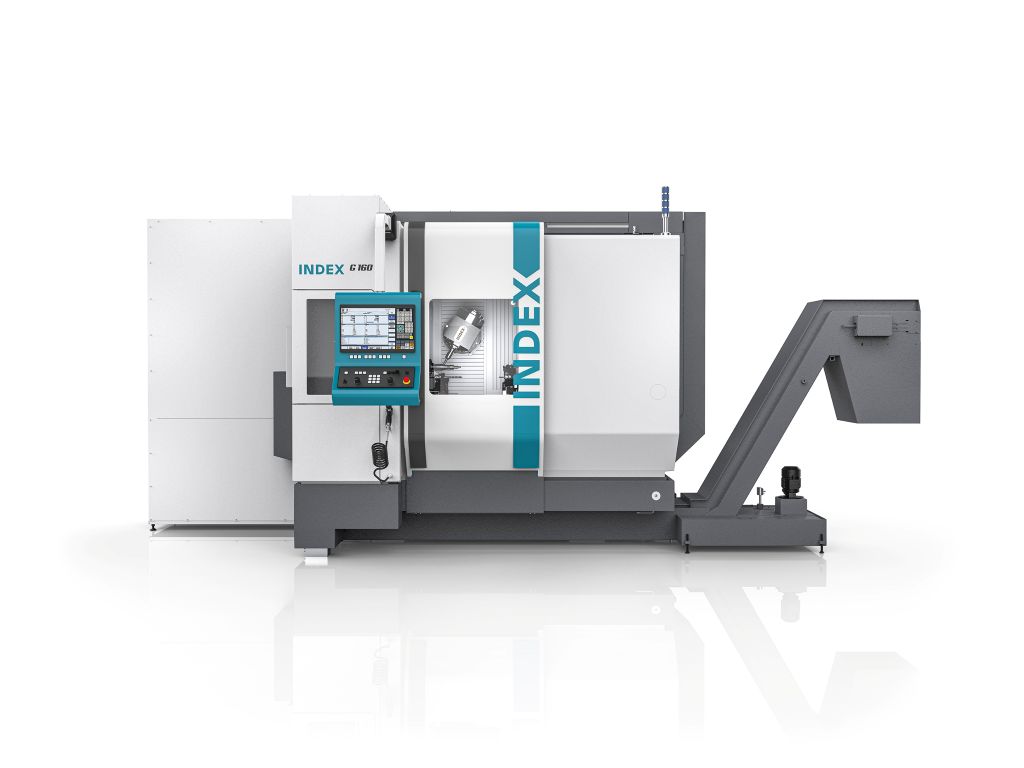
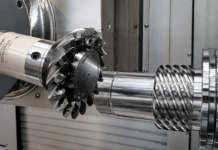
For the upper tool holder, a powerful motor milling spindle with B-axis is available to the customer. The very compact, directly driven milling spindle with HSK-T40 interface is available in two versions that match the main spindles - with 32,000 min-1 (17 Nm) and with 18,000 min-1 (29 Nm). Both allow for internal coolant supply of up to 80 bar, which promises advantages for deep drilling and difficult-to-machine materials.
It uses the newly developed tool magazine for the INDEX G160. This is a tower magazine with 60 or 90 tools. A double gripper automatically changes the tools into the milling spindle.
Extensive automation options
The simplest form of automation is a bar loading magazine, for which the INDEX G160 provides a Unimag 5 interface. This allows the connection of the INDEX MBL 76 loader, which is available for 3 m or 4 m bars and exhibits excellent guiding properties. On the other hand, the interface also allows for third-party brands. For example, INDEX offers short bar loaders from Breuning.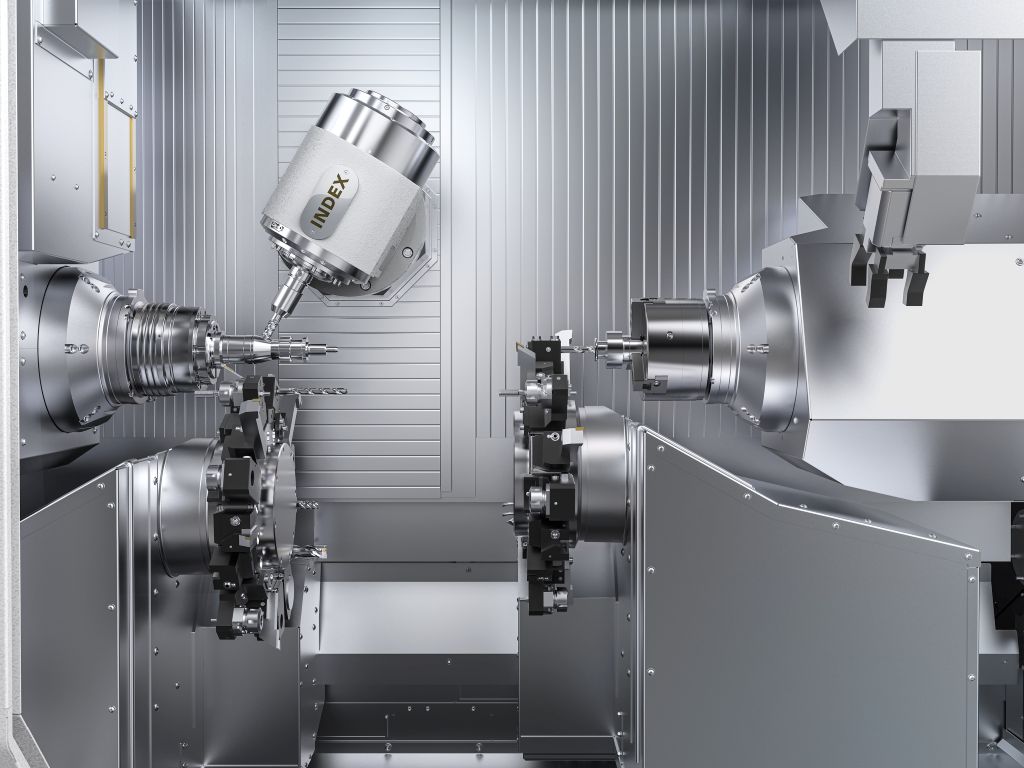
For part removal, the classic solution is a linear unit that picks up the finished part and places it on a conveyor belt. The integrated workpiece handling WHU developed by INDEX offers significantly more options. It is equipped with three axes and can be used for loading and unloading as well as for removing residual parts. High-end automation is provided by the INDEX robot cell iXcenter, which supports fully automated operation with a pallet storage system.
It is docked to the machine to quickly, safely, and flexibly feed in and remove raw and/or finished parts. Subsequent processes such as cleaning, measuring, deburring, etc., can also be integrated into the robot cell.
For automated processing, it is essential to check and measure tools within the machine. INDEX offers various systems for this, from tactile methods to lasers that non-contact detect geometric changes and tool wear at the tools in the motor milling spindle.
Additional options for the peripherals
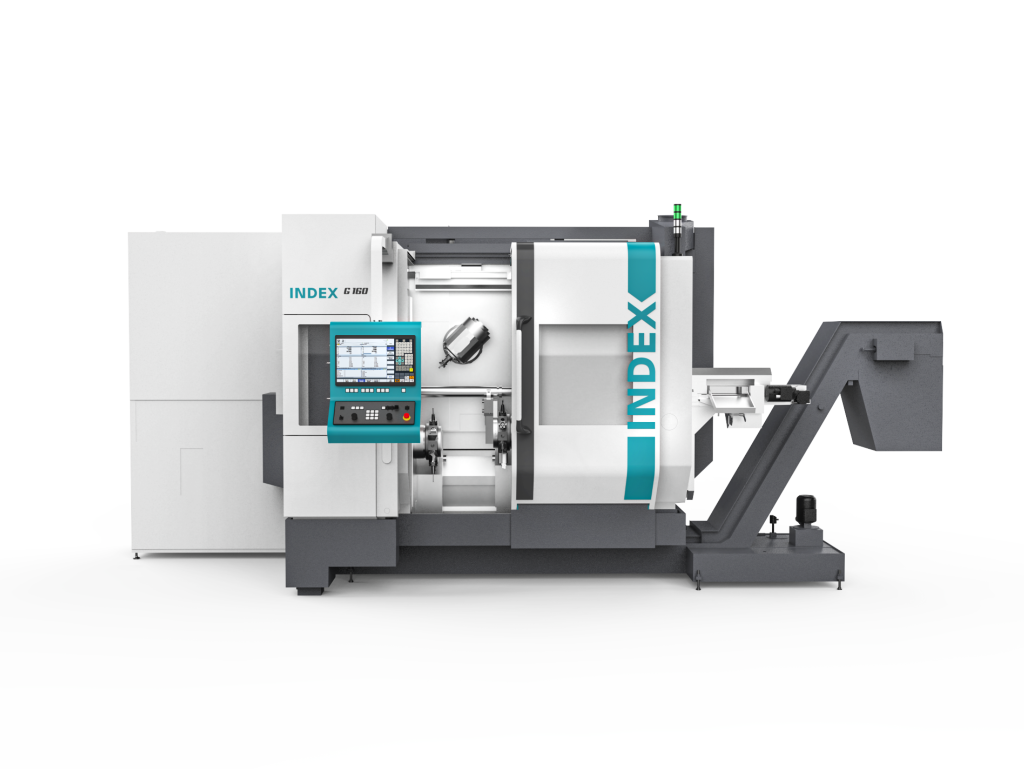
In terms of peripheral equipment, INDEX also offers extensive options for the G160. Several chip conveyors are available: a KNOLL plate conveyor and a hinge belt conveyor from Bürener. Both suppliers also provide various coolant solutions that differ mainly in filtration and high-pressure performance.
Both emulsion and oil can be used as coolant. Additionally, INDEX offers corresponding extraction systems: a mechanical separator for emulsion and an electrostatic system for oil.
The cooling concept of the INDEX G160 includes two solutions: a 14 kW cooler that only tempers the machine and a 20 kW cooling device that additionally maintains the coolant at the desired temperature.
Another important topic is the energy efficiency of the machine. Here, INDEX takes a pioneering role with many details: for example, through energy feedback to the grid during braking processes, through the use of frequency-controlled pumps, through weight balances for the vertical axes, etc. (see box for more details).
Last but not least - the INDEX G160 is equipped with the latest Siemens control, the Sinumerik ONE. This control, referred to by the manufacturer as 'Digital Native CNC', is a system optimized for high-productive machine tools that promotes innovations through the seamless interplay of the virtual and real worlds.
Facts on energy efficiency
- High accelerations and rapid traverses reduce peripheral running times (saves up to 50% of energy consumption)
- Energy recovery during braking processes through grid feedback
- Lower energy requirements through intelligent material pairings and coatings with minimal friction
- Energy savings through frequency-controlled pumps
- Reduction in consumption through intelligent automatic shutdown of peripheral systems during machine downtime
- Spring weight balances in vertical feed axes reduce the energy consumption of the servo motors
- Heat recovery through the provision of a central water interface
Contact: