
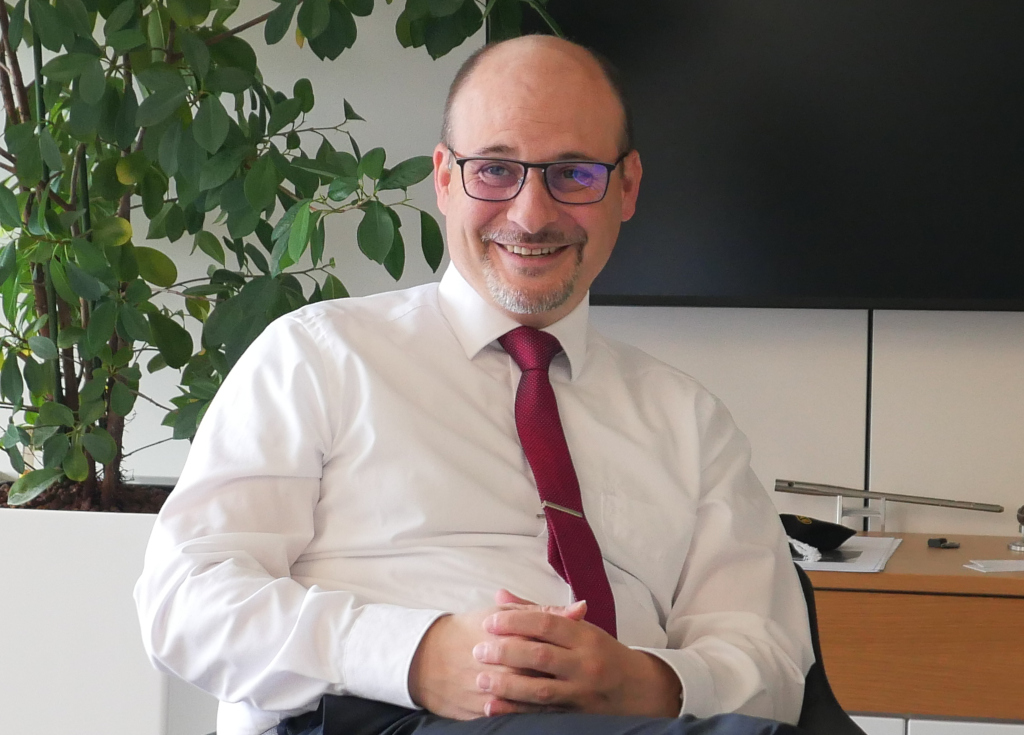
Frank Dietsche - Mr. Horn, your colleague Phillip Dahlhaus has already introduced me to the new products of your company and explained them. The sintered chip shape geometry in the Supermini tools is an innovation. Is this also a setup for international competition to copy this technology?
Markus Horn -With the sintered chip shape geometry for our core product Supermini, we have created something that cannot be easily or quickly copied. We also needed several years to achieve today's results. While the competition tends to shy away from the effort and costs involved, we are already working on further expanding this technology. For example, this can also be seen in our product area Mini.
FD - Paul Horn GmbH is traditionally active as an exhibitor at important trade fairs. This year in September, the AMB in Stuttgart is coming up. How do you see the future of trade fairs, especially regarding effort, costs, and returns?
Markus Horn -Trade fairs are still the focal point for dialogue at eye level and for presenting our products. Therefore, trade fairs are an integral part of our communication and marketing strategy. We are convinced that when users can perceive us and our products with all their senses, we create credibility and convince with facts. For example, with live machining. At AMB, we will have three machines running under chips at our booth. Of course, trade fairs involve a certain cost factor. However, we do not see these events solely as a cost-revenue relationship, but as opportunities beyond that. To learn more about our users' requirements and to do so in a unique competitive environment. Where else can you have so many providers physically on-site? We do not shy away from comparisons, as we are convinced of our products, solutions, and consulting expertise.
FD - Will social media and/or artificial intelligence change the world of trade fairs?
Markus Horn -In principle, I consider digitalization to be helpful. Especially where it creates added value. Thus, for me, social media and AI are additional opportunities to transport information and create ease. However, the trade fairs themselves do not replace these channels in any way. Following the motto of doing one thing and not leaving the other – with the caveat that it must deliver added value. AI could, for example, optimize the trade fair visit in the future by providing routes or additional information.
FD - The ongoing and never-ending discussions about the internal combustion engine, or, for example, the EU's REACH and RoHS regulations on lead-free materials, have posed great challenges for precision tool manufacturers. What is your assessment of the political influence on German companies?
Markus Horn -For me, it is clear: Politics creates frameworks and guidelines. Solutions are created by the economy or industry. And demand regulates enforcement. That is my understanding of (social) market economy. Currently, politics is going too far with legislation, regulations, and additional bureaucracy. I have noticed for some time how this is affecting us in Germany and Europe regarding global competition. Nevertheless, I point out that the basic idea behind these topics is often correct and important. For example, with REACH and RoHS, to better protect people and the environment from harmful substances like lead. Unfortunately, today, the target is often overshot.
FD - As a former president of the European Cutting Tools Association (ECTA), you certainly have contact with your European market counterparts. Are the political requirements for companies in other EU countries comparable to those in Germany?
Markus Horn -Many rules are set by the EU – too many in my opinion. Directives usually have to be implemented into national law at certain intervals. Regulations apply directly and uniformly to all member states. In this respect, the requirements are comparable. However, I believe that the meticulous adherence by those affected is controlled and implemented most strongly in Germany. Other countries show us how the same EU directives can be implemented effectively and efficiently.
FD -What do you think the politics in Germany should implement to quickly restore growth?
Markus Horn - Politics must finally reduce bureaucracy and make it easier for entrepreneurs in all areas. Why not define safe countries of origin in the Supply Chain Due Diligence Act that are inherently suitable? Similar to how it is regulated in the GDPR. Third countries with adequacy decisions. Those would be pragmatic solutions. Otherwise, the state shifts its own tasks and responsibilities onto companies, and that cannot be the case, no matter how you look at it. The same principle applies to companies and the population: We are happy to take responsibility!
FD - What are your expectations for the year 2026?
Markus Horn - Regarding us, we have fortunately started the year well. However, we are also struggling with declining order volumes. The mentioned problems must be addressed by politics promptly to finally emerge from the ongoing recession. We are doing everything we can on our own. However, the truth is also that growth is currently happening primarily internationally. I believe in us, in mechanical engineering, and in the German economy. It is time to act. Because our collective prosperity depends on it.
Thank you very much for the conversation
The interview was conducted by Frank Dietsche from Dieonlinemagazine.de