
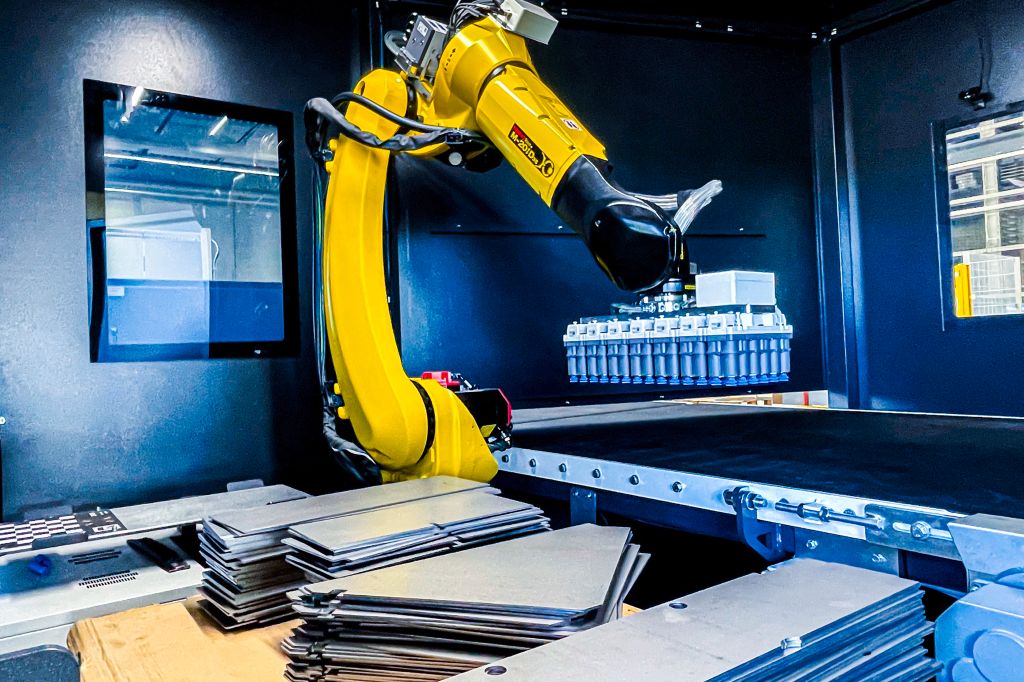
The challenge: personnel shortages. The goal: increase productivity. The solution: Solution Kit ivOS Sheet Metal. This loading and unloading system from Schmalz uses artificial intelligence, 3D vision sensors, and a flexible surface gripper to recognize and move different workpieces. Machine builder LISSMAC significantly increased its capabilities with this.
"We are specialists when it comes to optimizing work processes," says Daniel Wechsel. He is the head of sheet metal production at LISSMAC Maschinenbau GmbH. Therefore, the company continuously seeks solutions to increase its productivity and improve its facilities. In sheet metal production, employees loaded and unloaded the deburring machines – one person was required per machine. "The skilled labor shortage repeatedly led to bottlenecks. Our goal was to automatically load the machines to relieve our employees," summarizes Daniel Wechsel the task.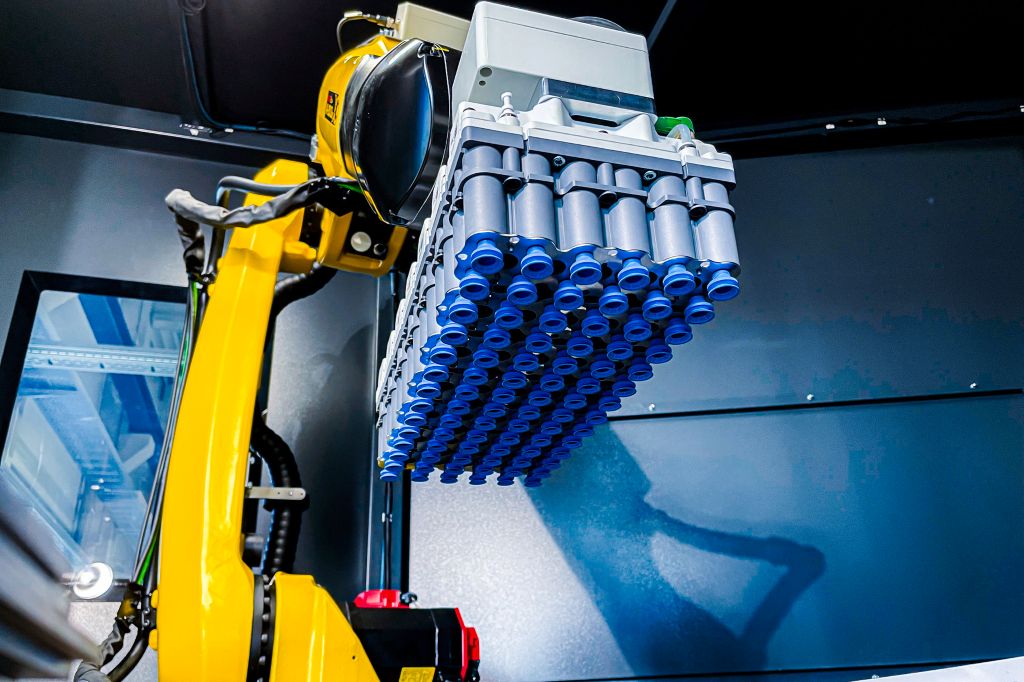
Founded in 1978, LISSMAC specializes in construction machinery such as joint cutters and stone cutting saws, grinding and deburring machines, as well as handling systems. With around 380 employees worldwide, the company based in Bad Wurzach in Upper Swabia generated around 68 million euros in 2023. The export share is over 40 percent, with a rising trend – the company is active in Europe, America, the Middle East, as well as in Australia and New Zealand – with assembly and service locations in the USA and Dubai.
Partnership on equal terms
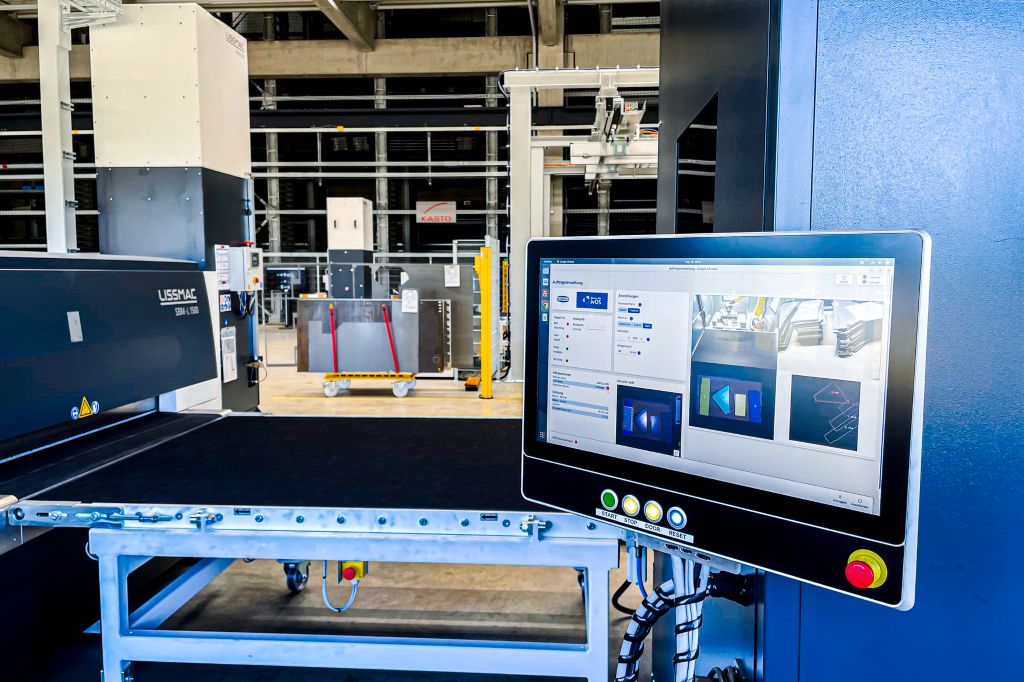
With its deburring machines, LISSMAC processes workpieces made of aluminum, steel, and stainless steel in-house, starting from a size of 150 × 50 millimeters and up to a diagonal of 950 millimeters, with thicknesses ranging from 0.8 to 20 millimeters. The components vary in their internal contours, and the surfaces can be dry or wet. "For automation, the system must be able to reliably recognize the parts," explains Daniel Wechsel.
"We have been working with our partner Schmalz on vacuum and gripping solutions for a long time. When we learned about the Solution Kit for sheet metal processing, we were immediately interested."
As a technology expert in the interplay between robots and grippers, Schmalz contributed not only the Solution Kit ivOS but also the Matrix flat gripper FMG. For this purpose, Schmalz combined seven modules, with each suction gripper being individually controllable. The FMG is characterized by a low vacuum requirement and can hold onto picked workpieces even in the event of actuator voltage loss. The highlight, however, is the artificial intelligence (AI) embedded in the Solution Kit ivOS Sheet Metal. It responds flexibly to changing requirements and workpieces without a learning process. "The AI-supported part recognition works extremely reliably – and noticeably saves time, as the tedious manual placement of workpieces is now a thing of the past," confirms the head of sheet metal production.
Vfrom manual to automated process
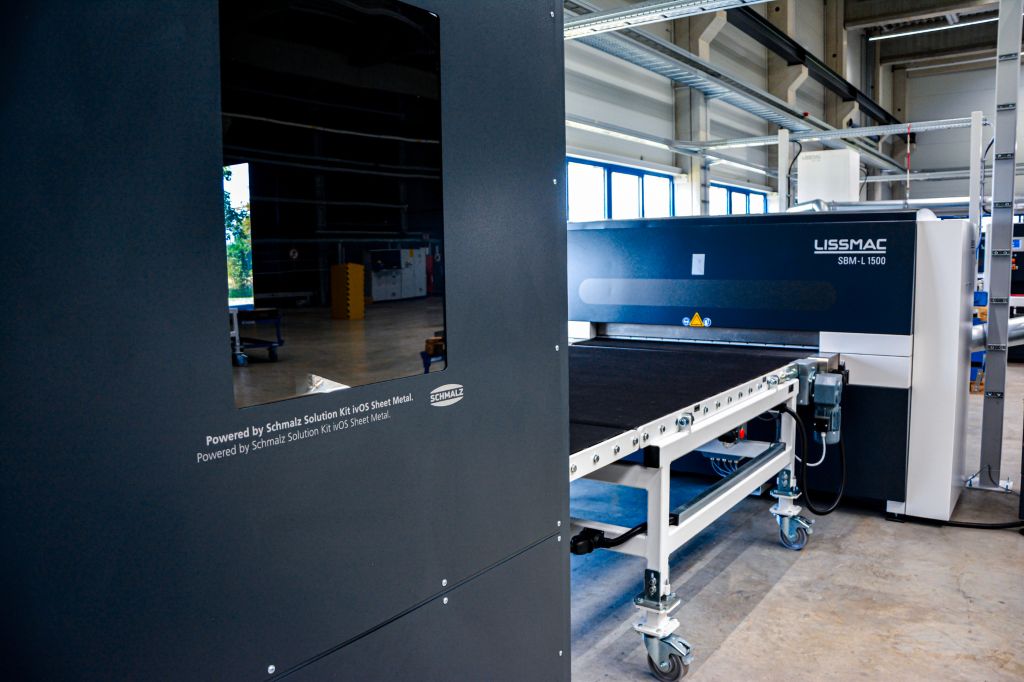
The employees bring the workpieces in pure stacks on a pallet into the robot cell. Only one sheet thickness is allowed in each container. 3D vision sensors mounted on the ceiling of the cell capture different sheet geometries and provide the necessary data for robot control. This allows the gripper to be positioned precisely and place the sheets accurately on the conveyor belt of the deburring machine. For this, Schmalz and LISSMAC defined rules and connected the robot cell and deburring system via an interface.
Per shift, the system automatically loads 700 to 1,000 workpieces into the grinding machine from LISSMAC. The system still has significant reserves – if needed, it can handle up to 500 parts per hour. After deburring, a conveyor belt transports the processed parts, which are still manually removed at the moment. "The Solution Kit has become an important tool in our sheet metal production," emphasizes Daniel Wechsel. Now the worker supplies and unloads two deburring machines at once. "This allows us to deploy our personnel much more efficiently," he is pleased to say. There is only one limitation: the sheet metal parts require a minimum rib width of 30 millimeters for the grippers to grasp them.
Since August 2024, the system has been in regular operation. The workforce has embraced the robotic solution well, as they have now been relieved of repetitive tasks. "The operation is intuitive, and the system works reliably," summarizes the head of sheet metal production. "We can now deploy our skilled workers on multiple machines simultaneously. This significantly increases productivity."
The next step
As a machine builder, LISSMAC is naturally thinking ahead with the automation solution. "We have a great product with a lot of potential. Therefore, we want to not only use the Solution Kit for our own production but also make it accessible to our customers," says Daniel Wechsel. For this reason, LISSMAC and Schmalz are developing a modular system for different load capacities and part geometries. "Full automation also includes a solution for removal directly after processing. We are currently working on that. This will make the system capable of handling any challenge."
Contact: