
While autonomous driving is already possible in some countries, Europe still lacks the legal framework for it and currently only allows partially autonomous driving. The combined brake housing, which unites the main brake cylinder, brake booster, and ABS/ESP in one component, supports autonomous driving at every level. Closely related to this is Break-by-Wire, where the brake signal is transmitted electronically rather than hydraulically.
The combined brake housing is a prerequisite for autonomous driving, but it also offers additional advantages. The electronic control enables shorter response times of the brake, significantly reducing the braking distance in an emergency stop.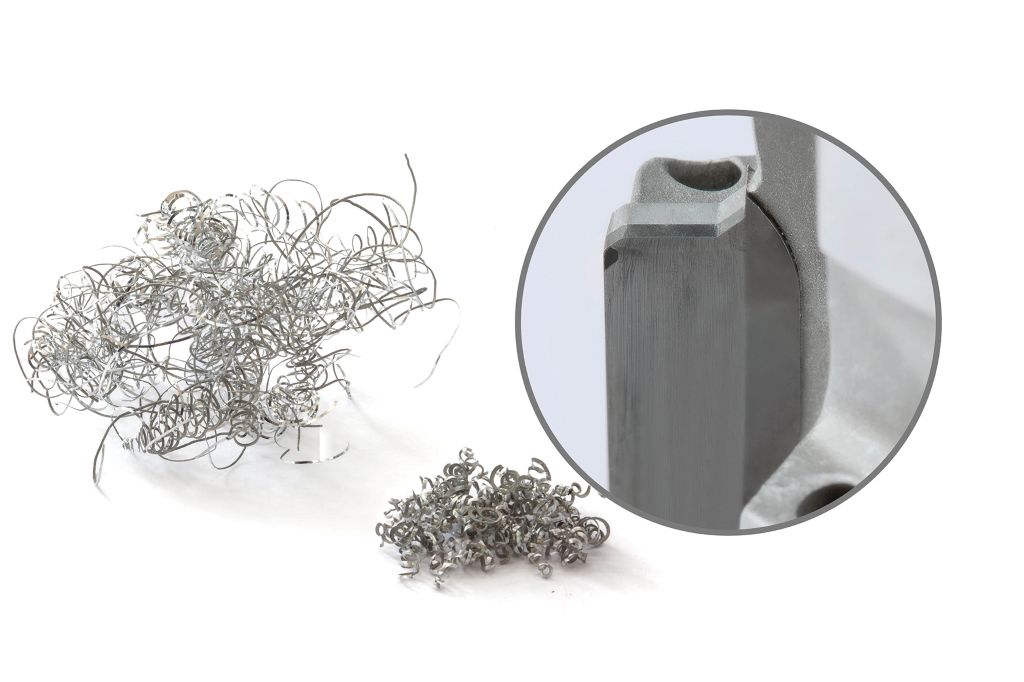
First automotive suppliers have already presented purely electric brake systems, but vehicles today still use a preliminary stage, known as wet-dry systems. This hybrid form employs hydraulic brakes at the front and a purely electric system on the rear axle. This redundancy is made possible with a sophisticated central component that combines both worlds in the smallest space.
Defined chip breaking for short aluminum chips
Aluminum with a silicon content of less than one percent serves as the material for the combined brake housing. For cost reasons, extruded profiles are usually used. The fiber orientation and low silicon content lead to long chips during machining. To ensure excellent chip breaking when reaming and honing with PCD cutting edges on low-silicon aluminum, MAPAL relies on application-specific chip breaker geometries. Their special topology, developed using 3D simulations, ensures defined chip breaking and thus short chips, even at low feed rates and small allowances. This guarantees the highest performance capability and process reliability.
With its many holes, the cut component resembles Swiss cheese. For each of the holes, there are tight tolerance specifications with accuracies ranging from IT6 to IT7. Since a medium still flows through the combined housing, high demands are also placed on surface qualities. The surfaces must be free of scratches that could arise from chips or vibrations during machining. Some holes are anodized afterwards for higher wear resistance. To ensure the coating adheres, a roughness of Rz 1 must be achieved.
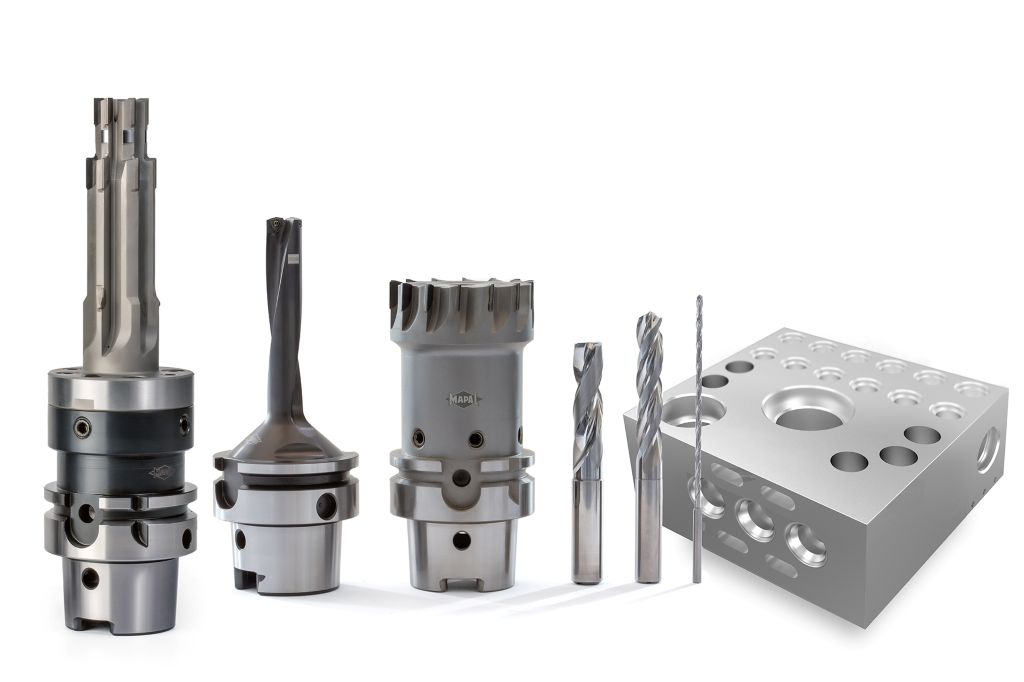
For the machining of the combined brake housings, MAPAL provides customized tools. This includes special carbide step drills for the preliminary machining of the motor hole. Subsequently, PCD tools with many cutting edges are usually used to achieve the desired surface quality. The different contours of the valve holes are produced by circular cutters with very high contour accuracy. Additionally, various deep holes are introduced into the aluminum block, which interlock within the component. Spiral tools with machining depths of up to 30xD ensure process-safe chip removal, allowing the medium to flow unhindered later. 20 percent of the cycle time of about 15 minutes is solely accounted for by the deep holes, so productive drilling machining solutions have a strong effect on cost savings.
The quantities of the combined brake housings reach up to five million components per year. They are usually manufactured on multi-spindle machines in two setups, with four-spindle machines being preferred due to their high productivity. As a technology partner, MAPAL collaborates with its customers to develop application-oriented machining processes and tool packages for this aluminum component.
Contact: