
Industrial transformation presents challenges to all production areas, which also affects component cleaning. The tasks have not only become more diverse and demanding, but they also need to be solved more efficiently and resource-conservingly. This requires effective and sustainable solutions that are optimally tailored to the cleaning needs.
New products, changed production techniques, and process chains mean that component cleaning must meet an enormously diverse range of tasks. The stable compliance with very different cleanliness requirements – from grease and/or particle-free to the removal of fine particulate contaminants in the sub-micrometer range and from nanolayers of filmic residual contamination – must be ensured, as well as a maximum of cost-effectiveness. To keep the CO2 footprint as low as possible, cleaning must also be energy- and resource-efficient. These diverse demands require solutions that are optimally tailored to the cleaning task.
Defining requirements for cleaning processes and plant technology
When selecting the most suitable solution, the cleanliness to be achieved, the type and amount of contamination to be removed, as well as the material, geometry, dimensions, and weight of the component are among the essential factors. Company-specific criteria such as throughput requirements, automation, and digitalization must also be considered. This complexity requires a partner who masters the entire range of cleaning technologies and has the corresponding application know-how. As an experienced full-service provider of future-oriented and efficient solutions for industrial component cleaning, surface treatment, and automation, Ecoclean possesses both.
With modular-based systems and individually designed special systems for water-based media, solvents, and modified alcohols, the plant manufacturer covers the complete spectrum of wet chemical processes for batch and single-part cleaning in practically all industries. Various application-specific process technologies, such as spray, high-pressure, immersion, ultrasonic, and plasma cleaning, as well as steam degreasing, injection flood washing, Pulsated Pressure Cleaning (PPC), or Ultrasound Plus ensure that required cleanliness specifications are achieved stably, reproducibly, and resource-efficiently.
Optimally tailored cleaning solutions
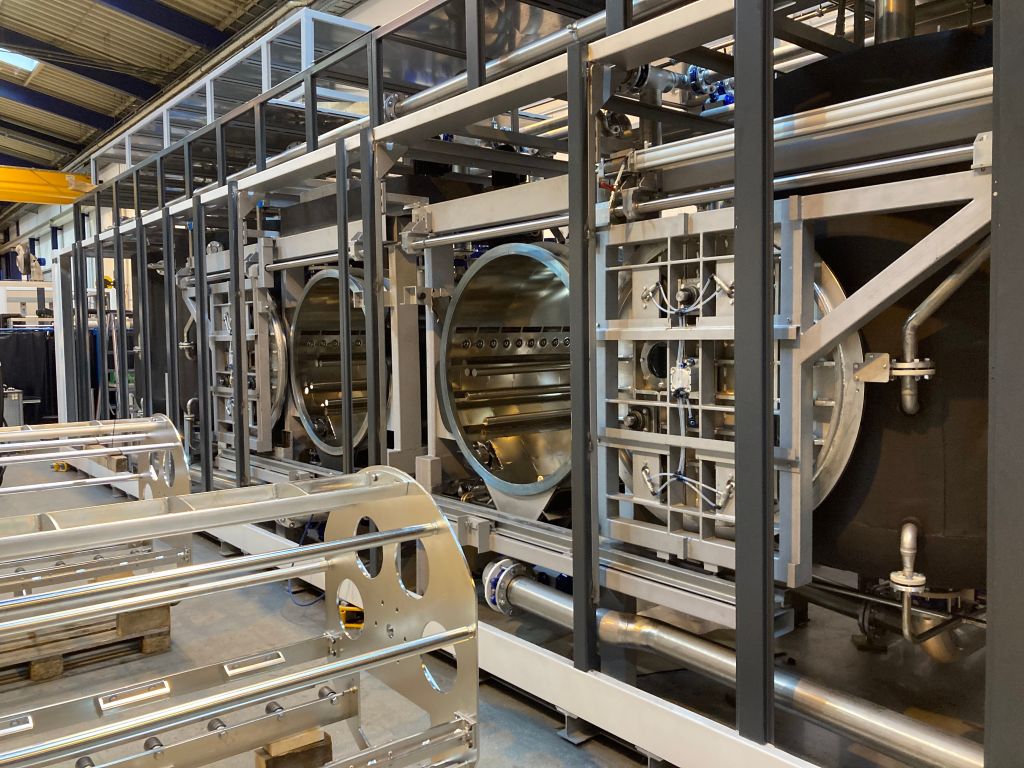
The modular-based design allows for the simple and quick design of cleaning systems that are precisely adapted to the tasks and company-specific requirements. For large-volume components and high capacity requirements, for example, the EcoCstretch can score points for operation with solvents and modified alcohols. The system operating under full vacuum is available in two sizes and with two different working chamber diameters each. This type of system is used, among other things, for the manufacturing-integrated cleaning of aluminum contacts for cell contacting systems before welding. The parts are automatically placed in cleaning containers immediately after stamping. The feeding into the system is done via a dual-lane feeding device as a double batch with two times four baskets of 600 x 400 x 125 mm stacked side by side. To ensure the cleanliness requirements of 'no particle larger than 500 µm and free surface energy ≥ 36 mN/m', ultrasound plus is additionally used alongside classical process technology such as immersion and injection flood washing. The pressure is varied according to the component geometry, so that contaminants can also be removed from hard-to-reach areas. After cleaning and vacuum drying, a robot removes the containers and places them in the unloading area equipped with filter fan units. From here, the parts are transported through a lift door into a clean room.
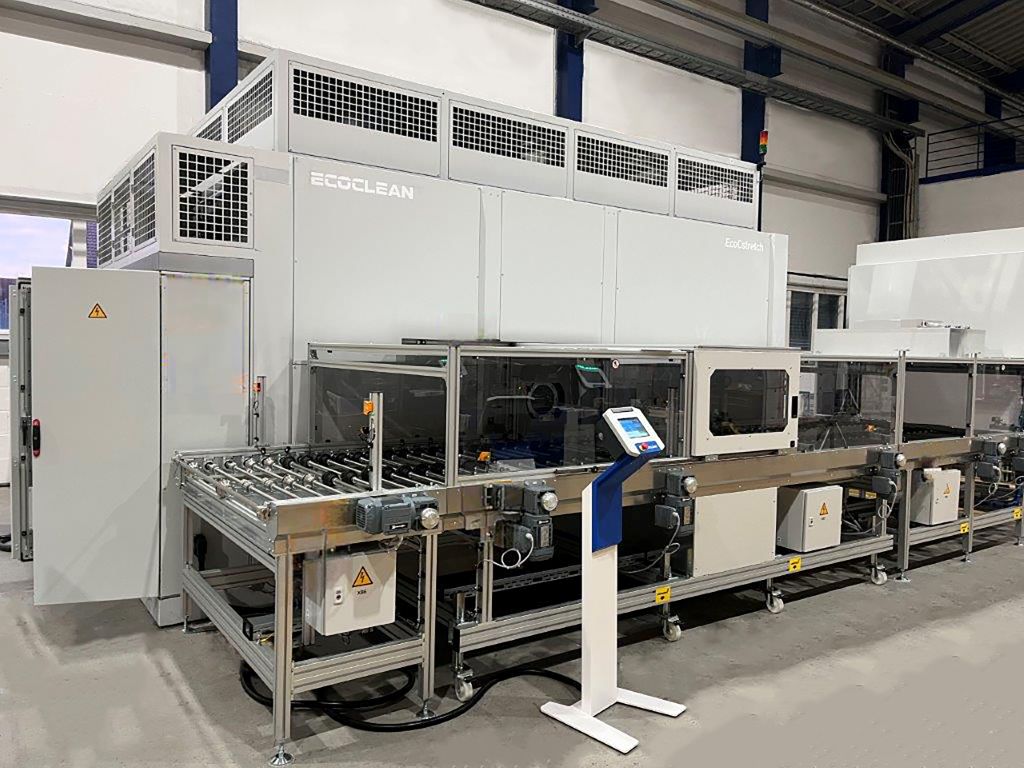
The modular design also opens up a wide range of applications for the EcoCvela, which is designed for cleaning with water-based media. The system can be equipped with one or more closed working chambers in different sizes, as well as several flood containers. This flexibility has convinced a leading manufacturer of vacuum valves for high and ultra-high vacuum in the production of semiconductors, displays, and digital technologies. The company uses a fully automated system of this type for the final cleaning of components made from various aluminum alloys, glass, quartz, and different plastics before surface inspection and assembly, which is carried out in a clean room. This EcoCvela L is equipped with two working chambers for batches of 800 x 500 x 600 mm and three flood containers. After cleaning, where depending on the components to be cleaned, work is done with spraying, flooding, high pressure, ultrasound, and PPC – sometimes in parallel – drying is done using vacuum, hot air, and infrared technology. The various drying technologies can also be used in combination, with the process air being treated with HEPA filters. Following cleaning, rinsing, and drying, the parts undergo component conditioning in a system also equipped with HEPA filters before they are introduced into the clean room.
Contact: