
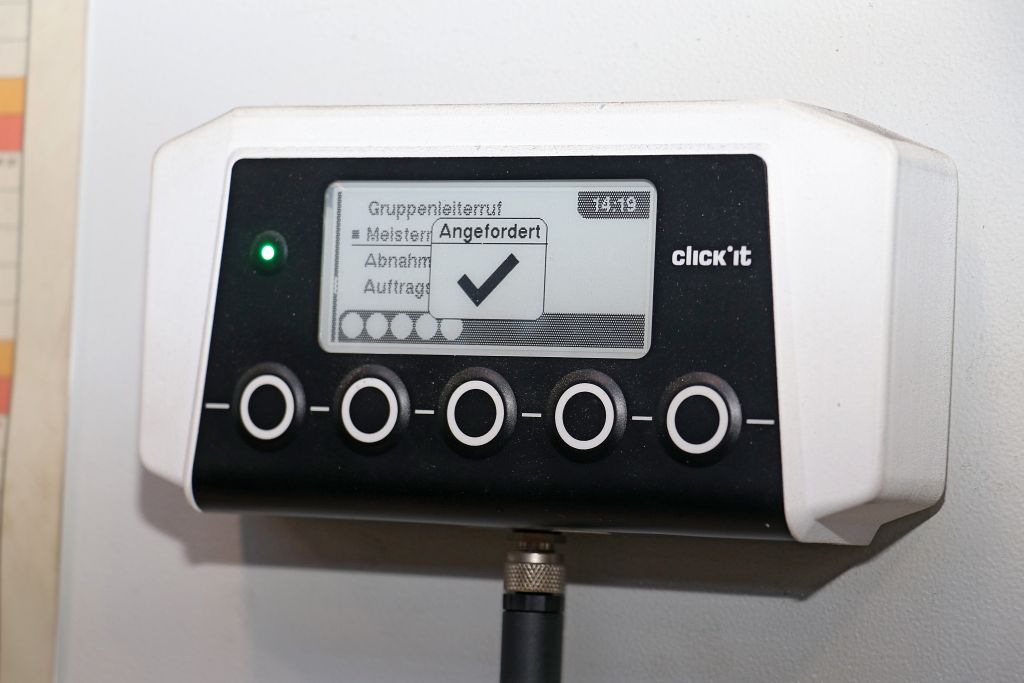
Whether material request or master call – the KNOLL Click.it system ensures that information and requests go directly where they belong. This saves unnecessary trips and idle times, stopping waste. Click.it can do even more: monitoring tasks for storage locations or capturing machine data can be done completely easily with Click.it.
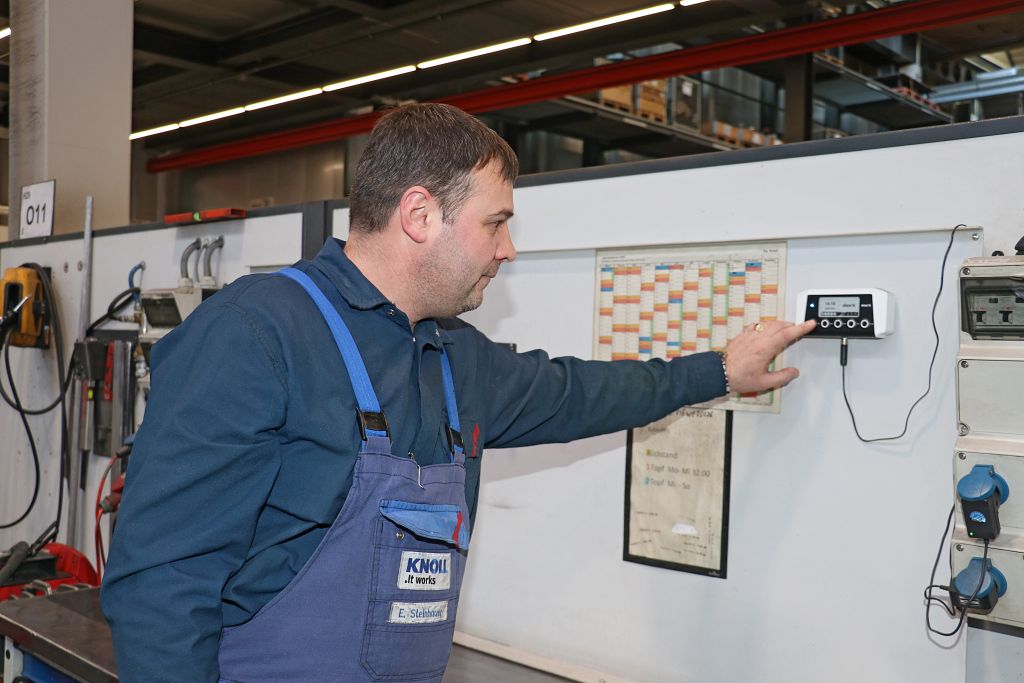
KNOLL Maschinenbau is primarily known in metalworking – as the provider of conveyor and filtration systems as well as pumps that transport and separate chips and cutting materials. The automation sector has opened up further fields of application with robust solutions for demanding assembly and logistics tasks. In addition to stationary transport systems with chain and roller conveyors as well as automated guided vehicles (AGVs), KNOLL now also offers small automation components with a big impact: the Click.it series – devices for networking at the push of a button.
Christian Spohn, KNOLL Head of Automation, explains: 'These are primarily easy-to-use buttons that can trigger standardized processes. This eliminates waste by saving employees unnecessary trips and ultimately a lot of time. This allows production and assembly processes to be significantly streamlined.'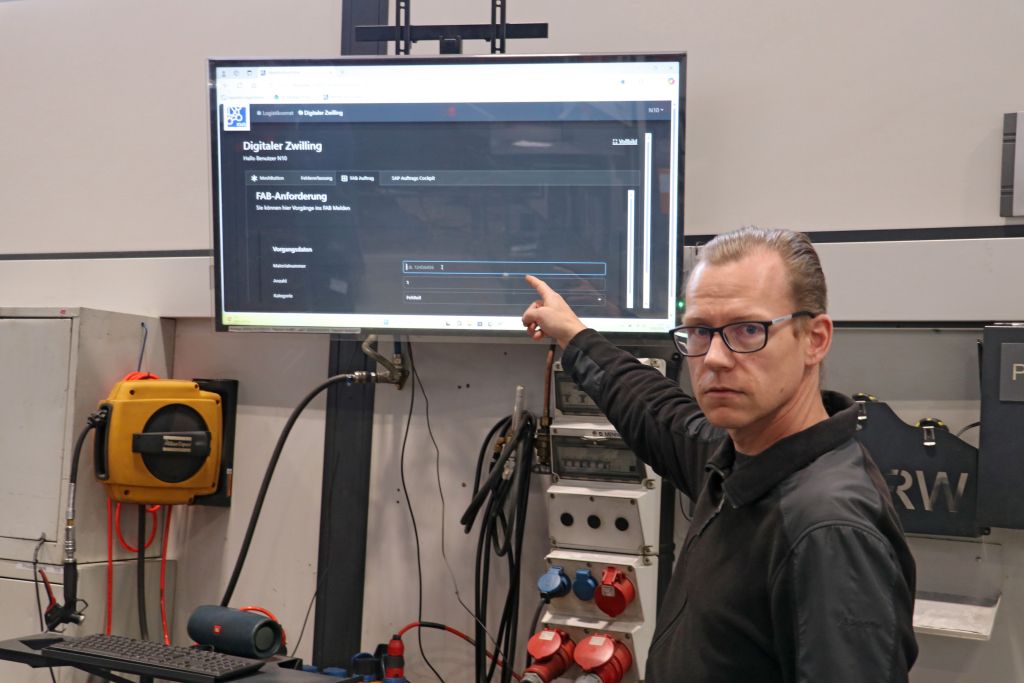
Click.it has already proven itself many times – including at KNOLL in its own factory, where the idea was born in 2018. This happened in the raw construction area, where KNOLL assembles and welds sheet metal parts, flanges, profiles, etc., before they go into painting and assembly.
In this department, manual workstations dominate, such as around 45 so-called welding boxes. Joachim Riebsamen, Head of Raw Construction, describes the initial situation:
'Our aim was to relieve our employees from unproductive ancillary activities so that they can work undisturbed. This primarily concerned the procurement of missing parts.'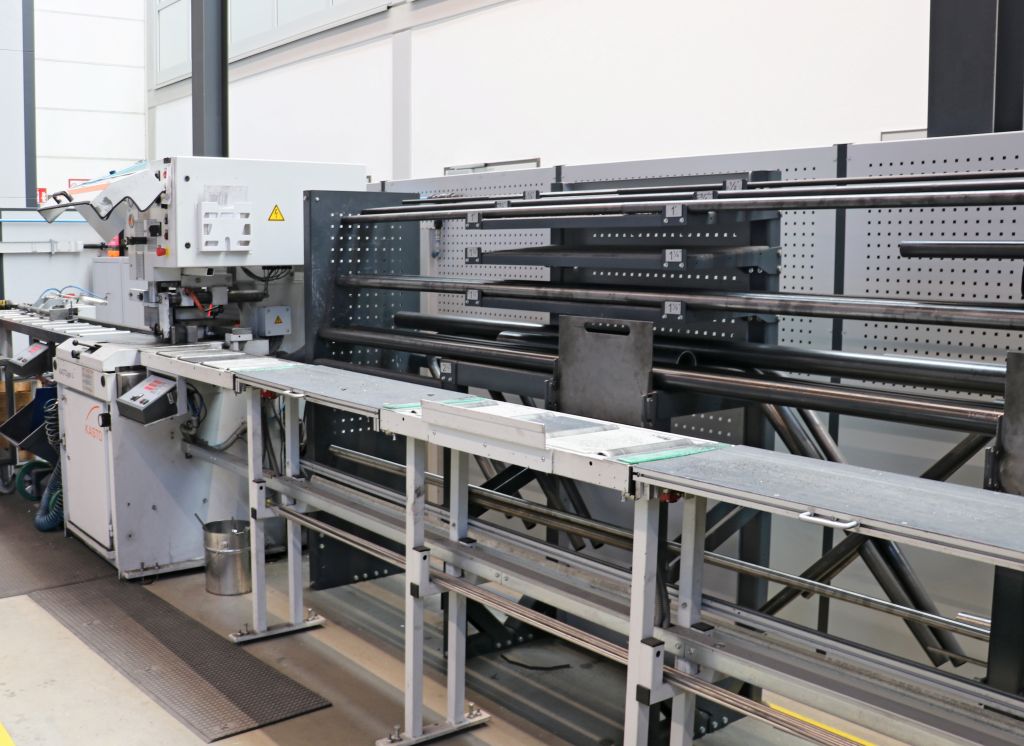
Markus Zinser, then still a scheduling expert in raw construction, explains: 'It was no longer contemporary to visually indicate the absence of a component with a flag and hope that the employee responsible for supplying the missing parts would see it and take care of it quickly.' In his opinion, this should be done more simply and quickly digitally. His vision: 'The welder presses a button, and the required missing part is immediately sent to him.'
Developing what cannot be bought
Since a suitable solution could not be bought, Markus Zinser took it upon himself to develop such a device. With the support of two mechatronics trainees, he built a small box with five buttons and a display. He programmed the core element, a microcontroller, himself.
Even during the development phase, Zinser recognized that the device could be optimally used for other purposes, for example, when an employee at their manual workstation needs support from the master or group leader.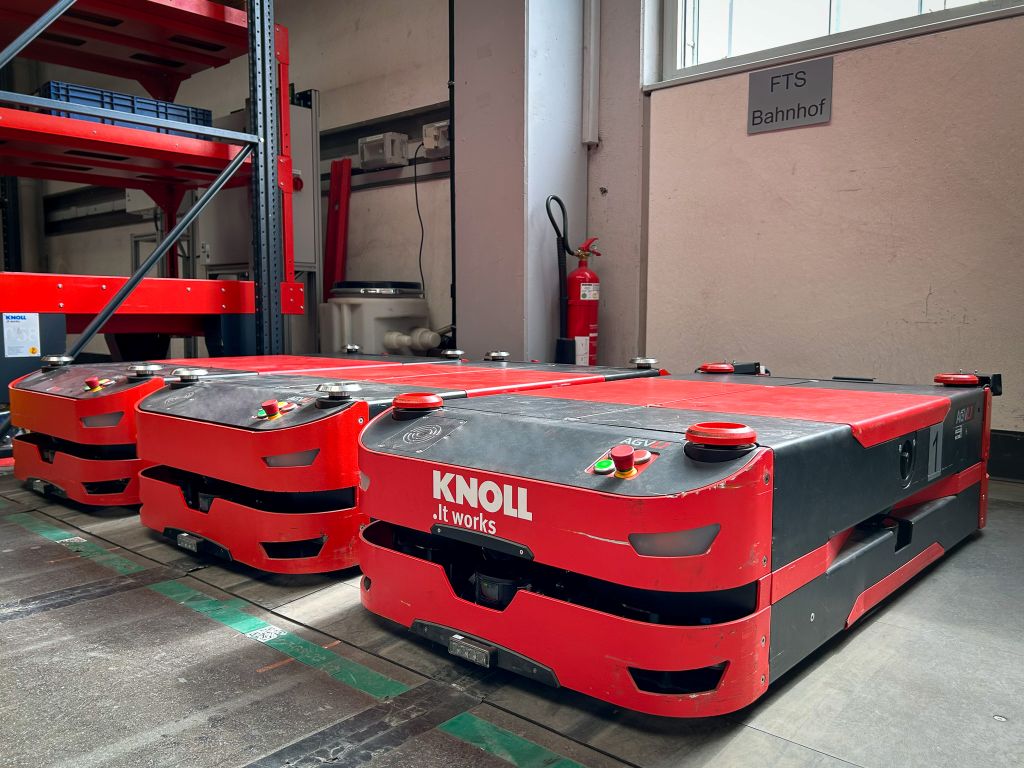
'Instead of signaling the call for help with a red lamp or searching for the master myself, a button press is sufficient here as well,' says Zinser. 'The desired person receives a text or audio message on their phone: 'Employee in box XY needs help.' They can respond immediately and avoid delays.' Joachim Riebsamen confirms the success: 'Our employees tested the system with several prototypes and found it good.' Therefore, he had additional devices built independently, with which he equipped all his welding boxes and other manual workstations.
How does Click.it work?
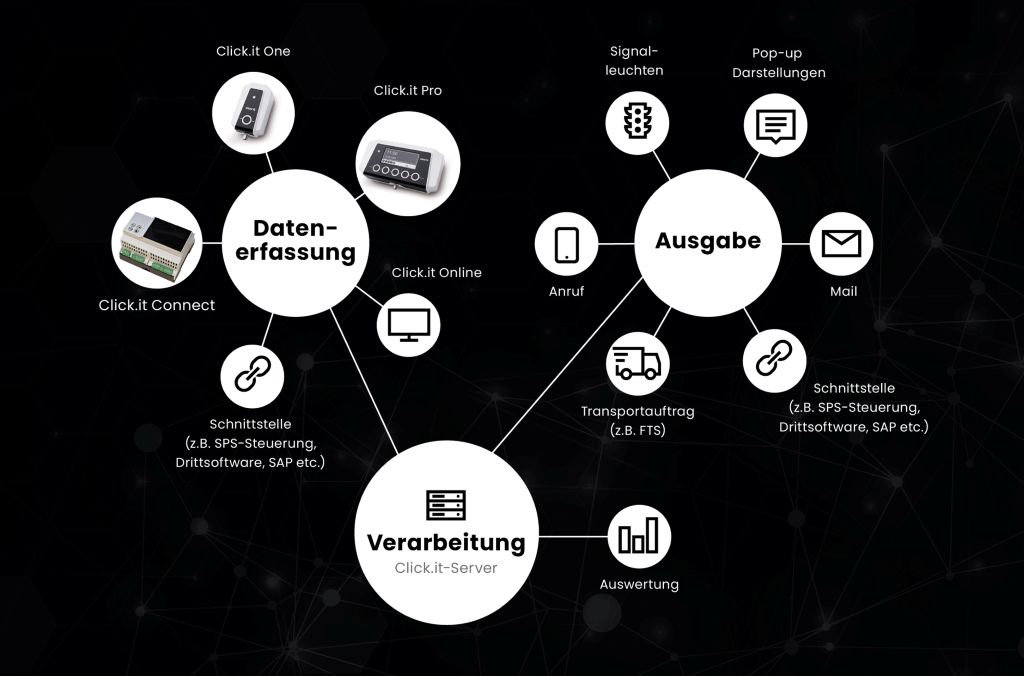
Click.it consists of an input unit that is connected to a server via Ethernet or Wi-Fi. This processes the incoming signals and triggers corresponding tasks, for example, that the phone rings at the master and a message is received.
The Click.it server is a simple computer integrated into the intranet. It does not require special performance and can also be set up as a virtual machine. Any PC, tablet, or smartphone connected to the intranet can – if the rights are granted – communicate with the Click.it server and exchange data. Markus Zinser explains: 'We have strictly focused on standardization in hardware and software to ensure that the system runs stably and changes or new developments can be implemented quickly.'
Click.it is also suitable for capturing machine data
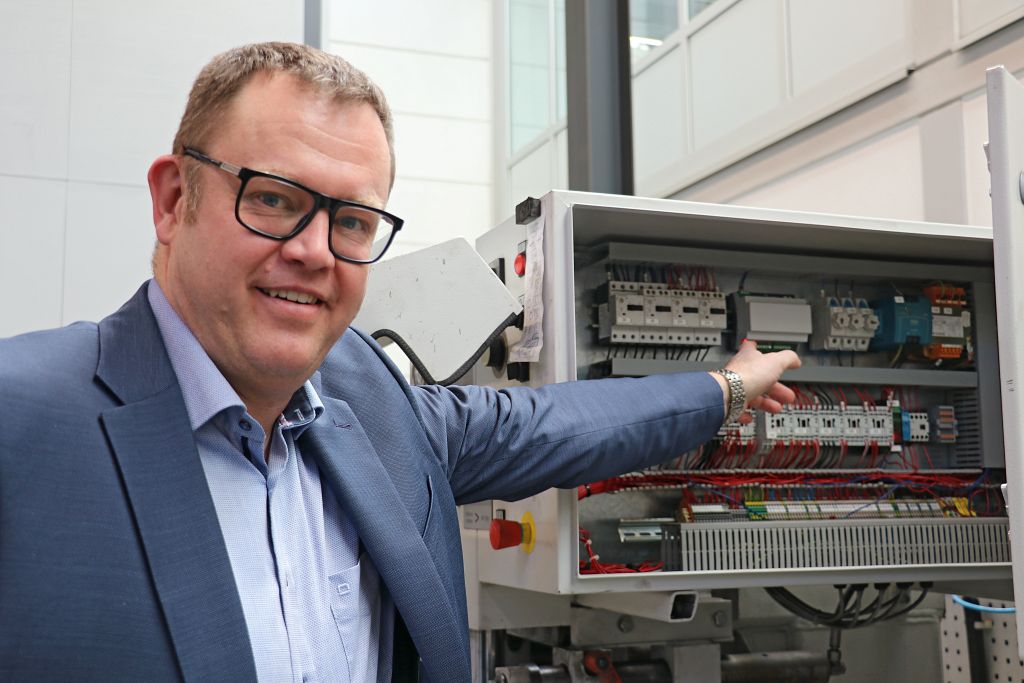
There have already been several developments. The raw construction managers quickly recognized that the system could also be used for capturing and evaluating conditions and machine data. 'We built a device that can be integrated into the control cabinet of a machine tool and captures control data there,' reports Click.it developer Zinser. The first deployment location was an automatic saw. Via Click.it, the responsible manager receives information about the machine's utilization – data that can be used for personnel planning.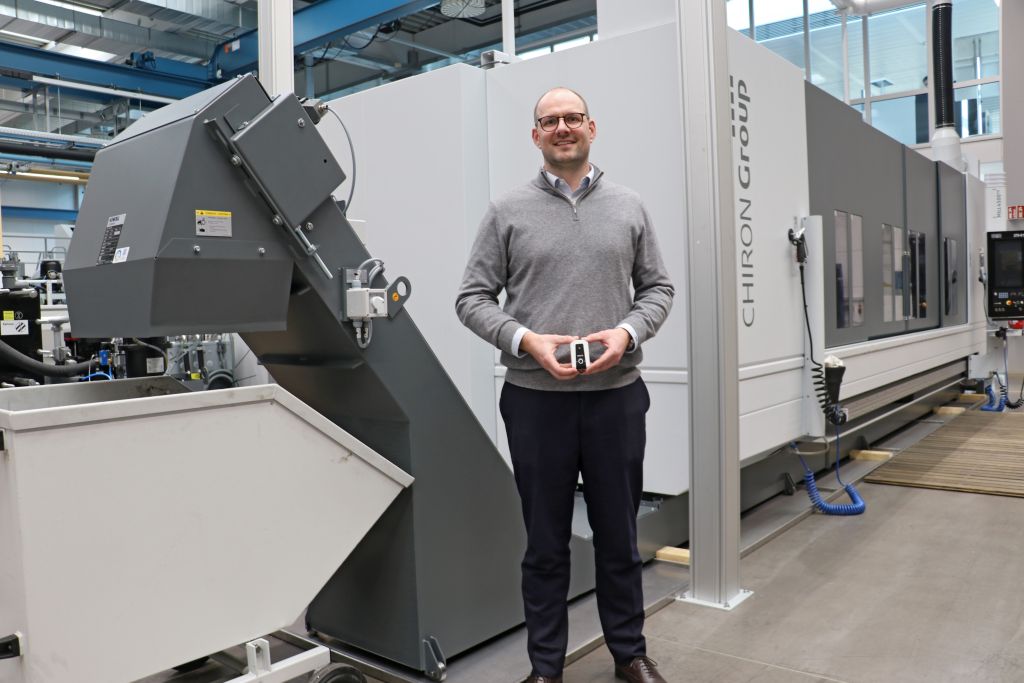
Riebsamen describes a second use case: 'We have a fully automated laser cutting system that performs sheet metal cutting without an operator. In case of a malfunction, a lamp turns red. The machine stops until the malfunction is resolved. However, no one sees this quickly due to the automatic operation. With a Click.it in the control cabinet, we now capture the malfunction notification. If it is still active after five minutes, a phone call is made to the responsible person, who then takes care of it. This reduces downtime, which positively affects productivity.
Customer interest piqued
After visitors to the KNOLL factory expressed their interest in the Click.it system multiple times – which unfortunately was not available for purchase anywhere – KNOLL decided to further develop the solution originally created for its own purposes into a marketable product. The first public presentation took place at the Open House 2023. At that time, over 100 Click.it Pro units were already in use internally at KNOLL. This system is equipped with five programmable buttons. Information and status messages are displayed in real-time on the screen.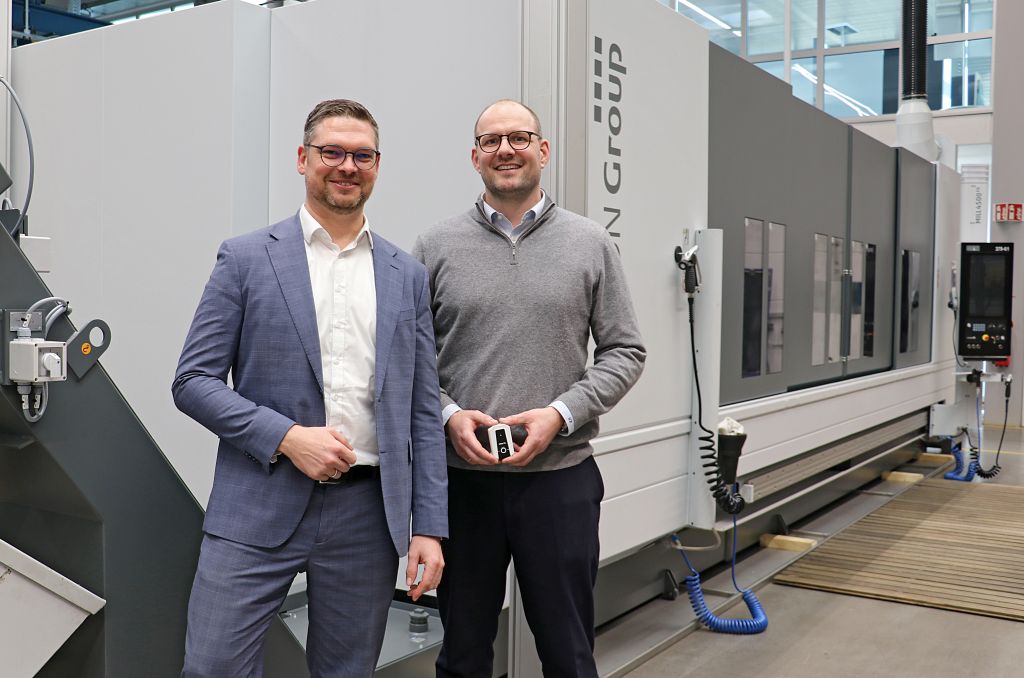
The 'Click.it Connect', which can be integrated into the control cabinet, was also showcased at the Open House. It can communicate with other systems via eight digital inputs and four digital outputs. Even the brand-new 'Click.it One' was presented. With just one programmable button and an additional input for sensors, it is perfect for simple tasks in limited spaces.
Available from stock since autumn 2024
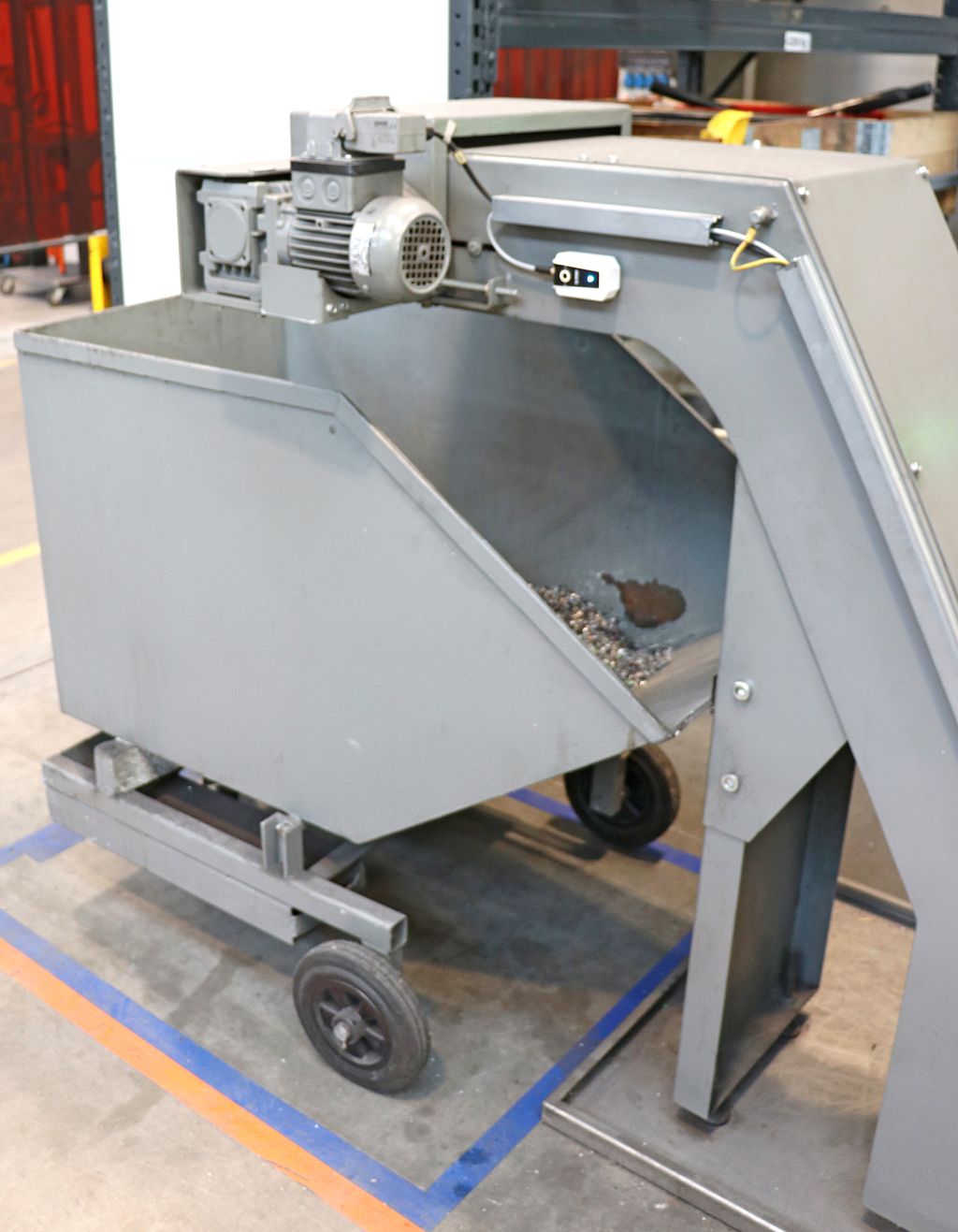
The interest in the Click.it solutions was so great that KNOLL has been offering the system for sale since the AMB trade fair in autumn 2024. 'In the first six months, we delivered over 150 devices,' says Christian Spohn, head of the automation department. 'We are already producing the devices in small series, so we can deliver from stock.' Markus Zinser, who is now part of the automation department, is expected to provide further momentum. His main task is to capture customer requirements and understand what else customers might need. This could lead to new solutions that he implements with his team. Markus Zinser sees Click.it on a good path – with both his external and internal customers. At KNOLL in Bad Saulgau, over 150 units have already been installed. 'The more intensively our employees get to know Click.it, the more ideas arise on how to use the system effectively,' emphasizes Christian Spohn, who offers Click.it with almost all automation inquiries. He mentions a few application examples: 'We can generate transport orders for our AGVs or monitor their parking spaces. We can initiate the emptying of chip carts, either by pressing a button or through a sensor signal. Rolling doors can also be opened and closed automatically with Click.it. The possibilities are virtually limitless.'
Now it really gets started
Thus, Click.it has expanded from the raw construction at KNOLL to other areas, including assembly and production. The responsible department head, Niclas Berner, sees enormous potential in the Click.it system: 'It's not just the simple buttons that make processes more efficient. For us here in production, I see the main strengths in data management. We want to integrate our entire heterogeneous machine park into the network with Click.it, from turning, milling, sawing, grinding machines to laser systems and bending presses, all the way to the powder coating system.'
According to Berner, this is possible because Click.it offers a simple way to extract any data from the controls across all machine manufacturers and make it available to other systems. 'Connections to the ERP system or our 3-liter PPS are no problem,' emphasizes the production manager. 'I want to receive statements from each machine via Click.it regarding the ratio of actual to target times, the percentage of scrap, and downtime. This provides me with key figures that are useful for planning capacities and eliminating bottlenecks.'
What seems relatively simple for machine tools is quite complex for the powder coating system. 'There is no software available for machine data acquisition,' says Niclas Berner. 'But with Click.it, we can design the queries entirely according to our wishes. This way, we receive reliable statements about important factors such as the utilization of the gearboxes after evaluating the data.'
Contact: