
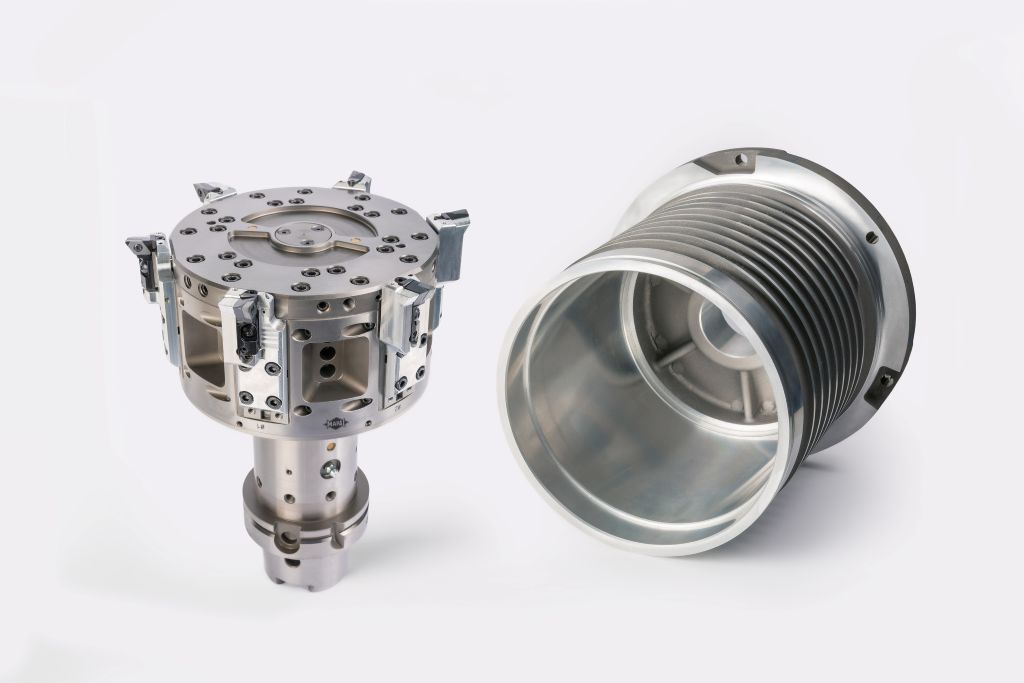
The new development represents a remarkable advancement in a highly specialized technology field: it increases the number of simultaneously controllable sliders, thus providing a significant boost in productivity. In the first customer application, the cycle time was reduced by 70 percent compared to the previous solution with four sliders.
Stator housings are among the focus components for MAPAL, for which the company provides a comprehensive portfolio of tool and process solutions. The starting point of the current development was the machining of a stator bore in a thin-walled aluminum housing for e-mobility. The specific application combines a challenging component geometry with high economic demands – and required a correspondingly powerful tool solution.
Control as a Flexible Tool Principle for Complex Contours
Control tools enable turning operations on machining centers with a U-axis, particularly for cubic components with complex internal contours, varying diameters, as well as undercuts or recesses. The machining takes place with the workpiece stationary and allows multiple machining steps to be combined in a single setup. In this case, it concerns the internal machining of the stator bore for an electric motor. The aluminum cast component is thin-walled and geometrically demanding: the bore contour features varying diameters, transition radii, undercuts, and recesses. At the same time, there are the highest requirements for coaxiality, roundness, and concentricity of all machining features.
Proven Solution with Four-Slider
Previously, MAPAL used a pull rod-controlled flat turning head with a four-slider and wide finishing cutting tools for machining. Four synchronously controlling sliders with a stroke of 20 mm each realized the complex machining in a cycle time of 120 seconds per stator housing. Given the increasing production numbers in the field of e-mobility, MAPAL was challenged to optimize the process.
New Concept Enables Six Sliders
Equipping the tool with more cutting edges is a straightforward solution to increase productivity. However, the innovation leap does not lie in the higher number of cutting edges, but in realizing this within the design limits of a control tool by redesigning the slider control. The existing concept did not provide space for additional cutting edges. While previous four-slider systems used a classic force transmission system via the pull rod, the new solution fundamentally reworked the internal structure of the tool.
By shifting the gearing outward into the slider itself, the moving components became significantly more compact and, above all, lighter, thereby reducing the forces acting on them. As a result, the number of simultaneously controllable sliders could be increased from four to six while maintaining the same tool interface and nearly identical external dimensions. A patent has been filed for this constructive solution, which has since been recognized.
Two Variants for Different Requirements
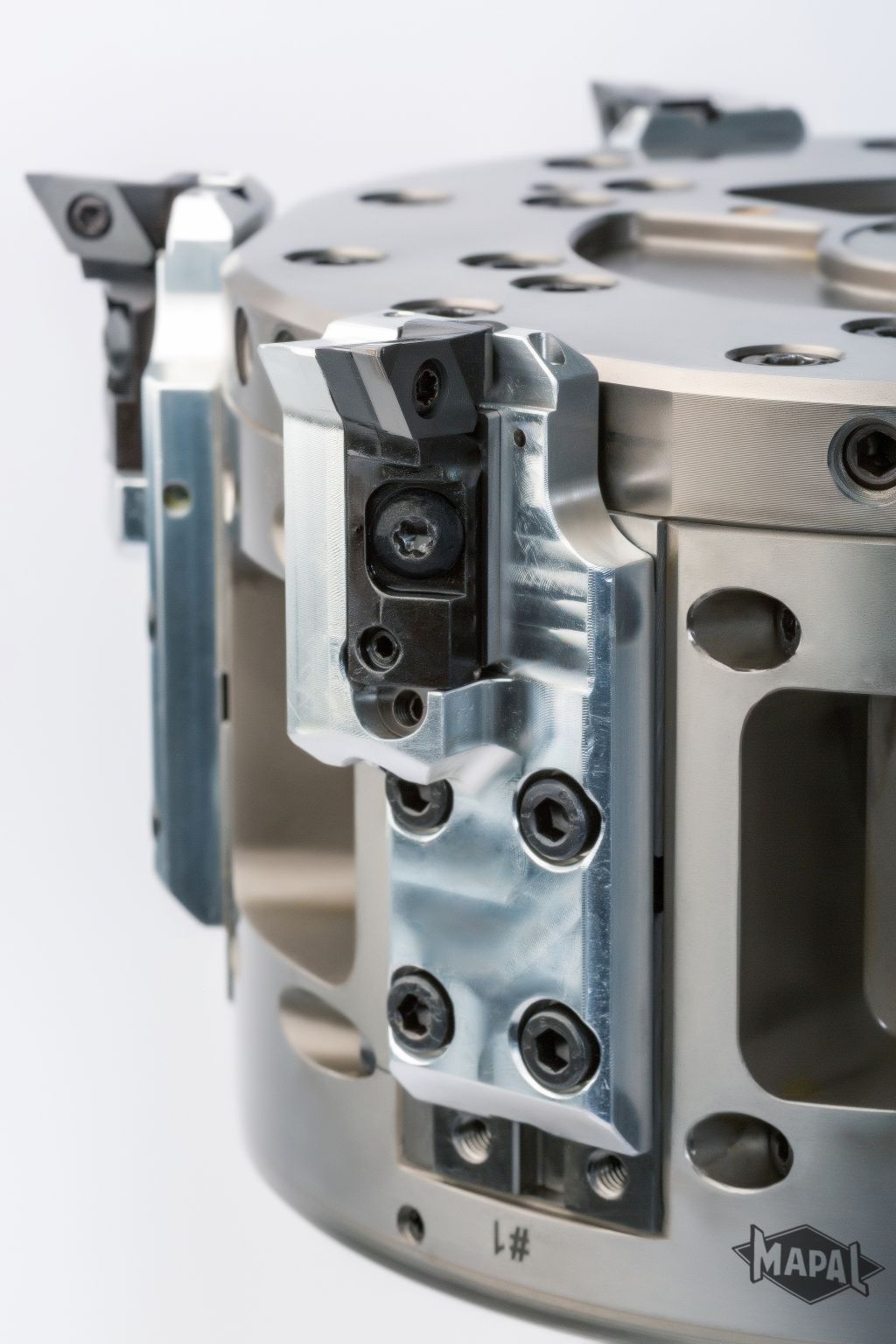
To meet different machining requirements, MAPAL has realized two variants based on the new concept. In the first version, six sliders work simultaneously outward, resulting in a fully functional six-cutting tool. The stroke is 10 millimeters, corresponding to a diameter range of 20 millimeters. In the second variant, the system is designed as a 3+3 concept: the pull rod actuates three sliders, while three counter sliders remain inactive. Due to the counter-movement, this results in a stroke of ±5 millimeters per slider, corresponding to a machining area of 10 millimeters in diameter. The arrangement of the cutting edges reduces the pulling forces and simultaneously allows for the combined use of different cutting geometries. Thus, for various contour areas, both wide finishing tools for high feeds and economical radius cutting tools for undercuts and transitions can be utilized.
Up to 70% Shorter Cycle Times in Practice
The customer benefit is immediately reflected in process performance. The previously used four-slider solution machined the contour in 120 seconds. With the 3+3 variant of the new six-slider, the cycle time could be reduced to 35 seconds. The fully functional six-slider version even achieved 33 seconds. Thus, the machining time is reduced by about 70 percent depending on the configuration, while maintaining high precision and process reliability. An additional advantage lies in the potentially reduced cutting material costs of the 3+3 variant, as standard cutting tools can be specifically deployed where no wide finishing geometry is required.
Crucial for this performance increase is the reduced mass of the moving parts. In control tools, the total weight is not decisive, but rather the mass of the moving sliders. The lighter they are, the lower the centrifugal forces and the higher the rotational speed can be, without exceeding the limited actuation force of the machine's pull rod. This is precisely where the new development comes into play. It enables higher rotational speeds and thus expands the process window. At the same time, the typical strength of control tools is retained: contours can be flexibly adjusted via the NC program in response to changes in the component, without having to change the tool's design. Furthermore, by exchanging the attachment tool, the basic tool can be used flexibly, quickly, and economically for component variants or new applications.
The first application of MAPAL's innovative six-slider in the machining of stator housings was extremely successful, and further tools are in development. The development also shows that MAPAL is consistently pursuing control machining as a strategically relevant technology field. For users, this means continuity in a demanding specialty segment – and a partner who has been supporting and advancing this flexible technology for many years.
Contact: