
When it comes to machining hardened steel, there is hardly a way around PcBN. This is even more true when it comes to the processing of demanding components such as homokinetic joints. As a long-standing close partner of manufacturers of drive joints, MAPAL possesses deep expertise in this area and will significantly increase efficiency in the production of these key components in 2026 with the targeted development of new cutting material types and optimizations of tool design.
High demands on the hard machining of CV joints
Depending on the type of vehicle, various designs of drive joints are used in automotive construction, both on the wheel side and the transmission side. The main components include the outer housing, also called the Outer Race, the ball hub (Inner Race), and the ball cage. The balls run in specially shaped tracks between the Inner and Outer Race and are guided by the cage in such a way that a constant rotational movement is allowed even at a bending angle, as in the case of a steering movement.
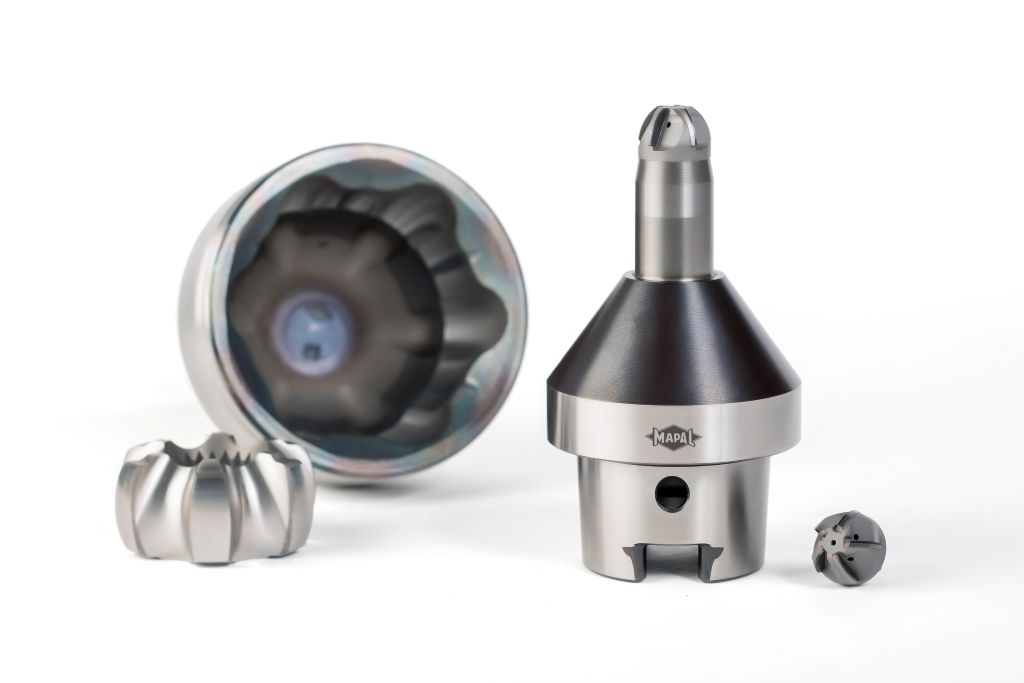
Both the Inner Race and the Outer Race must be hard milled. The requirements for shape and surface are very high at this point, which is why the geometric design of the cutter plays a crucial role. MAPAL precisely adjusts its ball track milling cutters to the tolerances required on the component. In addition to the geometry of the tool, the cutting material used and the cutting edge preparation are important for tool life, performance, and achieved surface quality.
Cutting material development specifically tailored to process requirements
With its experience, MAPAL is able to develop cutting materials specifically for the machining of certain components. The new uncoated PcBN cutting material FU240 is tailored to the requirements of hard milling the ball tracks on the Outer Race, while the cutting material FU290 is tailored to those of the Inner Race. Generally, different PcBN substrates are used to account for the different machining properties of the Inner and Outer Race and the associated wear mechanisms on the tool. Additionally, the industry uses different materials for the two components. Alloyed steels are used for the Outer Race, while case-hardened steels are mostly used for the Inner Race. While automotive manufacturers follow their own philosophy in shaping and especially in ball guidance, the materials are largely uniform.
Significantly higher tool life in milling
To successfully improve its PcBN cutting materials and thus secure the technological edge, MAPAL relies on a deep understanding of the entire process as a technology partner. For higher tool life when machining CV joints, it was necessary to find the optimal balance between high abrasion and diffusion resistance with sufficient toughness. Parameters for development included the CBN content of the cutting material, grain sizes, and the composition of the binder. The first results demonstrate a significantly increased tool life of the new cutting materials: Compared to those previously used, the new types FU240 and FU290 achieved an increase in tool life of over 30 percent at cutting speeds in the range of 180 m/min and a feed per tooth between 0.07 and 0.10 mm.
Five-flute cutter design reduces processing time and piece costs
At this point, the influence of a new five-flute tool design for the ball track milling cutters, which MAPAL will also introduce in 2026, has not yet been considered. Until now, four-flute designs have been the state of the art in practice. The additional cutting edge reduces processing time compared to the four-flute cutter by about 20 percent. The engagement time per cutting edge for each ball track is shortened, which additionally positively affects tool life in applications. With annual volumes of around 15 million components, both effects together create significant savings potential in terms of piece costs.
New cutting materials with significant advantages also in hard turning
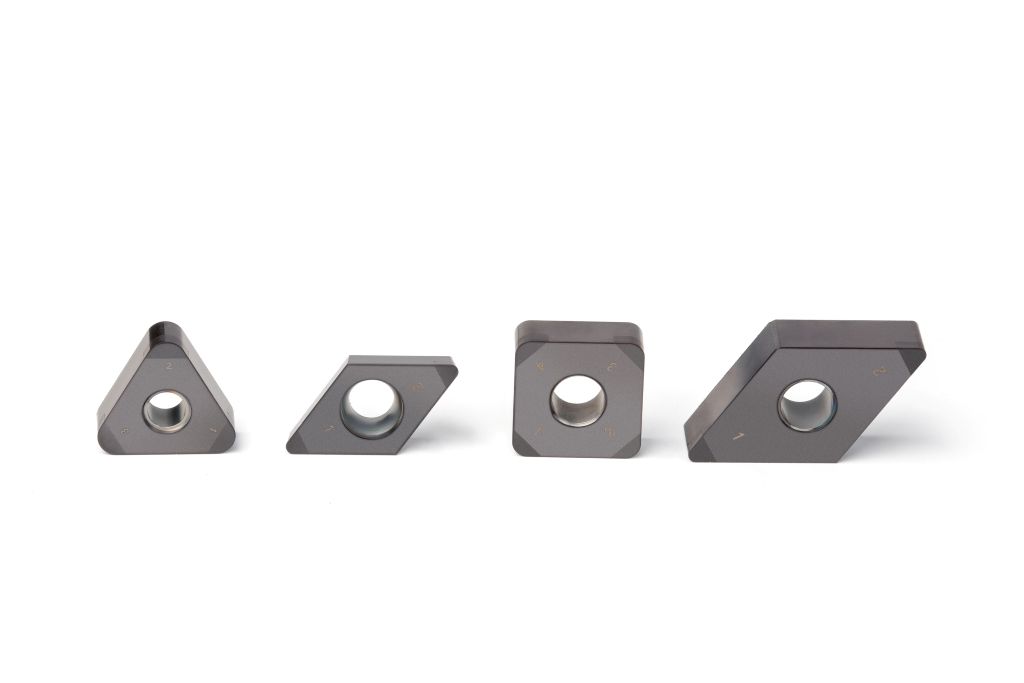
For hard turning, new PcBN cutting materials from MAPAL are also being introduced, with the initial focus on the machining of drive joints. The type FP240 is intended for continuous cut applications, such as on the shaft of the Outer Race. For interrupted cuts, as encountered with the Inner Race and the cage, the tougher type FP260 is used. Both are PVD-coated and achieve about 40 percent higher tool life in applications compared to conventional cutting materials.
The gradual introduction of the specific ball track milling cutters to customers and the PcBN turning inserts available from AMB 2026 underline MAPAL's commitment to consistently further develop the benchmark in the machining of hardened components.
Contact: