
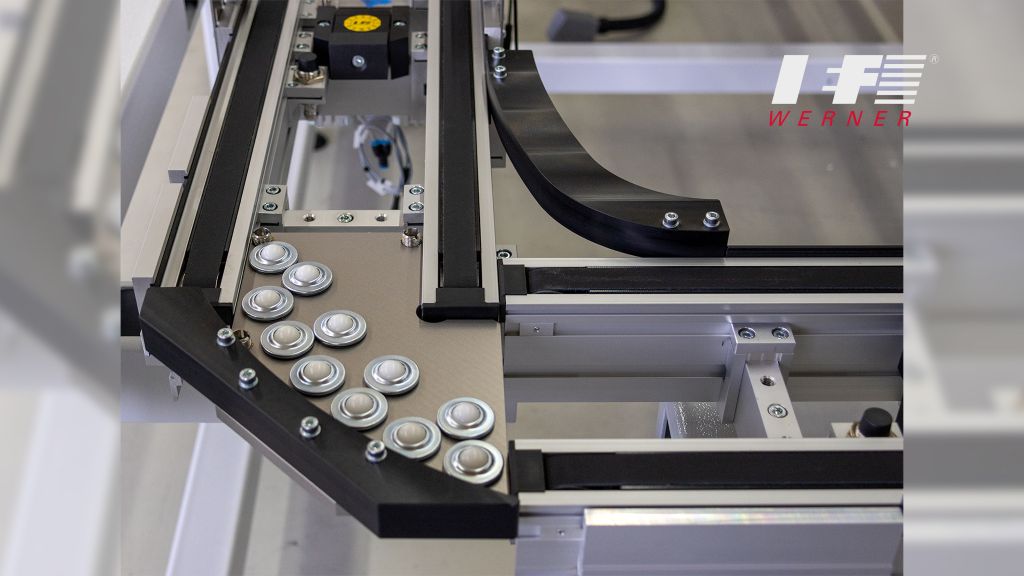
The new 90° curve element offers an economical solution by eliminating active drive and control components. This passive alternative was developed as part of a technician's thesis. It optimizes material flow and cost structure.
“We designed the new curve element as a passive solution. By omitting components such as motors, pneumatics, and controls, costs are reduced to about a quarter compared to the previous version – depending on the size of the workpiece carrier,” explains Oliver Koch, responsible for transport systems at IEF-Werner. The functionality remains the same, and since fewer parts are installed, this reduces maintenance effort.
Inner curve concept for smooth transport
The inner curve element enables precise material flow by guiding the workpiece carrier between the two bands over ball rollers. The solution works uniformly for all workpiece carrier sizes – 200, 240, and 400 millimeters – and still allows for a maximum load of up to 200 Newtons per workpiece carrier. No adjustments are required on the workpiece carrier itself, which means no additional costs or disadvantages for customers. Furthermore, the uniform construction using already existing standard parts and components supports pre-assembly, further reducing costs.
Advantages
• Cost reduction: The elimination of active components significantly reduces acquisition and operating costs
• Low maintenance: Fewer moving parts mean less maintenance effort
• Sustainability: Resource-saving material and energy use with the same operation compared to the previous active 90° curve
• Flexibility: Uniform design for all workpiece carrier sizes
Areas of application and perspectives
The new curve element is suitable for numerous industrial applications, including the automotive industry, electronics manufacturing, and medical technology. The continuous development of the posyART transport system demonstrates IEF-Werner GmbH's focus on sustainability, customer orientation, and efficiency in automation.
Contact: