
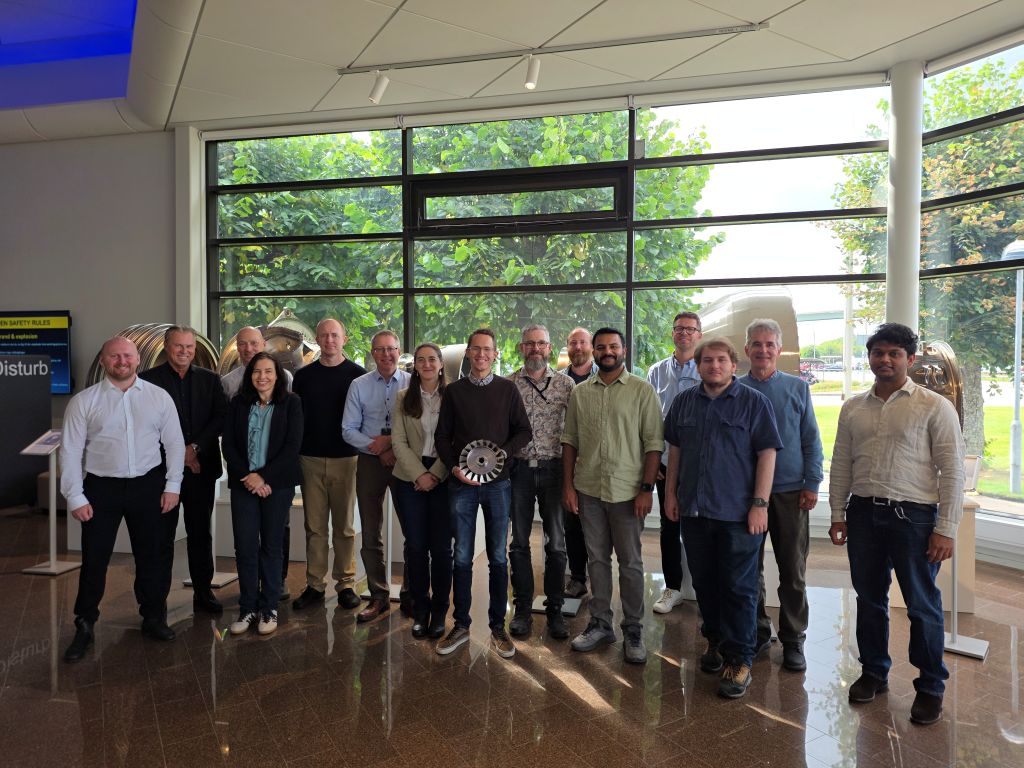
Sandvik Coromant has participated in a successful research project on STEP data exchange (Standard for the Exchange of Product Model Data). In collaboration with GKN Aerospace Engine Systems, Chalmers University of Technology in Gothenburg, and the Fraunhofer-Chalmers Research Centre for Industrial Mathematics (FCC), the working group developed a collaborative environment and applied it to the maintenance and repair process (MRO) for complex metal parts. The results show that ISO standards for digital manufacturing provide a foundation for interoperable, model-based data exchange and execution across the entire repair-related value chain.
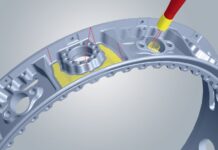
The repair of a damaged turbine blade is almost always an individual case. This is because no damage is the same as another, the tolerances are extremely tight, and the work requires expertise from various fields. To carry out repairs, images, PDFs, screenshots, and original CAD/CAM files had to be exchanged between companies and software systems. A very time-consuming process that increased the risk of errors.
As part of the Dig4ReMan project funded by Vinnova and the 'Advanced Digitalization' program, the project group applied the STEP application protocols AP242 and AP238 to develop a neutral, model-based language for 3D geometry, PMI, machining instructions, and tool data. Similar to a shared cloud document, all participants can view and update the same model without losing information.
The result is a fully connected digital process that spans the entire repair cycle: from inspecting a damaged part to material removal, planning additive manufacturing, simulation, CAM programming, and final machining and verification. According to GKN Aerospace, up to 95 percent of material, energy, and CO2 emissions can be saved in a refurbished component compared to a new replacement part. Additionally, costs are significantly lower.
Researchers from Chalmers University of Technology and the FCC contributed advanced models for predicting deformations, tolerances, and thermal behavior. Sandvik Coromant, in turn, brought its expertise in cutting tools and data standards, enabling CNC machines and CAM systems to exchange more extensive manufacturing information than is possible with G-code.
"This type of machining is extremely demanding," explains Johan Vallhagen, lead researcher and project manager at GKN Aerospace. "Every damaged blade presents a new challenge." Typically, one relies on manual adjustments and scattered communication across many systems. However, by using a standardized digital chain, we can drastically reduce complexity and ensure that all experts work with the same exact data."
The ISO-STEP standards were applied at every step of the workflow. AP238 enables the exchange of machining sequences, tool definitions, and ISO-13399 tool parameters between CAM systems as well as between CAM and machine. AP242 allows for a model-based definition that is uniformly used in inspection, planning, simulation, and verification.
"It was not just about repairing parts," emphasizes Mikael Hedlind, project coordinator at Sandvik Coromant. "It was about proving that design, machining, simulation, and testing data can flow seamlessly between companies. The STEP standards provided us with a common language. And once everyone speaks the same language, collaboration becomes faster, clearer, and smarter."
The Dig4ReMan project has shown that STEP-based data exchange can convey concrete manufacturing intent across different organizations, disciplines, and software systems. To further strengthen digital collaboration in manufacturing, Sandvik Coromant and its partners will continue to develop suitable new methods in the future.
Contact: