
Technical ceramics are highly interesting as a material for increasingly high-performance components. However, their hardness and low toughness make machining extremely challenging. MPK Special Tools has good news on this front. The specialists in precision engineering mill ceramics in the micrometer range with exceptionally sharp edges. They have everything for custom component manufacturing: innovative tools from the MARLIN 3D series by ZECHA, a variety of manufacturing processes, and decades of know-how for realizing even complex geometries with tight tolerances.
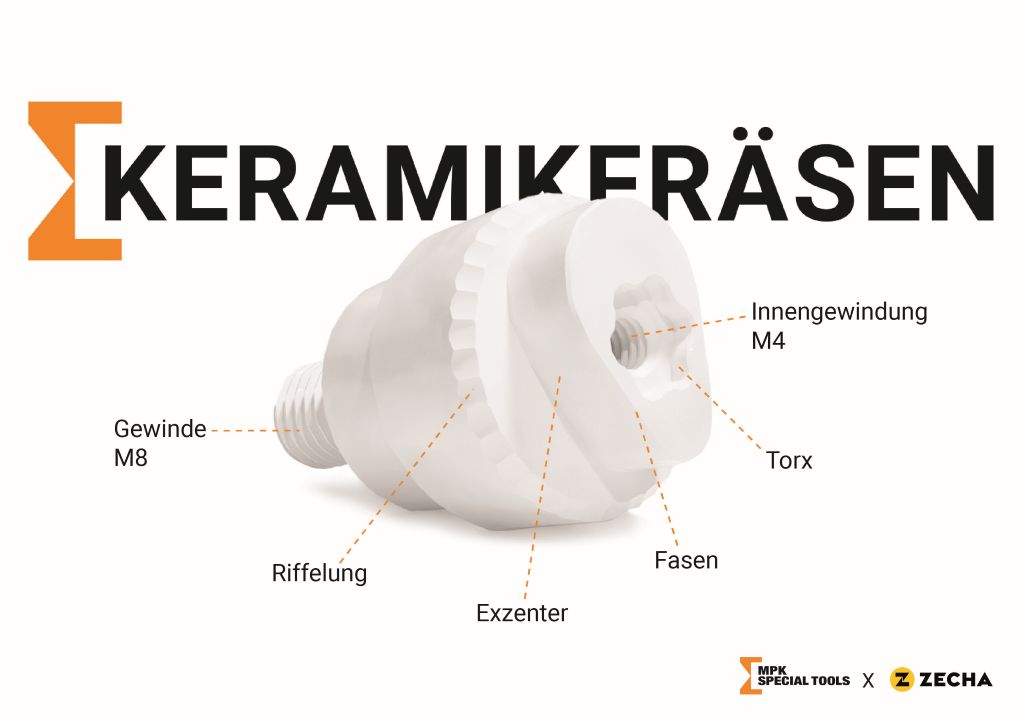
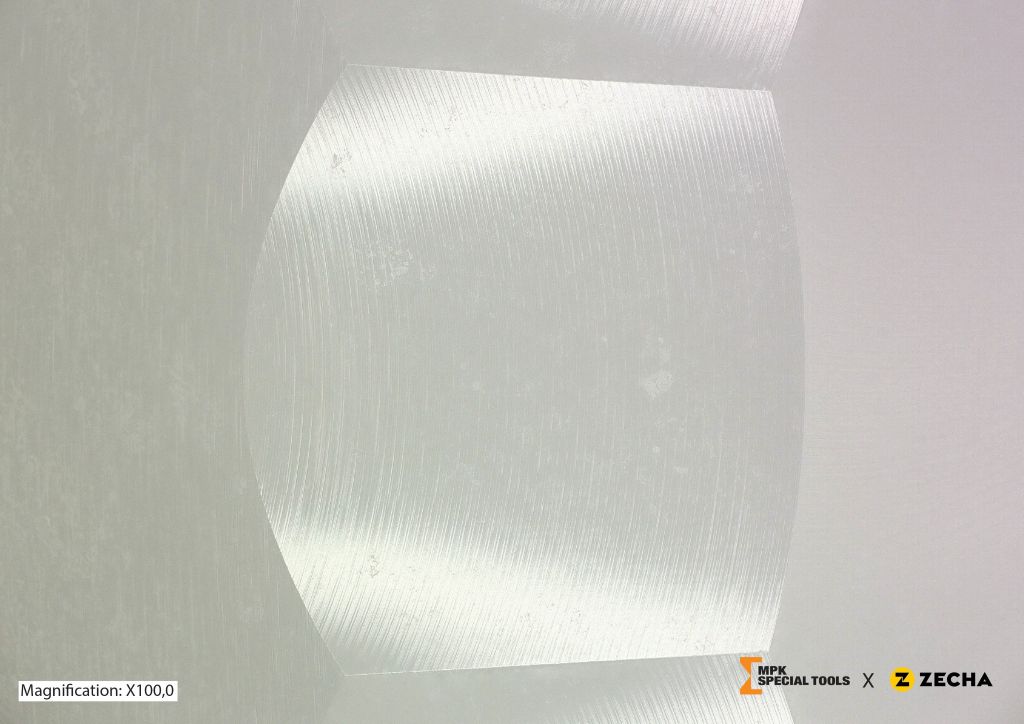
The results at MPK Special Tools, an expert in high-performance tools and components from Schwäbisch Gmünd, speak for themselves: Various manufacturing processes such as milling are applied to the ceramic prototype part made of partially stabilized zirconia.
Grinding or drilling with the highest precision and surface roughness in the nanometer range. Depending on the objectives, also with sharp workpiece edges and in significantly shorter process times than would be allowed by elaborate grinding.
"Micrometer tolerances in ceramic milling are achieved by only a few manufacturing companies. This elevates the milling of technical ceramics to a higher performance level compared to standard processes. For our customers, we can now also efficiently realize delicate, complex component geometries that would be partially impossible to produce through grinding, using milling," summarizes Christoph Steiner, Operations Manager at MPK in Schwäbisch Gmünd.
The current state of the art for machining high-performance ceramics primarily involves grinding and polishing. These proven methods allow for the precise production of high surface qualities without excessively stressing the material. The latter
is crucial, as such sintered ceramics are extremely hard and mechanically highly stress-resistant, but they are also brittle and have low fracture toughness. Machining techniques such as milling require a lot of expertise in this area.
and so far, such high accuracies in the micrometer range could only be achieved with difficulty. Grinding processes allow for more precision but consume a lot of manufacturing time.
Revolution in Ceramic Machining Thanks to New Tool Innovation
With the tools of the MARLIN 3D Laser series from ZECHA HartmetallWerkzeugfabrikation GmbH, milling of ceramics is fundamentally revolutionized – and this with a technology that sets new standards for precision and efficiency. The specialists for micro-tools from Königsbach-Stein use lasers to manufacture their innovative torus and ball end mills as well as spiral drills for ceramic and hard metal processing.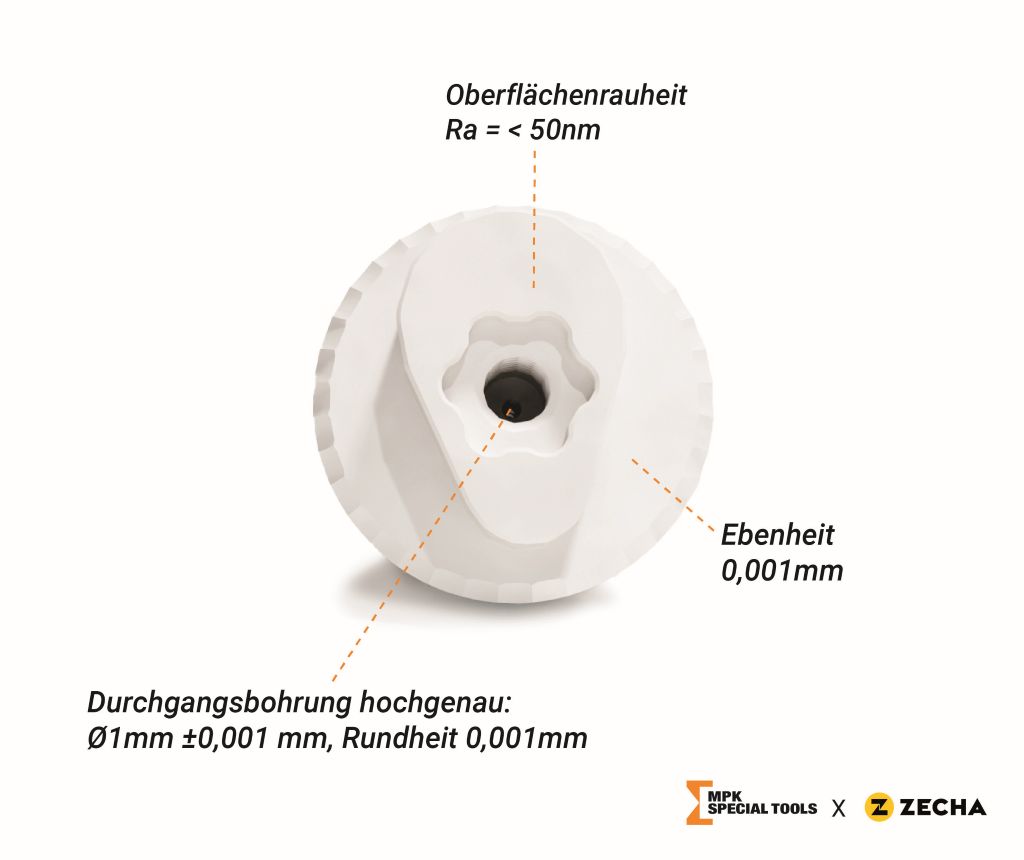
This technology allows for the precise incorporation of extremely delicate, complex, and previously unachievable geometries into highly hard PKD and CVD cutting materials. Additionally, especially with small tool diameters, it is possible to equip the tools with many more cutting edges than before. An example of this is a torus cutter with a diameter of 6 mm and 42 teeth. The high number of cutting edges and the geometry tailored to the material result in a better distribution of cutting forces and thus less heat generation.
This is important because excessively high machining temperatures can affect the material properties of certain ceramic materials. Internal and shaft cooling also minimizes friction and tool wear. Thanks to the new laser technology, ZECHA is able to manufacture special tools in any shape, such as groove cutters. Additionally, ZECHA's versatile offerings also provide the opportunity to efficiently process ceramic green bodies with diamond-coated tools.
This bundle of advantages excels in a crucial area of ceramic processing: achieving the highest surface quality, dimensional accuracy, and process reliability that the market increasingly demands. Ceramic components are becoming increasingly interesting for more and more.
High-performance applications, because technical ceramics can be manufactured from a variety of materials with diverse, sometimes unique properties and can be specifically tailored to their intended use. The requirements in medical technology are extremely high, as biocompatible ceramic implants need a perfect fit to minimize health risks. In electronics, precision at the micro level is demanded, as even minimal deviations in ceramic insulators can lead to malfunctions. And in aerospace, where ceramic components are used in engines or heat protection systems, dimensional accuracy and surface quality determine safety and efficiency.
Impressive manufacturing precision on the sample part
MPK Special Tools ensures the required extreme accuracy, surface quality, process reliability, and one hundred percent reproducible quality in the best possible way: The CNC application of the MARLIN 3D tools in the iQ300 from Makino offers repeatable 3-axis machining precision down to the micrometer range, combined with advanced testing and measuring technology. MPK's hallmark is a great versatility of manufacturing processes perfected over decades, ranging from milling technologies to flat, internal, and external grinding in terms of ceramics. This allows for the adaptation of machining strategies to the specific and very different ceramic materials.
"To make the comprehensive MPK expertise tangible for customers, we manufactured a sample part that reflects both the current requirements of the ceramics industry and the manufacturing diversity and competence in Schwäbisch Gmünd," describes Jannik Kimmel, Head of CNC Milling. The sample part received a highly precise internal bore (Ø1±0.001mm). When using a PKD torus milling cutter with 42 cutting edges, tolerances of 0.002 mm were achieved during eccentric machining as well as on flat and bottom surfaces, with surface roughness in the nanometer range (Ra < 50 nm), flatness within 0.001 mm, and radius tolerances of 0.005 mm. Torx geometries, knurling, chamfers, and standard threads could be produced with various tools almost without chipping. The size of the chips is in the grain size range of a maximum of 5 µm. The MPK expertise in ceramic grinding was particularly evident on the back of the sample part.
Service Ceramic Milling: Consulting and fast production starting from batch size 1
"Our many years of experience in the carbide sector also helps us in some aspects of high-performance machining of ceramics. We find tailored solutions for individual requirements starting from batch size 1," says Jannik Kimmel. Clients, especially those with higher quantities, particularly benefit from the more efficient and faster production that ceramic milling enables compared to grinding. This can make a significant contribution when it comes to time-to-market. Customers also save on the acquisition of specialized, knowledge-intensive, and costly tools, machines, and techniques for ceramic processing. "And as committed precision engineers, we also promise our ceramic clientele: With us, the µ takes the lead," summarizes Christoph Steiner.
Contact: