

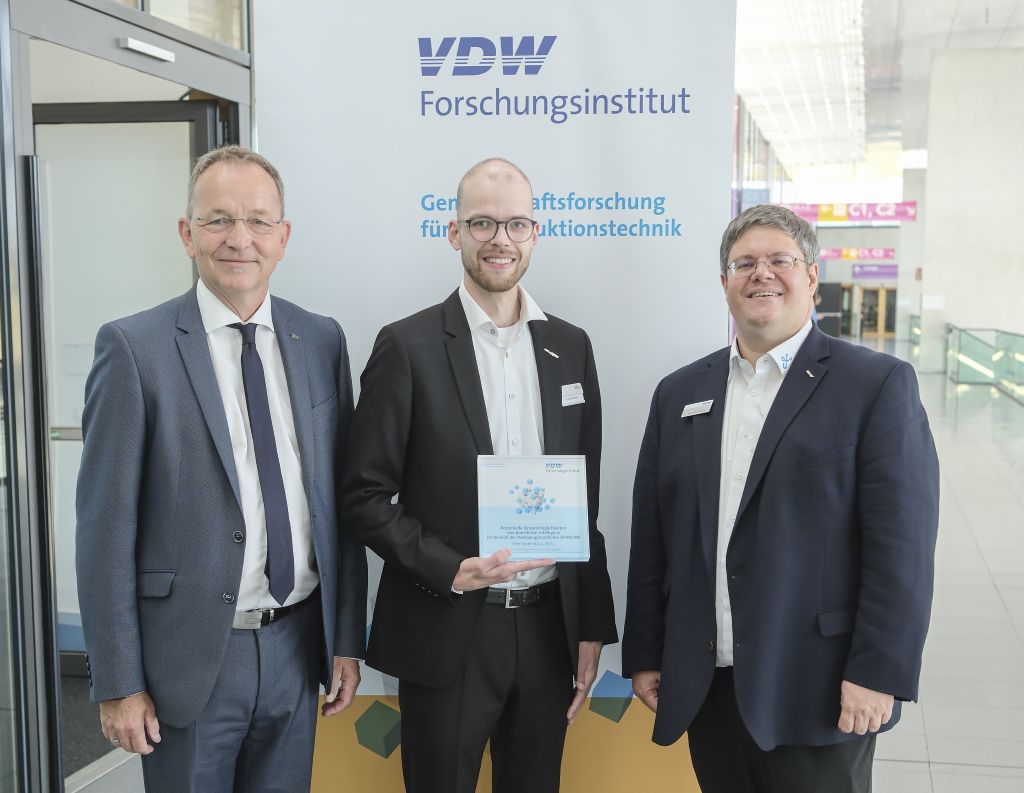
Artificial Intelligence is on everyone's lips, but where exactly are the potentials for machine tool manufacturers? Eike Rodenbäck from the German Research Center for Artificial Intelligence GmbH (DFKI) investigated this in the project 'Artificial Intelligence for Machine Tools' (KI4WZM) – and was awarded the Research Project of the Year by the VDW Research Institute e.V. on September 17, 2026, at the Stuttgart AMB fair. 'Eike Rodenbäck is advancing the machine tool industry significantly on the path of digital transformation,' says Dr. Alexander Broos, Managing Director of the VDW Research Institute. 'His results particularly help our medium-sized members answer the question of where and how they can purposefully use AI – in application cases that create value and with AI models suitable for these tasks. Since he has elaborated this in an excellent manner, Eike Rodenbäck was chosen as the award winner.'
Initial hints about where challenges might lie have been provided by the VDW members themselves. Building on this, Rodenbäck identified application areas where AI could economically support companies in the industry. The actual implementation in concrete pre-competitive projects will take place at a later date.
Automated Knowledge Management and Fault Diagnosis
This includes the field of knowledge management. Especially in times when many employees will be leaving the workforce in the foreseeable future, automated documentation of process knowledge is important to minimize the loss of know-how. 'Companies from various industries still collect data simply in Excel spreadsheets that are maintained manually,' Eike Rodenbäck points out. 'They are copied and shuffled around. This naturally opens the door to errors and data loss.'
One project idea developed within KI4WZM is the automated documentation of software code. Here, AI-supported analysis of existing code bases and comparison with existing documentation could help secure existing knowledge, even when experienced employees leave the company.
Artificial Intelligence can also assist in fault diagnosis. Rodenbäck focused his work on cases where the problem has already occurred. 'Often a fault is reported, but the cause is not immediately found,' explains the 28-year-old computer engineer. In a multimodal diagnostic support system, control alarms are linked with log files, runtime data, and machine documentation to identify causes more quickly and also provide immediate recommendations for action. 'This could reduce downtime and decrease service efforts.'
Process Optimization Without Cloud
Last but not least, processes can be automated and optimized – another area where machine tool manufacturers can increase the efficiency of their production with the help of AI. To obtain data-driven suggestions for parameters such as speed, feed, or delivery while considering material, tools, process data, and quality goals, large, energy-intensive AI models are not always necessary. Simpler or locally executable models that can be used without connecting to external cloud servers not only save money but also energy.
'AI offers great potential in the machine tool industry – but not every challenge requires a highly complex model,' summarizes Rodenbäck. 'It is crucial to start where companies have a specific need and suitable data is available. This connection between technological possibilities and practical requirements was particularly important for us at KI4WZM.'
Focus on Knowledge Transfer
Rodenbäck summarized the project results in a detailed report. Additionally, a workshop was held where the previous results were made accessible to a broader circle within the VDW (Association of German Machine Tool Manufacturers) organized machine tool manufacturers. In addition to the goal of maximizing knowledge transfer, the 60 participants also collected further project ideas, developed them, and prioritized them.
The digital transformation of the industry is a work in progress, explains Broos. And Rodenbäck adds: 'Ultimately, we aimed to raise awareness among companies about the importance of data quality, reliability, traceability, and local data processing. Because this is often where deficiencies exist that slow down further activities.'
Authors: Gerda Kneifel, Dr. Alexander Broos
Contact: