
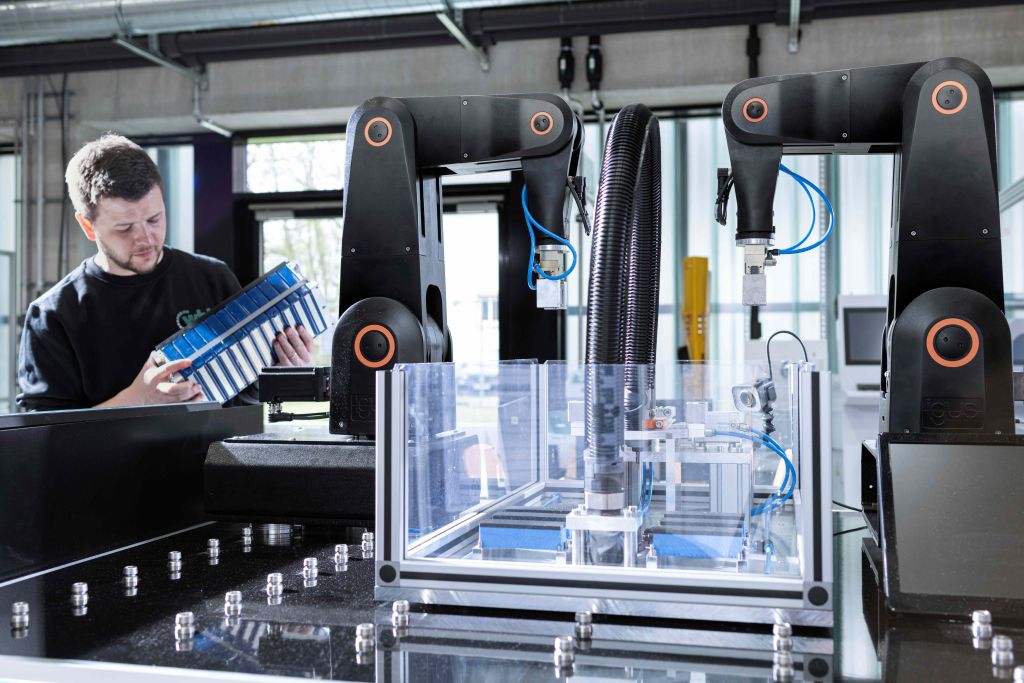
Not only do the Chinese martial arts choreographies with humanoid robots give the impression that Germany and Europe have long since lost the competition in this area. However, around 70 leading German production scientists see it quite differently. Within the WGP (Scientific Society for Production Technology), they have published a position paper that outlines completely new paths for the development of humanoid robots. They have the manufacturing industry in mind, which is currently known to be in turbulent waters. Their new concept of 'Humanoid Production Robots (HPR)' could be a chance to catapult Germany and Europe back into a leading position.
The WGP defines HPR as intelligent robots that assist factory workers in production – a must given the shortage of skilled workers and increasing productivity pressure. They are characterized primarily by rigidity, accuracy, load capacity, and, thanks to appropriate sensors, comprehensive perception and domain-specific AI.
Thinking humanoids detached from embodiment
The researchers do not view the humanoid manifestation as an end in itself, but define it through the human-centered production infrastructure. 'Essential humanoid characteristics are environmental recognition and derived actions. The shape arises from the respective task in production,' explains Prof. Jürgen Fleischer, President of the WGP and head of the wbk Institute for Production Technology at the Karlsruhe Institute of Technology (KIT). And there, alongside accuracy down to the sub-millimeter range, load capacity also plays a significant role. Transporting heavy components or tools is significantly more difficult with two arms on a narrow torso than with maximally load-bearing arms on a stable floor conveyor.
The researchers describe different kinematics for defined areas of tasks in their position paper. To make the various models economically and quickly available, they propose a modular structure of the systems so that they can be quickly retrofitted for new tasks when needed.
Reversing the approach in the development of humanoids
In addition to these newly developed HPR, existing industrial robots should also be upgraded. 'Industrial value creation in this country predominantly takes place in existing factories. The challenge is therefore to empower these robotic solutions to integrate flexibly and economically into brownfield structures,' emphasizes Fleischer. 'We also need to equip our highly developed robots with new kinematics, sensors, and AI models so that they can perceive their environment and respond appropriately to their respective tasks.' The WGP thus distinguishes itself from the common approach of first developing a humanoid robot and only then looking for areas of application.
Since they cooperate with humans in the factory, the scientists pay special attention to safety. Economic efficiency is also considered from the perspective that a change of task should be associated with significantly lower effort than the implementation of a corresponding automation solution.
It must become concrete quickly
'We have outstanding mechatronic competencies in Germany,' says the WGP President. 'If we combine this knowledge with the possibilities of AI, we can create a unique selling proposition for humanoid production robots in the global market.' However, this is only possible if collaborative projects and extensive partnerships are established: across companies and throughout Europe. Because with all mechatronic competencies, dependencies come into play, especially regarding artificial intelligence or computing hardware.
Nevertheless, a 'coordinated research, standardization, and pilot agenda' must be quickly decided upon and made visible with initial industrial applications. This is particularly challenging in these crisis-ridden times, where there is a lack of venture capital for scaling. But the 70 professors are confident that this is a desperately needed investment in the future of the industrial location Germany, to stop the trend of deindustrialization and secure prosperity for the future. 'If we make substantial progress with the HPR in the next two to three years,' concludes Fleischer, 'then this is Germany's chance to take the world lead in this area.'
Contact: