
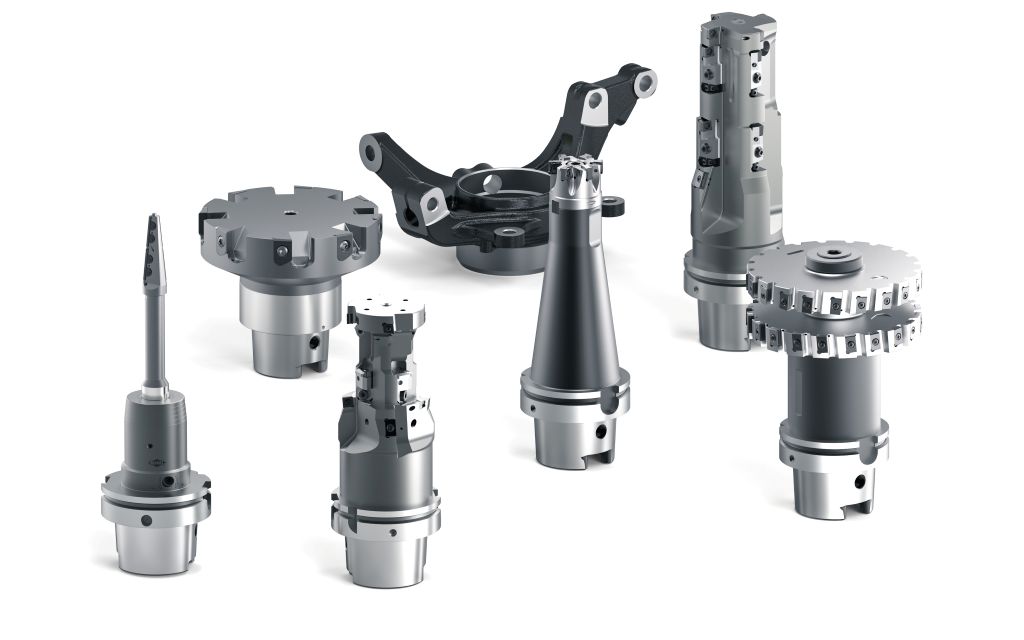
Wheel carriers and swivel bearings determine the driving comfort and safety of a car. In recent years, the complexity of these chassis components has significantly increased, evolving from a passive structural component to a highly integrated and precise functional module. The variety of variants is very large, and MAPAL, as a technology partner for machining, offers efficient processing solutions for every requirement.
Wheel carriers and swivel bearings perform central functions in wheel guidance, power transmission, and steering kinematics, depending on the axle and vehicle concept. The components must be able to carry large wheel loads and, as safety-relevant components, are subject to the highest mechanical and kinematic requirements. Depending on the automobile manufacturer, steering system, vehicle class, and installation space, a variety of different component variants are used.
There is also variance in the materials used. Cast iron is used as a cost-effective material primarily in the lower vehicle segment, where the components are needed in sometimes high quantities. MAPAL's manufacturing solutions take into account the high abrasiveness of this material.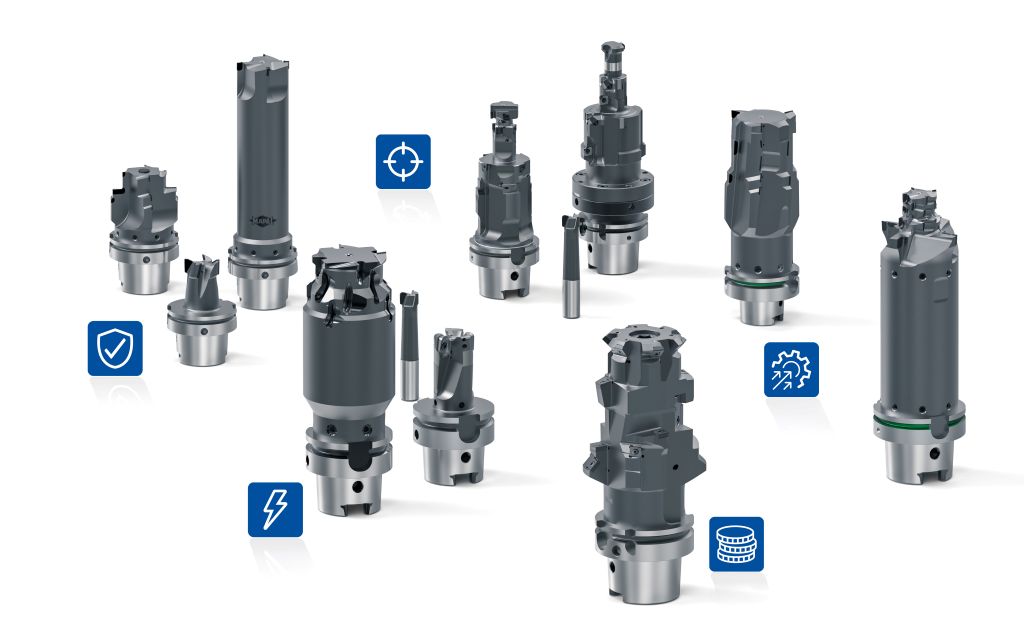
In light of increased efficiency requirements and the ongoing lightweight trend – further intensified by electromobility – these components are increasingly made of aluminum. This involves a shift from aluminum die casting to forged aluminum, which withstands higher loads and allows for a longer lifecycle. For machining, this presents a challenge: the forged material has a lower silicon content, making chip breaking more difficult and potentially leading to edge sticking.
Swivel bearings become functional modules
The components have become more complex over the years. Whereas a control arm was previously simply bolted to the component, today an additional bearing is provided. To press this bearing in cleanly, tight tolerances must be maintained, and good surface quality must be achieved. Functional integration is progressing further. The brake caliper also finds mounting points like the wheel hub, control arm, and ABS. As a functional module, the swivel bearing contributes to efficiency, driving dynamics, and the integration of additional sensors – for example, for autonomous driving.
With this functional integration, the requirements for machining solutions also increase. The specified precision requirements and tight tolerance fields benefit driving comfort, noise development, and the lifespan of bearings. To achieve the highest possible accuracy and avoid clamping errors, the machining of swivel bearings or wheel carriers increasingly takes place in a single clamping setup and on multi-spindle machines. Depending on the component variant, the industry achieves batch sizes of 500,000 pieces per year and more.
For the critical machining processes, MAPAL offers several solutions tailored to different customer conditions. The following solutions are exemplarily explained for aluminum swivel bearings. This way, the tool manufacturer accounts for both the variety of variants among automobile manufacturers and the different characteristics of the raw parts and clamping situation.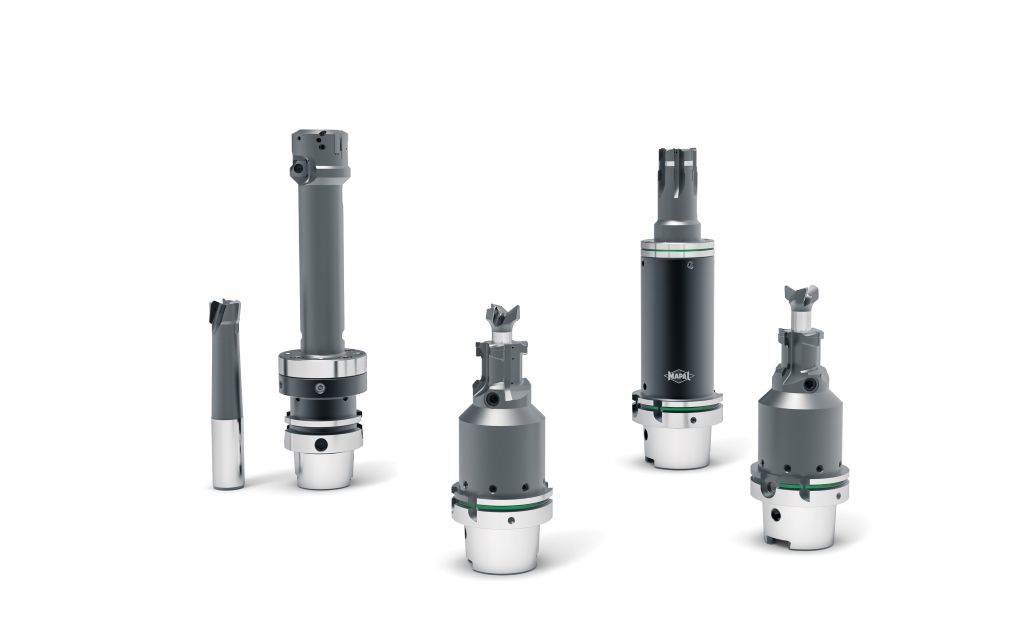
The main bearing hole in focus
For machining the main bearing hole, MAPAL has defined different tool concepts. As a technology partner, they are familiar with the respective requirements of customers, select the appropriate machining strategy, and adapt it to the individual conditions on-site.
Depending on the casting process and contour, the hole can be completely pre-cast, contour-near pre-cast with a radial allowance of 4 mm, or ideally pre-punched. In the first step, a high material removal is often necessary. The preliminary machining is carried out by MAPAL specialists with PKD circular milling tools to reduce the allowance and pre-machine the hole contour-near. Depending on the hole contour, different process executions are realized with milling tools, drilling-milling tools, or drilling tools with hook cutting edges for backward drilling. The tolerance requirements for the main bearing hole go up to IT6.
If machining is done in two clamping setups and a critical or unstable clamping situation exists, the three-stage machining concept for aluminum swivel bearings initially provides for preliminary machining with a PKD milling tool from both sides. Subsequently, the diameters are finished with two PKD reaming tools.
If the hole can be circular milled, MAPAL offers a machining solution that allows for higher cutting values. Here, the OptiMill-Diamond-SPM cutter with soldered PKD cutting edges demonstrates its capabilities. Thanks to its highly positive cutting edge geometry and optimized chip spaces, it reduces cutting forces by up to 15 percent compared to conventional PKD cutters. The optimally embedded PKD cutting edges ensure high stability during machining. An alternative with indexable cutting inserts is represented here by the NeoMill-Alu-QBig. This aluminum high-volume cutter is designed for use at high speeds. MAPAL has equipped the basic body with a fine balancing system. Finally, a complex PKD milling tool finishes the complete contour of the main hole.
If tight tolerances must be maintained, MAPAL selects a multi-stage reaming tool with indexable cutting inserts for semi-finishing after preliminary machining with the OptiMill-Diamond-SPM; for finishing, a fine boring tool with an EasyAdjust system is used in this case. In this system, the reduction of the cutting edge is already integrated into the cassette, which serves as a holder for the cutting edge. This eliminates the adjustment process for the reduction of the secondary cutting edge. The diameter is adjusted in a classic fine-sensitive manner, ensuring highly precise machining results.
The MAPAL solution portfolio for machining the main bearing hole is complemented by one-shot solutions for machining pre-punched aluminum swivel bearings. The drilling-milling or milling combination tools with PKD cutting edges are highly efficient, for example, in machining situations with very stable clamping that allow for finishing the contour. Customers who do not have adjustment options and prefer an alternative to soldered PKD tools are recommended by MAPAL a tool with replaceable indexable cutting inserts. The tangential cutter is a complex tool concept that combines as many machining steps as possible in one tool.
To keep the wheel in line
In addition to the main bearing hole, the control arm connection is another feature of the swivel bearing that MAPAL focuses on for machining. The control arm connection is the central interface between the swivel bearing and the chassis. High tolerance requirements of IT6, tight form and positional tolerances, as well as surface qualities are necessary to ensure that the mounting components keep the wheel precisely in line. Here too, MAPAL designs the tools according to the respective requirements. The process usually involves two tools; under certain conditions, a one-shot solution is also possible.
The preliminary machining is done on the full material, where the tabs of the control arm connection are usually not supported in the clamping device. Therefore, it is important to generate only low cutting pressure during preliminary machining. MAPAL also utilizes the advantages of the OptiMill-Diamond-SPM here, which mills the holes in helical paths without displacing the component. Since high values for feed and helical feed are used, there is a significant heat development in practice, as cooling often occurs through MMS, which can lead to built-up edges. However, deformations of the hole caused by this can only be recognized after cooling of the finished component. With a strong understanding of the process and a holistic view of the control arm connection, MAPAL works with its customers to develop the optimal process that maximizes productivity potential while excluding such negative effects.
During finishing, the clamping device may require the use of tools with high overhangs of up to 300 mm. With such long tools, approaching the spindle can sometimes cause a tilting moment on the tool, resulting in the set tool diameter not reaching the component. To enable high tolerance requirements in production even under these conditions, MAPAL's EasyAdjust system is again the first choice. With simple handling, the tool cassettes allow for micro-precise adjustment of the tool diameter with just one screw. This makes diameter corrections possible with minimal effort to maintain quality requirements in the process. For machining where slightly less precision is required, a bonded PKD reaming tool is available for finishing.
Precision at the connection to the wheel hub
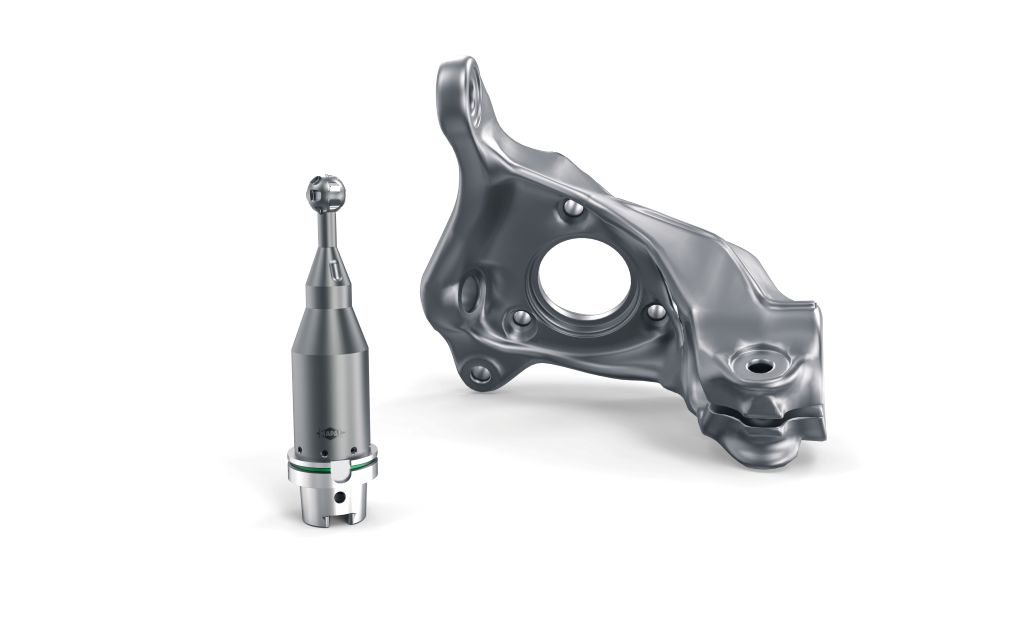
Another function-critical machining process involves the screw hole drilling, through which the swivel bearings and wheel hub are connected with high strength, requiring high contour accuracy. During this machining process, the component must be swiveled into a specific position to allow entry. Due to the angular position, there can be high deflection forces during machining, which can cause the PKD ball cutter used to swing. Loud machining noises, poor surface quality and form accuracy, as well as short tool life would be the result.
MAPAL ensures that this difficult machining situation is reliably controlled through optimal tool design. An exactly defined arrangement of the cutting edges and cutting edge position, as well as appropriate cutting edge preparation, consciously prevent the tool from swinging and simultaneously ensure high performance.
Turnkey competence for demanding components
The machining of swivel bearings requires profound process and application know-how as well as precise design according to the respective customer requirements. Against this background, turnkey projects are gaining increasing importance. MAPAL has specifically developed this area into a strategic focus and bundles process design, design and delivery of clamping devices and tools, programming, and commissioning in an integrated approach. In this way, the technology partner supports its customers in implementing even demanding machining processes reliably and efficiently.
Contact: