

Data transmission rates in high-speed networks are influenced by numerous factors – one of the most important is the quality of the connectors used. In particular, in fiber optic networks, insert housings play a central role in speed and signal quality. The more precisely these components are manufactured, the less loss and more stable electromagnetic light waves are transmitted. Kern Microtechnik implements the highest precision standards in contract manufacturing – with tolerances of up to 2 µm and production quantities of several thousand units.
Connectors are often the 'bottleneck' for transmission processes. This applies to high-pressure applications of liquids as well as to data transmitted in the form of electromagnetic light waves over fiber optic cables. Even minimal inaccuracies in position, angle, or parallelism hinder the transmission rate. To prevent this, the insert housings of the connectors used, primarily made of stainless steel, brass, or Arcap, must be manufactured with uncompromising precision.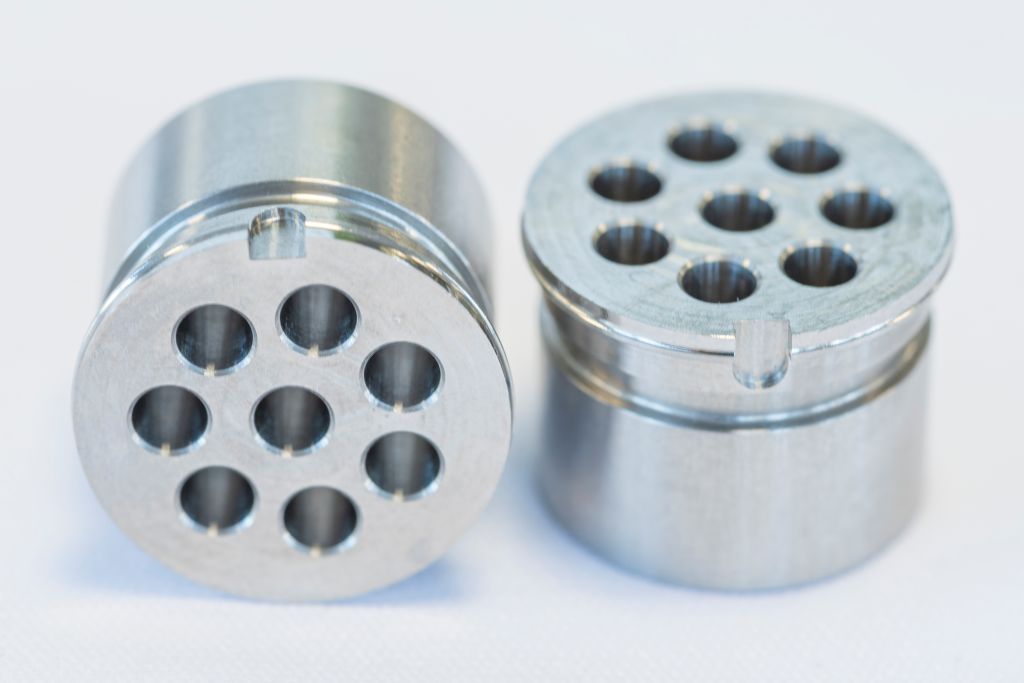
Kern Microtechnik GmbH's contract manufacturing in Murnau has developed high competence in this regard over many years in collaboration with demanding customers. Many companies from data processing, analytics, measurement technology, as well as the chemical and pharmaceutical industries appreciate this. Alexander Stauder, plant manager of Kern's contract manufacturing, explains: 'The challenge for us is primarily to optimally meet the demands of each individual customer. To ensure this, we are usually already involved during the development phase of the first prototypes.'
Precision machining saves inspection effort
In this way, according to Stauder, expectations and reality can be guided in the right direction from the beginning. This means: Depending on the needs, quality and cost specifications are weighed together to achieve an optimal result in the end. As a high-end quality example, the experienced engineer cites insert housings for fiber optic connectors from various customers, which are located in many different segments – from advanced entertainment technology to the defense sector.
Due to strict NDA and confidentiality agreements, which are always a top priority for Kern, no specific information can be provided about customers and the use of products.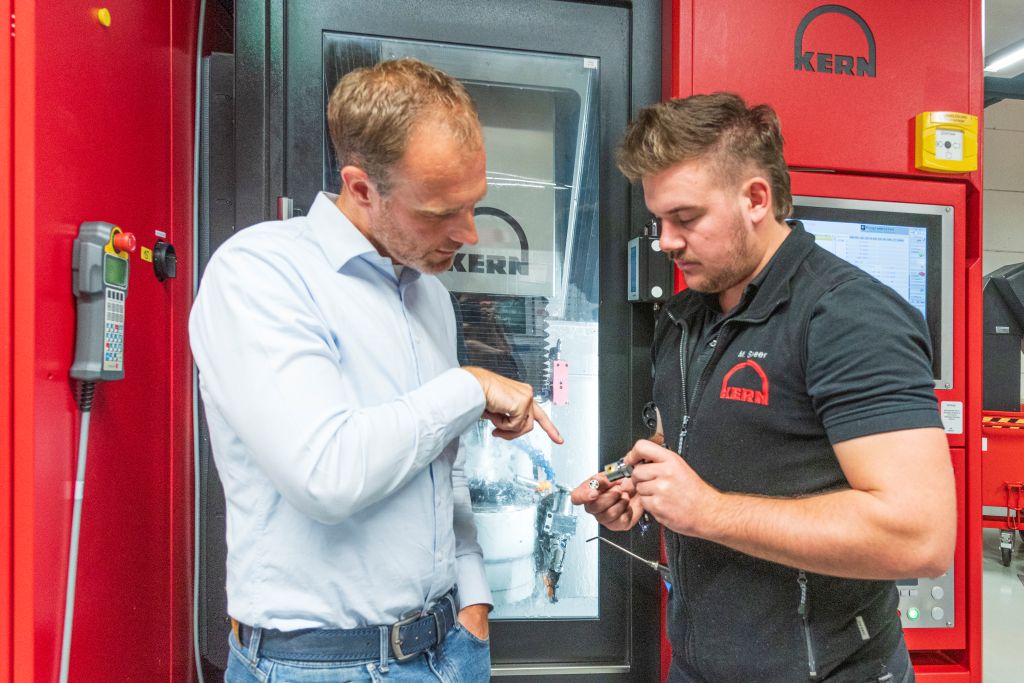
All that can be said is that the connectors must be designed to be very robust so that they can reliably transmit maximum data volumes even under difficult conditions – such as unpredictable natural influences. This means that if the opposing holes of the connector are even slightly misaligned by a few µm, it has enormous negative effects. 'To prevent this, most high-end manufacturers often check the alignment of the holes during connector assembly through a hundred percent visual inspection,' explains Alexander Stauder.
'However, after intensive development work and thanks to the high-end machining center Kern Micro HD used for production, this costly additional effort for our customers is a thing of the past.'
Fully automated series production – µm-precise
The Murnau contract manufacturing reliably produces the insert housings of the fiber optic connector with an accuracy of ≤ 2 µm in position and alignment, not only as a single part or small series but fully automated in batch sizes of tens of thousands of pieces per year. 'This number is by no means a limit for us,' emphasizes plant manager Stauder.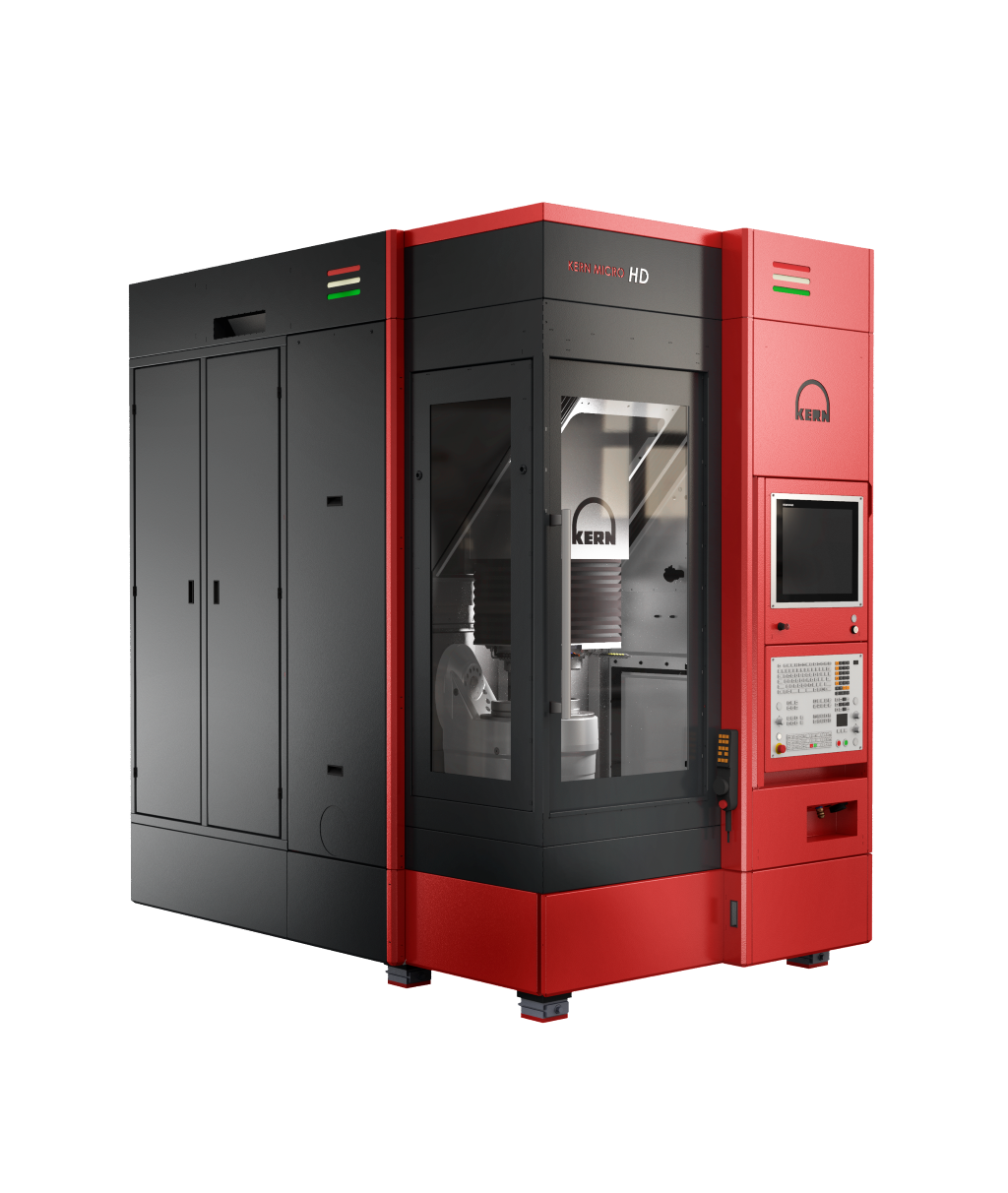
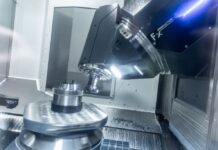
Currently, Kern's contract manufacturing uses the high-end five-axis center Kern Micro HD for the production of insert housings. The entire manufacturing process is fully automated. Simply put, this means: At the beginning of the order, the operator equips the tool and workpiece station as needed. Then, he calls up the corresponding program and starts it. After that, a pre-configured blank is positioned in the machine via the selected automation solution (internal or external), completely processed there, and finally removed and placed as a finished part in the same way. The next blank is then picked up – and so on.
Quality of the machining center makes the difference
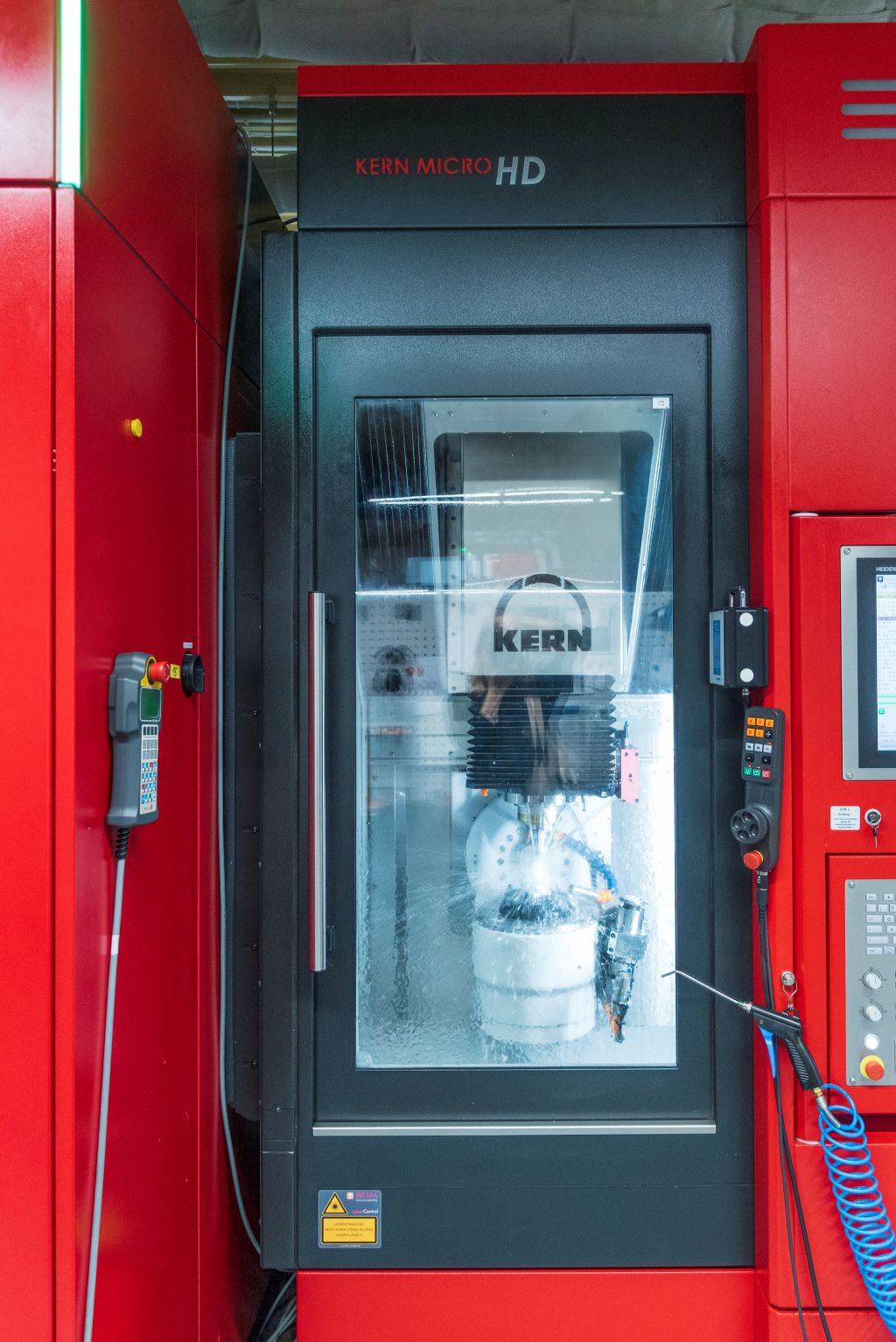
What is described here in a few words is, in practice, a highly complex process that is primarily based on the quality of the machining center used. In it, fine chips fly, and it only needs to be clamped once, including finishing. This is important because the requirements for position, angle, and diameter tolerances of the critical holes must be reliably within the single-digit µm range. No matter what material is being machined.
For Alexander Stauder and his production team, this poses no problem. They claim to feel absolutely comfortable even in large-scale production with tolerances of up to 2 µm in all mentioned positional tolerances: 'The finished components are usually even more precise. The greatest challenge is primarily reproducibility. And we prefer to remain conservative with our figures to be on the safe side. We can proudly claim to be the supplier with the best possible results.'
Highest precision through micro gap technology
Crucial for the extremely high, reproducible precision of the five-axis machining centers Kern Micro HD used are several technical highlights. One of them is the large-sized and temperature-controlled linear motors, which completely do without mechanical transmission elements that could wear out. Additionally, the machines feature a unique hydrostatic micro gap technology developed and patented by Kern. The small gap thickness of less than 10 µm in all linear axes ensures, according to Sebastian Guggenmos, technical managing director of Kern Microtechnik GmbH, maximum stiffness and the best damping properties of the system.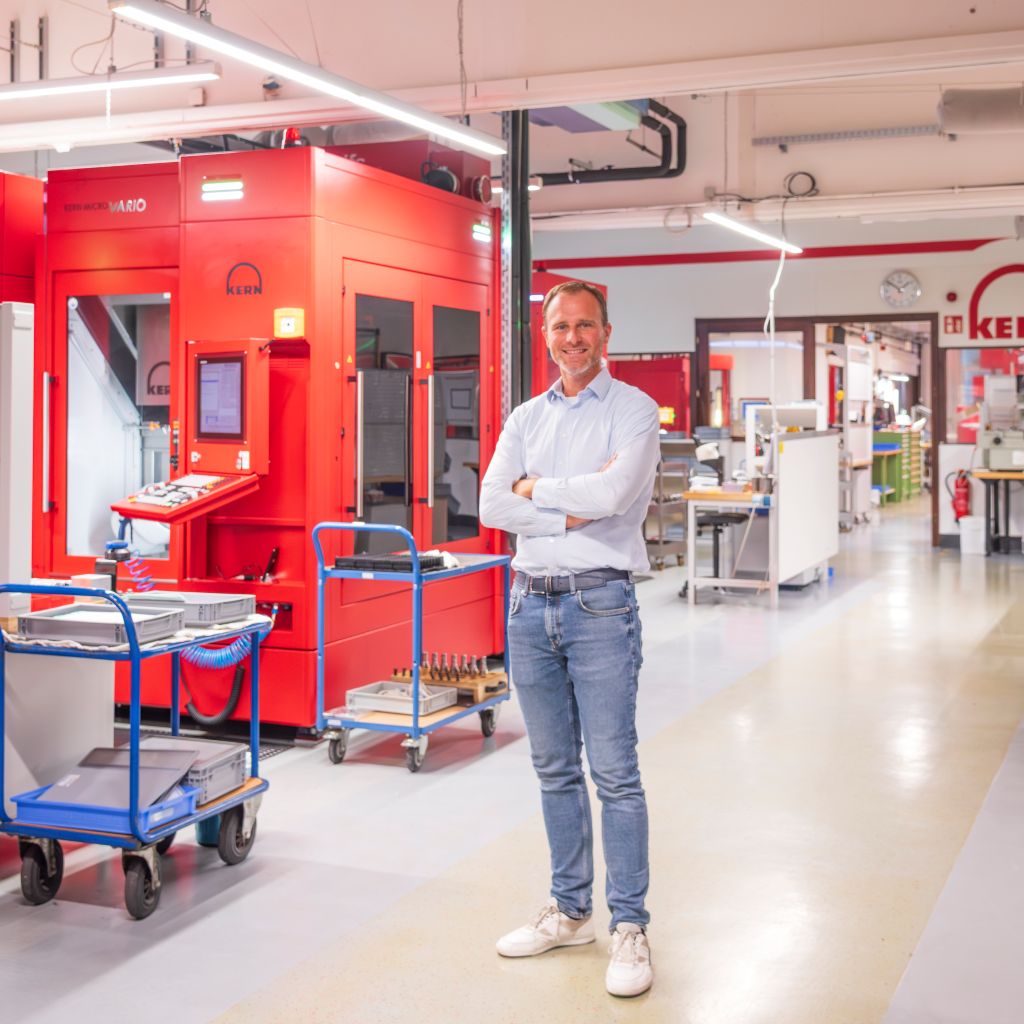
In addition, Chief Technology Officer Guggenmos highlights the actively tempered aluminum axes and hydrostatic media, adding: 'Thanks to all these technical features, we can ensure maximum stability and consistently perfect quality of the workpieces in series production. This also applies under less than ideal environmental conditions, as we currently have in Murnau.' This primarily refers to trains that run over nearby tracks and cause slight vibrations in the plant. Plant manager Stauder is unimpressed: 'Other machines would have a problem with the required precision. Ours does not.'
Growing demand from analytics and measurement technology
For customers of core contract manufacturing with particularly high demands, the achievable results are enormously helpful. This allows them to reliably guarantee the highest data transmission rates to their customers. On the other hand, possible additional steps in assembly – such as pairing or inserting lenses – are significantly simplified. And since the advantages of highly precise series production are also interesting for other industries, this positively affects the overall order intake in Murnau. According to Alexander Stauder, the demand from companies in analytics and measurement technology is rising as strongly as from those that require insert housings for fiber optic connectors, as described here.
Contact: