
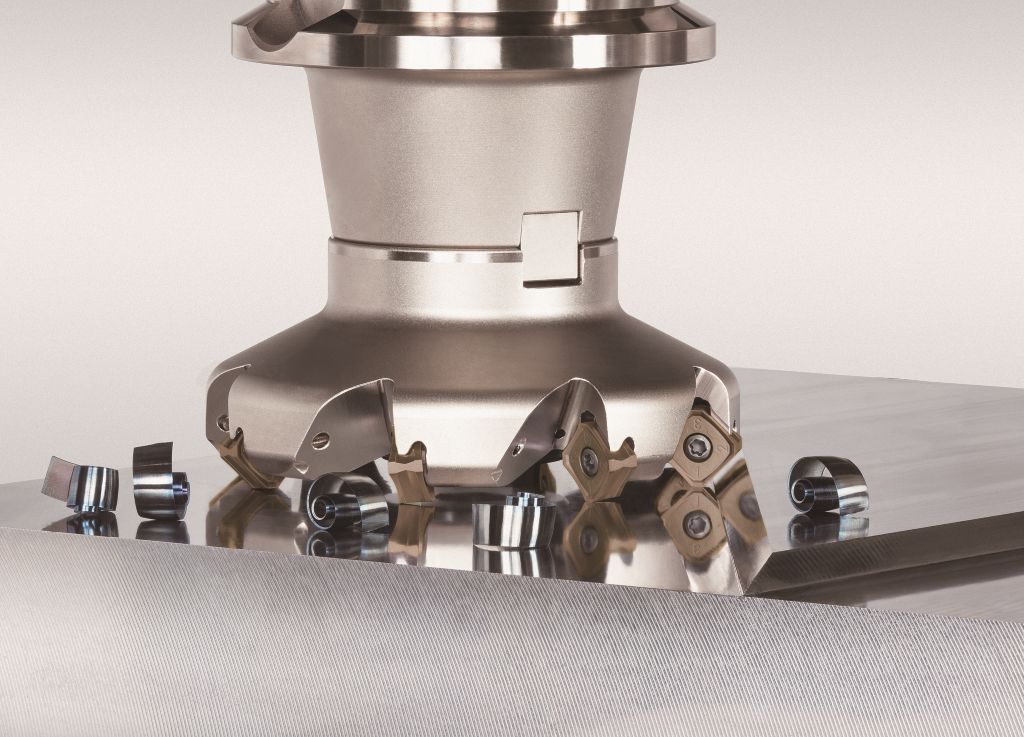
In manufacturing, every minute often counts. Therefore, every tool that simplifies processes is worth its weight in gold. The DoTriple-Mill from Tungaloy is such a tool: it combines three different insert geometries in just one holder – a true multi-talented tool for face milling. This not only saves space in the tool magazine but also creates room for flexible processes and economical milling strategies – in roughing and finishing processes.
Turbine blades made from superalloys, turbocharger housings made from stainless steel, valve bodies made from cast iron, front axles made from steel: the variety of workpieces in the aerospace, automotive, and heavy industries demands stable processes. Often, tools in face milling must withstand enormous forces and large cutting and counter forces. A reliable clamping system that additionally relieves the cutting inserts makes a crucial difference here. For such high demands, Tungaloy designed the DoTriple-Mill.
Firm grip, free choice – the clever clamping system
What makes the Tungaloy milling system DoTriple-Mill so special? The combination of a clever clamping system, three usable insert geometries in just one insert seat, and optimized chip formation.
The clever insert seat with dovetail structure ensures improved performance and extended tool life. 'A single screw is enough to give it a firm hold in the insert seat. There, it balances cutting and counter forces and enables high stability. This reduces forces that could cause the insert to lift or the clamping screw to shear off. Especially at high feed rates, this clamping system pays off,' explains Maik Meyer, product manager for rotating tools at Tungaloy-NTK Germany.
The trick: the insert seat is designed so that all three insert geometries – square, octagonal, and round – are form-locked and stable. This makes the DoTriple-Mill a true chameleon among milling tools. Whether rough milling, fine finishing, or dynamic high-feed milling – the user remains maximally flexible with just one tool holder. Changing the milling strategy no longer requires a tool change, but only the exchange of the inserts. This saves setup time, reduces inventory effort, and ensures stable processes with high repeat accuracy.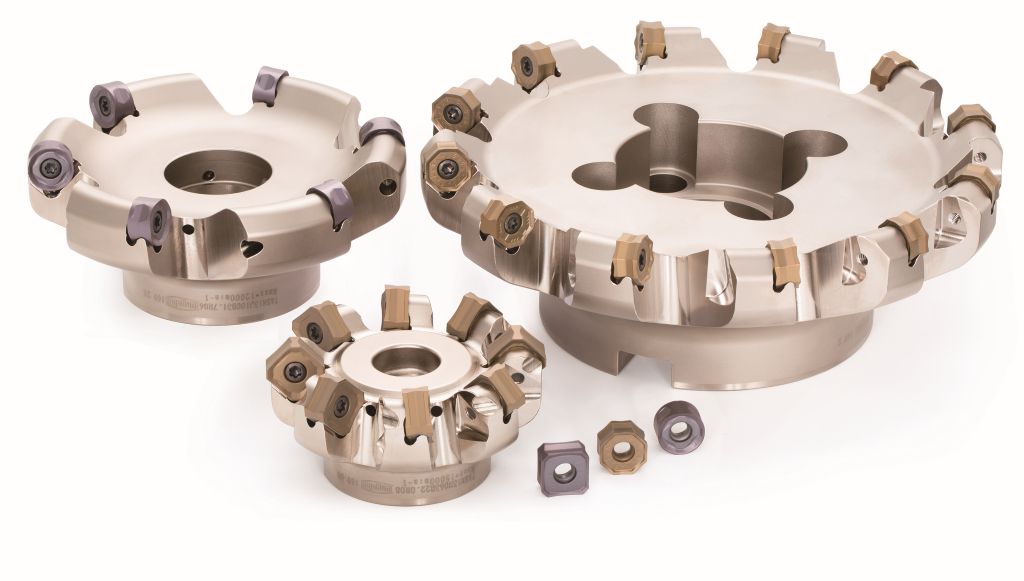
The square insert is the all-rounder in the system. It allows cutting depths of up to 6 mm, making it ideal for versatile standard applications. Notably, its large cutting edge ensures excellent surface quality – a clear advantage when both material removal and finish count. Its robust geometry is suitable for both roughing and many finishing operations.
The octagonal insert scores especially in terms of economy: with 16 usable cutting edges per insert, it maximizes savings potential. It is designed for cutting depths of up to 3.4 mm and is extremely reliable due to its break-resistant cutting edge geometry – even under changing cutting conditions. Furthermore, it impresses with its low cutting force requirement, which reduces wear on the machine and spindle while increasing tool life.
The round insert is the specialist for demanding cases: it was developed for high-feed milling as well as for roughing particularly irregular or rough surfaces. Its spiral-shaped cutting edge ensures a smooth chip removal, thereby reducing cutting forces and simultaneously decreasing thermal stress on the cutting edge. This makes it ideal for tough or difficult-to-machine materials, where process reliability is of utmost priority.
Intelligent cutting edge geometry for more process reliability
No matter which insert geometry is chosen – two variants are also available in Wiper version (SNGU-W and ONGU-W). These special cutting edges significantly optimize the surface finish during finishing and open up additional possibilities for the user in fine machining. Especially the square and octagonal Wiper inserts expand the application range in the field of finishing and ensure a consistently high quality level.
Another advantage of the system lies in the thoughtful design of the cutting edges. The double-sided inserts specifically developed for the DoTriple-Mill feature concave-shaped edges that prove themselves in practice multiple times. 'We deliberately designed the cutting edges concave – this way, at large cutting depths, shorter, compact chips are produced,' explains Maik Meyer. 'This minimizes the risk of chip jamming and makes the machining not only more process-reliable but also more economical.' The chip formation stages of the inserts have also been optimized so that even stainless steels with a high nickel-chromium content can be reliably machined. Additionally, it is practical that the neutrally designed inserts can be used on both right- and left-handed milling machines – a detail that opens up additional flexibility in tool planning.
More tool life, less changeover
In a practical test while milling turbine blades made from stainless steel, the DoTripleMill demonstrated its capabilities: with the octagonal inserts, it milled at vc = 80 m/min, fz = 0.10 mm/Z, vf = 200 mm/min, ap = 2.0 mm, producing a solid 220 components – while the competitor gave up after just 150 workpieces. This corresponds to a 46 percent longer tool life – a real competitive advantage for anyone who operates milling with heads (and system).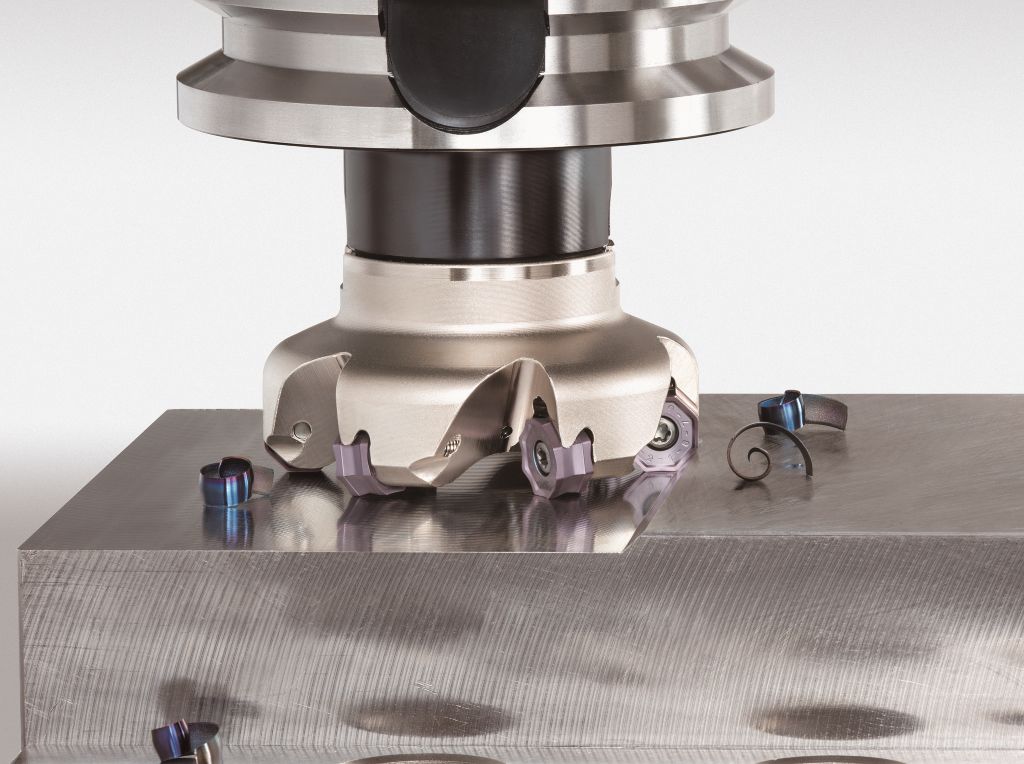
With the DoTriple-Mill, Tungaloy delivers a well-thought-out tool concept that perfectly meets modern manufacturing requirements: maximum flexibility, high process reliability, and economic efficiency – all packaged in a single milling system. The combination of a clever clamping system, three usable insert geometries, optimized chip formation, and excellent surface quality makes the DoTripleMill a reliable partner for face milling. Those who want to streamline their processes, reduce setup time, and deliver consistently high quality will find in the DoTriple-Mill more than just a tool – but a true solution for practice.
Contact: