
Composite materials are changing the industry, yet their machining remains very challenging. Even with advanced machines and control processes, machining fibers and resin poses a significant challenge for engineers and operators. Liam Haglington, product manager for solid carbide end mills at Sandvik Coromant, explains how advanced tool design and modern material technology support manufacturing companies in overcoming the limits of machining abrasive composite materials.
Lightweight, high-strength composite materials such as carbon fiber reinforced plastics (CFRP) enable unmatched performance and impress with an excellent stiffness-to-weight ratio as well as corrosion resistance and design flexibility. All of these are critical factors for successful lightweight construction.
The aerospace industry remains the most demanding application area for composite materials. Components such as the fuselage frame, wings, stabilizers, spars, ribs, and floor beams are crucial for structural integrity – they are often machined with high precision in large series. Composite materials are particularly well-suited for this, as they offer a high stiffness-to-weight ratio and excellent resistance to material fatigue. By orienting the fibers, they can be tailored to provide strength exactly where it is needed. All these are properties that are essential for lightweight, high-performance aircraft components.
But other industries also benefit from this. Automotive manufacturers use CFRP to reduce weight and increase efficiency. According to JEC, composite materials are 'critical for applications where weight reduction is essential to improve fuel efficiency and limit greenhouse gas emissions.' They now account for around 17 percent of materials used in aerospace and 8 percent of materials used in the transport sector. In all these areas, stable process control and reliable tools directly lead to cost savings and increased production security.
Why machining composite materials is so challenging
Machining composite materials differs significantly from machining metals, as they combine stiff, abrasive fibers with a softer resin matrix. Even a slight change in fiber orientation can significantly alter the material behavior during machining. What appears uniform on the surface presents a constantly changing environment for the tool.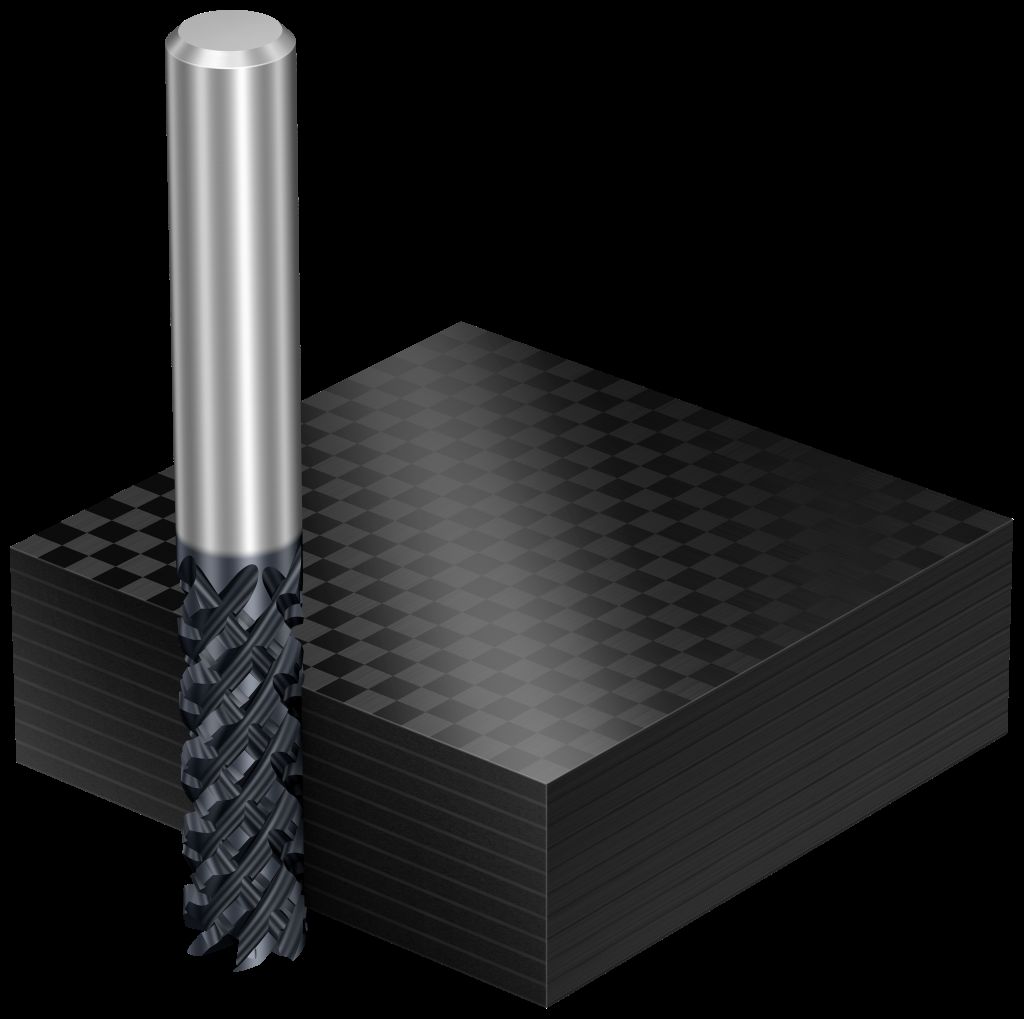
This changing behavior leads to the well-known defects for manufacturing companies that machine composite materials:
• Delamination: The layers separate under excessive forces.
• Uncut or pulled fibers may occur if the tool cannot cleanly cut through the reinforcement.
• Surface quality can become uneven if fibers and resin react differently to heat and pressure.
All these problems have the same underlying cause. The material behaves inconsistently, making its failure possibilities unpredictable.
The impacts on production can be significant. Errors lead to scrap, more inspections, rework, and production downtimes – especially in high-precision aerospace environments where deviations are not permissible.
Additionally, the increased heat sensitivity further complicates matters. As temperatures rise, the resin softens while the fibers remain rigid. This increases the risk of delamination or fraying. If the cut is too cold, the resin remains brittle, accelerating tool wear. Therefore, cutting parameters must be controlled very precisely, but conventional tools often struggle to find the right balance. The result is faster wear, uncertain tool lives, and reduced component quality.
Reliable machining depends on tools that stabilize the process, control vibrations, and manage heat generation. Without this control, machining composite materials remains a challenging and unpredictable task.
Solution: CoroMill Plura Composite 2P350
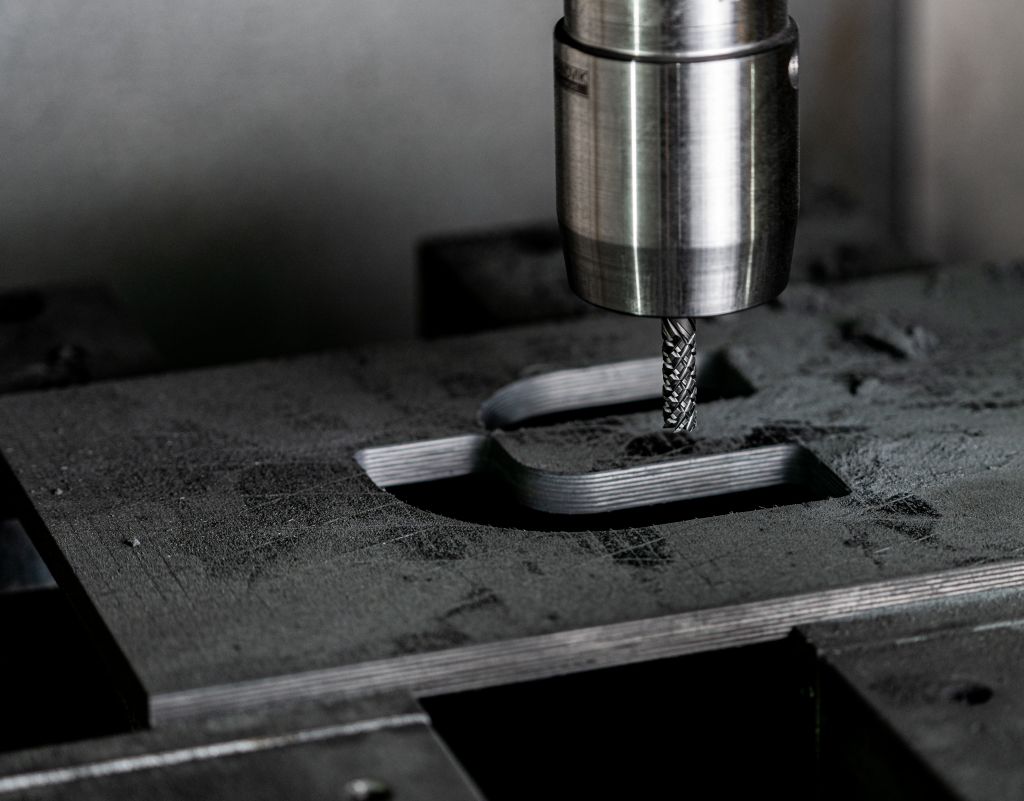
To meet these requirements, a tool is needed that not only cuts the material but also controls how the fibers separate and how wear develops over time. Based on these criteria, the CoroMill Plura Composite 2P350 was developed.
The core of the 2P350 is its unique double cutting mechanism. Unlike conventional end mills, it cuts the fibers cleanly instead of tearing them. The mechanism operates on the shear principle: two cutting edges are brought together to control the lifting and cutting of the fibers. One edge guides the fibers while the other cuts them. This keeps the laminate stable and prevents delamination. This coordinated movement also balances the cutting load, reducing vibrations and enabling a more uniform and predictable machining process.
The tool geometry is designed for high productivity. Large chip channels ensure effective extraction of dust and loose fibers generated during the machining process. By quickly removing them, the risk of re-cutting is reduced, and the cut remains stable and clean. Whether grooving, ramping, or edge milling – the 2P350 performs all steps from roughing to finishing in just one setup. Lower vibrations and a more uniform cut also create a quieter and more pleasant working environment in manufacturing.
The CoroMill Plura Composite 2P350 maintains its cutting behavior under a variety of conditions. This allows manufacturing companies to ensure consistently high quality regardless of variations in workpieces or tool holders. The controlled cutting mechanism also improves performance in complex machining. This is particularly important in unmanned or automated manufacturing, where no manual interventions are possible. The predictable tool behavior and reduced vibrations decrease the likelihood of sudden tool wear, enable continuous production, and reduce dependence on operator experience.
The capability of O2AD
In applications with abrasive composite materials, geometry alone is not sufficient. The cutting edges must also withstand the constant impact of reinforcement fibers, for which the O2AD grade is ideally suited.
The O2AD grade combines advanced material technology with a thick, strongly adhering CVD coating. The tailored substrate ensures an optimal bond between the diamond layer and the tool body, preventing premature detachment of the coating and thus extending the tool's service life.
Tests have already shown that tool life has approximately doubled compared to the previous grade O12M. In a specific application case in the aerospace industry, where a component of an aircraft wing was machined dry under vacuum on a 5-axis portal machine, a 100 percent increase in tool life was achieved with grade O2AD under the same cutting conditions compared to O12M. The wear behavior is predictable and occurs gradually, allowing for increased confidence in raising cutting parameters while simultaneously reducing scrap and the number of tool changes. This leads to noticeable cost savings through longer machining windows, a reduced tool inventory, and less downtime.
The O2AD grade combines the strength of the diamond coating with a stable substrate. This directly addresses the main challenges in milling composite materials. Consistent cutting edge quality ensures constant cutting forces, reduces vibrations, and allows for better predictability of the machining process. Manufacturing companies can achieve cleaner cuts, more uniform tool life, and more reliable results with abrasive composite materials.
Conclusion
The CoroMill Plura Composite 2P350 with the O2AD grade handles abrasive wear, delamination risk, heat sensitivity, and vibrations. It enables the production of high-quality components with consistent performance – regardless of their complexity or variability. The 2P350 helps companies in aerospace, automotive, and defense, space, and maritime applications to increase their productivity, protect component integrity, and control their costs. It opens up new possibilities for those facing the challenge of machinability in the reliable high-performance milling of composite materials.
In a broader context, these advancements demonstrate how developments in geometry and materials technology are redefining the possibilities of composite material machining. Delamination, fiber variability, and heat sensitivity are always factors to consider when working with these materials, but the right technology can master these challenges and ensure stable and predictable operation.
Contact: