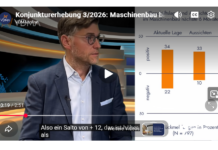

The mood in the machinery and equipment manufacturing sector continues to worsen. According to the new VDMA economic survey, less than a quarter of the 877 companies surveyed (23 percent) assess the current situation as 'very good' or 'good' (July: 26 percent). About a third of the companies (33 percent) rate the situation as 'poor' or 'very poor' (July: 32 percent). The outlook has also significantly deteriorated. More than half of the companies (61 percent) expect no change in the situation over the next 6 months. Only about one in five companies (21 percent) is optimistic about the next 6 months (July: 29 percent). Approximately 18 percent expect a worsening of the situation.
This also affects the outlook: In the current year, around 35 percent of companies expect a nominal decline in sales, 27 percent consider stagnation realistic, and 38 percent expect sales growth. For 2026, many companies are somewhat more optimistic. Here, 55 percent see nominal sales growth as possible.
"The environment in which machinery and equipment manufacturers must navigate remains extremely challenging. In addition to the trade conflict with the USA and the increasingly strong competitor China, the ongoing weakness in key customer sectors is increasingly impacting machinery and equipment manufacturing. For about a year, more than 75 percent of the surveyed companies have reported a poor or even very poor situation regarding the automotive industry. It is therefore not surprising that automotive-related sectors such as machine tools, robotics + automation, or precision tools have given particularly poor assessments of the situation, and the outlook there is cautious," comments VDMA Chief Economist Dr. Johannes Gernandt on the results.
No bright spots in key customer industries – Defense in focus
The situation is tense not only in the automotive industry but also in other important customer sectors. In particular, the construction industry stands out negatively here. About 67 percent of the surveyed machinery companies assess the current situation there as 'poor' or 'very poor', with only 6 percent feeling a positive situation. However, the evaluations of the chemical industry as well as the electrical and electronics industry are also mixed. In the chemical industry, 36 percent see a poor or very poor situation, and only 14 percent draw a positive conclusion; in the electrical and electronics industry, 32 percent are negative, and 17 percent are positive. In these two sectors, about half of the companies draw a 'satisfactory' conclusion. Looking ahead to the next 6 months, the majority of machinery companies in all mentioned sectors expect no improvement, with most seeing a stable situation.
The situation appears more positive in selected other customer sectors. Defense, shipbuilding, pharmaceutical products, aerospace, and medical technology perform well. In defense, around 68 percent assess the situation as good or very good. In shipbuilding, it's slightly more than half of the companies (51 percent), in pharmaceuticals 44 percent, aerospace 41 percent, and medical technology 39 percent. The outlook for these sectors is consistently better.
Staff reductions continue
Staff reductions are likely to continue in the coming months given the difficult and uncertain framework conditions. Although more than half of the companies (55 percent) expect a stable core workforce in the next 6 months, more than one in four companies (26 percent) feels compelled to reduce staff. Less than one in five companies plans to increase staff (19 percent). Given the prevailing shortage of skilled workers, companies are likely to fill the positions of departing employees less frequently and initially reduce flexible workers such as temporary workers. "However, this will not be sufficient to cushion the lower demand for labor," says Dr. Gernandt. The low willingness of companies to hire is also reflected in the open positions. About 46 percent of companies expect a decrease in open positions in the next six months, and only 17 percent expect an increase.
"The cost burden at the location in Germany is too high. The federal government must now act quickly and decisively and promptly initiate reforms. Implementation must not be hampered by excessive bureaucracy. Companies need reliable framework conditions for more planning security and improved location conditions in general for greater competitiveness – and as quickly as possible!" demands the VDMA Chief Economist.
Contact: