
Laser-based inertial fusion is a strategic future market for photonics. Its feasibility has been demonstrated. In Germany, consortia of industry and research are forming to tap into this climate-neutral and intrinsically safe energy source and to establish robust supply chains. The government is funding the development of the base technologies for fusion power plants with over one billion euros. The approaches hold significant innovation potential beyond fusion. Key players will meet at LASER 2025 for the Application Panel "Laser Fusion: Energizing Photonics Industry." Led by Fraunhofer ILT, it will explore market potentials and opportunities in fusion. Laser-based inertial fusion is on the verge of transitioning from fundamental research to application-oriented technology development. Germany has set the course to quickly harness this climate-neutral, round-the-clock available energy source. Since the federal government launched the program "Fusion 2040 - Research on the Path to Fusion Power Plants" in spring 2024, 16 consortia have formed with a funding volume of 140 million euros. Corporations, medium-sized companies, startups, research institutes, and universities are combining their competencies to develop base technologies for fusion power plants. This marks the beginning of a research offensive that Germany will support with over one billion euros by 2030. In addition, there are private investments from the participating companies, most of which come from the photonics industry and have recognized fusion as a strategic future market.
Application Panel »Laser Fusion: Energizing Photonics Industry« at the LASER
An application panel at the Laser World of Photonics will explore the potential for the photonics industry. Led by Dr. Jochen Stollenwerk, the acting director of the Fraunhofer Institute for Laser Technology ILT in Aachen, leading experts from industry and academia will discuss the state of the art, challenges, and photonic solutions. The keynote speech of the panel "Laser Fusion: Energizing Photonics Industry" will be delivered by Prof. Constantin Häfner, Board Member for Research and Transfer at the Fraunhofer Society. Until the end of 2019, he was responsible for the development of the world's most powerful laser systems as Program Director for Advanced Photon Technologies at the Lawrence Livermore National Laboratory in California, USA, where the ignition of a fusion plasma was achieved for the first time at the National Ignition Facility (NIF).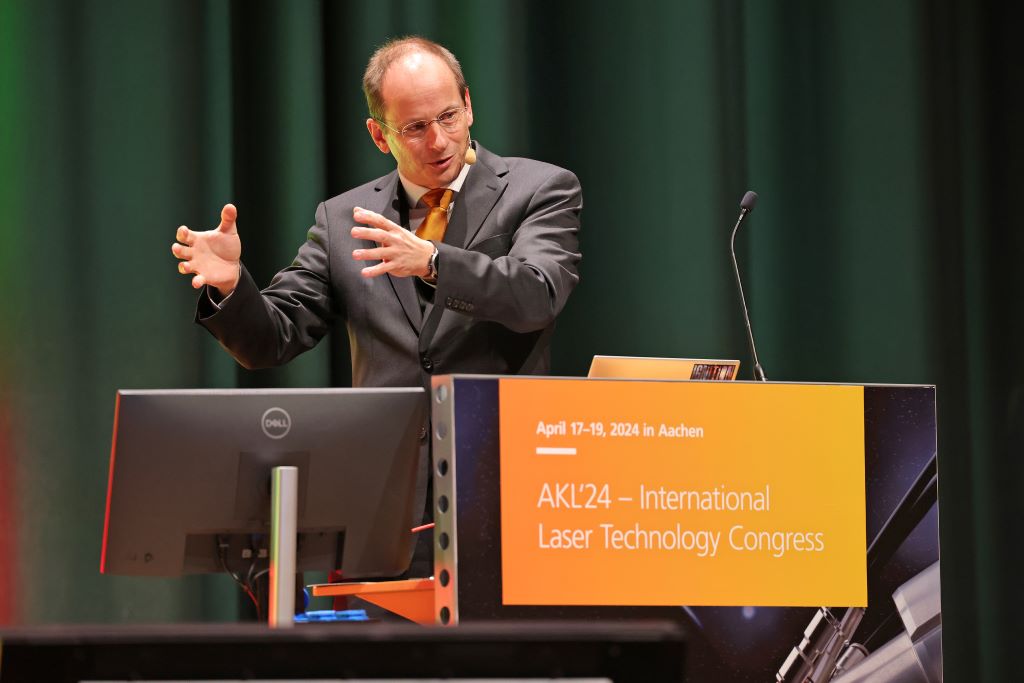
Since his move to Germany, Häfner has been contributing his expertise as an advisor to the federal government in the Fusion Advisory Board of the Federal Ministry for Research, Technology and Space (BMFTR) and as the head of the expert commission for laser fusion. In his keynote speech, he will highlight the opportunities for Germany and Europe in the future market of laser fusion; this also in light of
that German photonics companies have played a significant role as technology and hardware suppliers in the construction of the NIF.
"The establishment of efficient supply chains in photonics is a prerequisite for the technical and economic feasibility of a fusion power plant," says Häfner. On the way there, several innovations are still needed. These will lead to far-reaching transformations in today's market for industrial lasers, laser applications, and optics due to the expected market size. In the form of spill-over.
The effects of the ongoing research and development could also have a short-term impact on the photonics market.
Kick-off for the establishment of powerful supply chains
With the formation of the first consortia in the "Fusion 2040" program, the starting signal for the necessary innovation offensive has been given. The projects bring together players from photonics, optics, and materials science along with their competencies. A focus is placed on the development and manufacturing of highly efficient diode lasers as well as robust optical glasses and crystals. These will be used in the continuous operation of commercial applications.
Power plants are exposed to extreme stresses. Their task is to pump laser pulses at a high frequency to the necessary energy level in order to convert a mixture of the hydrogen isotopes deuterium and tritium into plasma and ignite their fusion. For commercial operation, ten to twenty targets with this mixture must be ignited per second. There is also a need for development for these targets – pinhead-sized pellets – and for the first reactor wall. The latter is subjected to the neutrons released during fusion and the thermal radiation from the over
exposed to fusion plasmas at 150 million degrees Celsius. Development fields are also emerging in the tritium cycle and, if possible, the additive manufacturing of complex power plant components. These topics are being addressed by the consortia. It is already evident today that the aforementioned spill-over effects will occur in photonics and its user industries. One of the projects aims for significant performance improvements of diode lasers while simultaneously reducing costs due to fully automated manufacturing. If the consortium achieves this,
its objectives, then diode lasers could unleash transformative – and sometimes disruptive potential across various industries. There is also demand from other markets for high-performance beam sources and the optical glasses needed for fusion power plants. Additionally, there is a growing need for lasers that can be used as secondary sources for the generation of EUV, neutron, or X-ray radiation. They are
among other things for combined X-ray and neutron imaging. The method is intended to enable optical and material analyses of the contents through the walls of closed barrels and containers. Laser beam sources are the key to miniaturizing the particle accelerators needed for this and integrating them into compact devices.
Fundamental physics works – A breakthrough in application development
The development of laser fusion has been advancing rapidly since December 5, 2022 – the day of the breakthrough at NIF. According to Häfner's assessment, the increasing use of AI will further accelerate the pace of innovation. AI is already being used to optimize experiments at the US testing facility: At the end of 2022, the ignition of the fusion plasma released 3.15 megajoules (MJ), which was 1.5 times the laser energy required for ignition. By the end of 2024, NIF reported an increase to 5.2 MJ – and in May 2025 to 8.6 MJ. This means that fusion released 4.13 times more energy than the laser focused on the target. The successful experiments demonstrate that the fundamental physics works. However, the facility is not designed for energy generation but for plasma research. In its 192 parallel beam paths, flash lamps and special glasses pump the energy level of the laser pulses to the necessary level. After each ignition, the system must cool down, as neither the optical components nor the laser system or the materials of the combustion chamber are designed for continuous power plant operation.
On the way to power plant-compatible concepts and technologies
To make fusion technology usable in power plants, entirely new concepts are needed. The development of these has been initiated by the federal government with the 'Fusion 2040' program. The industrial participation in the first tenders was enormous. The development of optical, photonic, and materials science power plant technologies has begun. By 2030, more than one billion euros are available for technology-open research: alongside laser-based inertial fusion, magnetic fusion is on the agenda. The consortia bring together manufacturers of lasers, optics, coating processes, increasingly AI-supported manufacturing technology, as well as from testing and software development with research institutions to tap into the enormous potential of the photonic future market. The collaboration between industry and science connects knowledge, processes – and supply chains. This creates the foundation for the commercial use of fusion. As an intrinsically safe energy source, it is to develop alongside wind and solar energy into a reliable component of an energy system decoupled from the carbon cycle.
Application Panel 'Laser Fusion: Energizing Photonics Industry'
Date: Tuesday, June 24, 2025
Time: 10:30 AM – 12:00 PM
Location: Hall A2.561
Chair: Dr. Jochen Stollenwerk, Fraunhofer ILT
Panel, including:
Prof. Constantin Häfner, Board of Research & Transfer, Fraunhofer Society
Prof. Thomas Thiemann, Senior Vice President (SVP), Siemens Energy
Dr. Ulrich Steegmüller, Chief Technology Officer (CTO) & Senior Vice President (SVP), ams OSRAM
Dr. Frank Nürnberg, Global Head of Sales Optics, HERAEUS Covantics
Alexander Ancsin, Managing Director (CEO), Layertec GmbH
Contact