
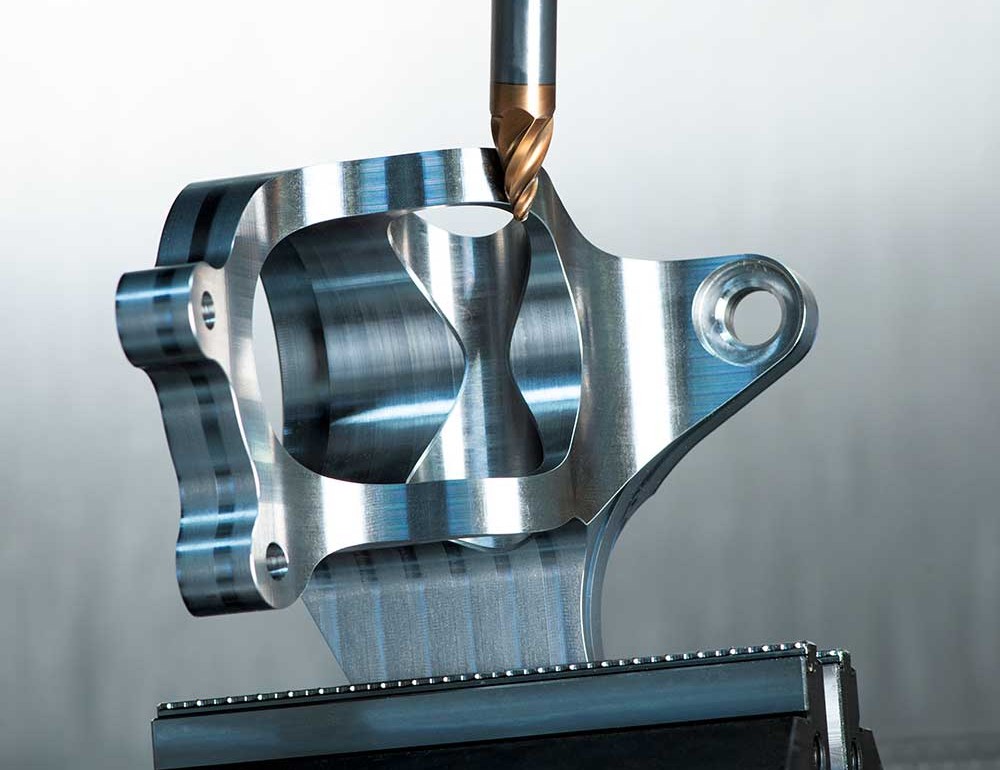
The tool has been specifically developed for complex contours and high finishing performance. It covers a wide range of applications – from deep cavities in tool and mold making to the manufacturing of blades and impellers, as well as the machining of demanding 5-axis components.
The PGMS-4BC is particularly suitable for cavities with negative flanks and strongly curved surfaces in tool and mold making. Other areas of application include the production of complex implant geometries, such as artificial joints, in medical technology, as well as the machining of turbine and blade components in aviation. In general mechanical engineering, the cutter supports the machining of complex planes and contours, especially in multi-axis and 5-axis areas.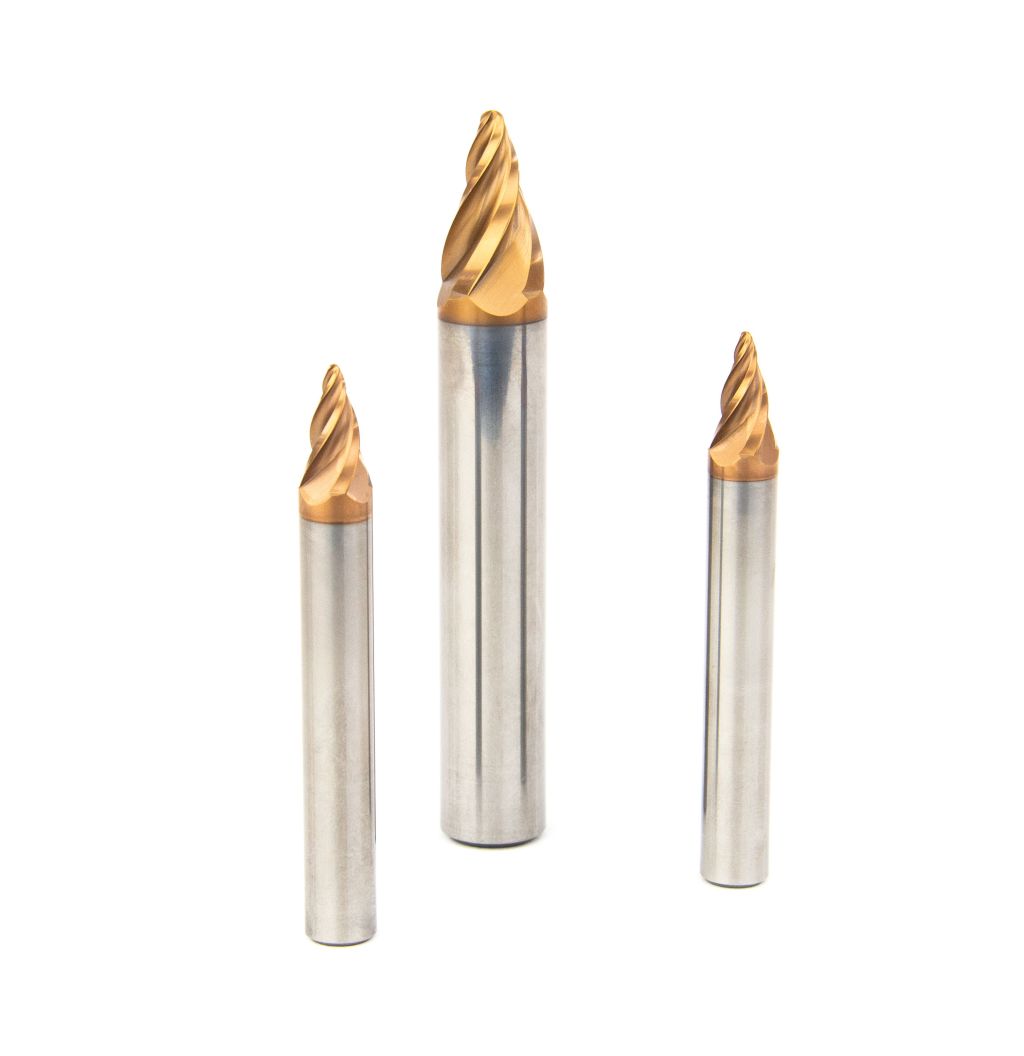
Larger line spacings reduce processing times
The curved cutting edge creates a significantly larger virtual ball diameter than a ball cutter with a comparable shank diameter. This allows for larger line spacings to be chosen while maintaining comparable surface quality. The number of tool paths decreases, which can reduce machine running times.
With a classic ball cutter of 12 mm diameter, a line spacing of 0.2 mm may be required for high surface quality. The PGMS-4BC generates a virtual ball diameter of 300 mm with the same shank diameter.
This makes a line spacing of 1 mm possible under suitable machining conditions. The actual time savings achieved depend on the component geometry, the machining strategy, and the requirements for surface quality.
Flexible use through circular segment geometry
Compared to a purely conical cutting edge shape, the circular segment milling cutter offers a larger flexible range of use. The curved cutting edge allows for variation of the angle of attack within a certain range. In conjunction with dynamic contact point control, the contact area can be shifted across the cutting edge. This allows for more uniform distribution of tool wear, which can contribute to a longer usable service life.
Stability and service life for demanding materials
The conical shape counteracts lateral deflection and thus supports vibration-free machining. Together with the self-stabilizing anti-vibration geometry, it creates the conditions for stable processes and uniform surfaces.
The PGMS geometry combines a positive rake angle with a comparatively large wedge angle. The positive rake angle helps keep cutting forces low; the larger wedge angle supports cutting edge stability. This design is particularly suitable for
HRSA materials, titanium, and highly alloyed stainless steels. The AlTiSiN coating supports high service lives. With the PGMS-4BC, ZCC-CT Europe complements the existing conical PGMS design with a conical circular segment milling cutter.
Another version is already planned as the next development step: In the future, the PGMS family will be expanded to include a lollipop geometry.
Technical features
• Shank cutter with curved circular segment cutting edge
• four cutting edges
• Cone angle: 15° per side
• Diameter: 6, 8, 10, 12, and 16 mm
• Cutting radii: 40 to 1,000 mm
• virtual ball diameter: 80 to 2,000 mm
• self-stabilizing anti-vibration geometry
• AlTiSiN coating
• suitable for roughing, pre-finishing, and finishing
• suitable for complex contours and 5-axis machining
• usable in HRSA, titanium, and highly alloyed stainless steels
Contact: