
Sustainability data, CO2 balances, digital product information: For many medium-sized companies, these topics are increasingly becoming a competitive factor. At the same time, the requirements are rising due to new European regulations and reporting obligations. The Ministry of Economic Affairs, Crafts and Tourism of Baden-Württemberg has therefore approved the expansion of the S-TEC Center for Climate-Neutral Production and Holistic Accounting (ZKP) with around two million euros. The state is responding to the growing need of medium-sized companies to successfully implement sustainability requirements and develop concrete competitive, innovation, and efficiency advantages from them. Several Fraunhofer Institutes and the University of Stuttgart are partners of the ZKP. New projects between these partners and the Baden-Württemberg industry are expected to start in October 2026.
Since its founding in 2022, the ZKP has completed more than 150 transfer projects with companies from Baden-Württemberg. Companies present concrete challenges, and researchers develop easily implementable solutions together with them. The demand has grown since then. With new European regulations such as the Ecodesign for Sustainable Products Regulation (ESPR), the Carbon Border Adjustment Mechanism (CBAM), and the reporting obligations of the Corporate Sustainability Reporting Directive (CSRD), medium-sized companies are also facing new requirements. However, many companies lack the necessary tools, data structures, and personnel capacities to implement these efficiently. At the same time, reliable sustainability data, digital processes, and transparent value chains are increasingly becoming crucial factors for competitiveness, market opportunities, and investment decisions.
"Climate-neutral production and economic success go hand in hand. For the structural change to succeed, European regulations must remain practical for companies. Especially small and medium-sized enterprises must not be further burdened by additional bureaucracy. With the expansion of the Center for Climate-Neutral Production, we support them in efficiently managing regulatory requirements, driving innovations, and strengthening their competitiveness in the long term. Because the medium-sized sector is the backbone of our Baden-Württemberg economy," says Dr. Nicole Hoffmeister-Kraut, Minister of Economic Affairs, Crafts and Tourism of Baden-Württemberg. Therefore, two additional areas of offerings will be established in line with the needs of companies as part of the expansion of the ZKP's five existing thematic focuses.
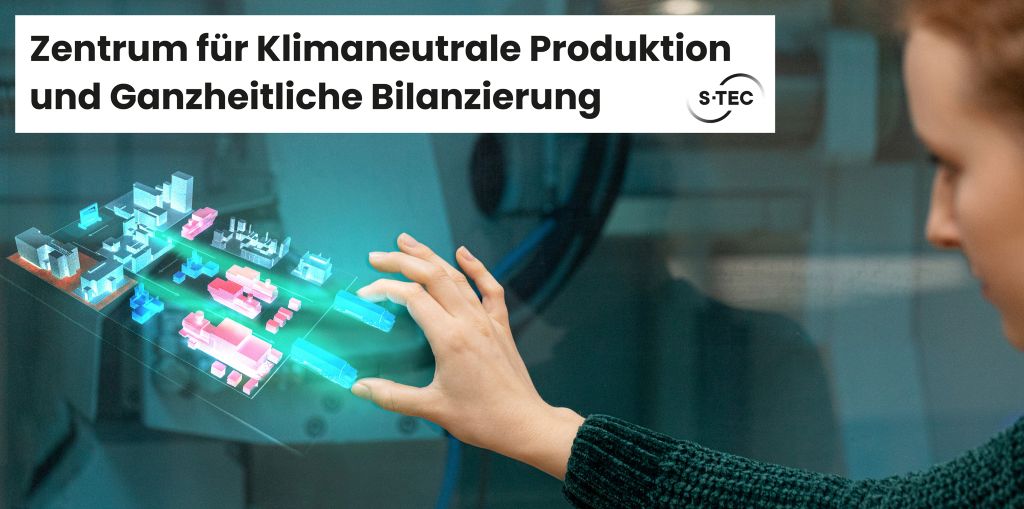
A woman's hand reaches for the virtual model of a factory
Systematically implement sustainability requirements
The first new area of offerings addresses the administrative burden of sustainability requirements. In practice, implementation often fails not due to a lack of willingness, but due to a lack of clarity: Which requirements specifically apply to one's own company? What has priority? How can necessary tasks be integrated into existing processes? The ZKP aims to help answer these questions in a structured manner in the future and to automate recurring processes, such as reporting or data maintenance. The goal is to relieve companies of administrative burdens while simultaneously creating the foundation for more efficient processes, higher productivity, and data-driven innovations. The digital structures built for this purpose not only help companies meet regulatory requirements but also create the basis for new competitive advantages and a faster adaptation to changing market demands.
Savings potentials that remain invisible in everyday life
The second new area is the so-called Ultra Efficiency Navigator. The concept considers energy, material, and emission flows not in isolation but as part of a whole system, also taking into account organizational and personnel factors. This allows previously hidden efficiency potentials to be identified, which arise from the interplay of individual processes and often remain concealed in everyday operations. For example, unnecessary energy losses between production steps or material losses along a production line can become visible.
"Many companies today have the technical capabilities to reduce their energy and resource consumption," says Dr. Daniel Wehner, head of the ZKP at Fraunhofer IBP. "The real challenge is to bring together data, processes, and requirements so that concrete decisions can be made. Those who strategically use this information can not only operate more sustainably but also increase productivity, steer investments more purposefully, and build long-term competitive advantages. This is precisely where we focus." The offering ranges from an initial assessment to the development of concrete measures.
Five strong partners, one common framework
So far, the Fraunhofer Institute for Building Physics IBP, the Fraunhofer Institute for Production Technology and Automation IPA, and the University of Stuttgart have supported the ZKP. With the expansion, the Fraunhofer Institute for Industrial Engineering and Organization IAO and the Fraunhofer Institute for Interfacial Engineering and Biotechnology IGB will be added permanently. The center is part of the Stuttgart Technology and Innovation Campus S-TEC.
This expands the range of competencies: Technological, organizational, and regulatory issues can now be addressed together. This is not just a formal increase. "Many transformation projects do not fail due to a lack of technology but because technical solutions do not fit into existing operational structures," explains Wehner.
With the two new areas of offerings, the ZKP supports companies in actively shaping the transformation to a sustainable and competitive economy and developing concrete added value for their business models.
The first projects, Quick Checks and Exploring Projects funded by the state of Baden-Württemberg, are expected to start in October 2026. Applications are already possible. More at: https://s.fhg.de/s-tec-zkp
Contact:
www.ipa.fraunhofer.de