
When manufacturing companies aim to make their processes more efficient and flexible, automation solutions come into focus – especially where humans and machines increasingly collaborate. AMB 2026 addresses this focus topic in a practical way and shows how collaborative processes are evolving along the machining production. In an interview, Patrick Schwarzkopf, Managing Director of the VDMA Robotics + Automation Association, explains the current drivers and gives an outlook on what developments companies should keep an eye on.
AMB: The robotics and automation industry expects a revenue decline of five percent for 2026 – and yet the pressure on manufacturing companies to automate is growing. Why is now the right moment for collaborative processes, and what motivates companies to take the leap?

Patrick Schwarzkopf: Indeed, we still see a significant reluctance to invest – for various reasons, from geopolitical upheavals to the well-known location issues. Nevertheless, the trend towards automation remains unbroken. Demographic change will intensify in the coming years; therefore, we need to automate tasks to support the remaining skilled workers.
Only in this way can we remain competitive. The interplay between humans and machines will be crucial. The rapid development of Artificial Intelligence (AI) – particularly generative and 'physical' AI – opens up new possibilities, such as through AI agents ('Agentic AI') and significantly easier operation and programming of automation solutions.
AMB: For a long time, automation was thought of in terms of large series – today, robotic solutions are also a concrete option for small series. How far has this development progressed, and what does a smaller company specifically need to implement automation in its production?
Patrick Schwarzkopf: SME automation is currently making great strides. The technological development of recent years has been enormous – thus, the entry barrier for SMEs is noticeably lowering. Typical are 'Low Volume, High Mix' scenarios: Programming must be quick, easy, and manageable by the workforce without significant effort. Today, there are numerous no-code approaches that do not require knowledge of programming languages. Automation processes can be assembled via graphical interfaces using drag-and-drop. Robot paths can also be 'taught' manually and saved at the push of a button. The large manufacturers have long offered suitable solutions for SMEs. Often, pragmatic setups are sufficient – for example, when a robot works at night, enabling a productivity leap. The hurdle is often less about the technology than the expectation that automation is fundamentally too complicated or too expensive. This is too simplistic, as the solutions are available – and can be seen well at trade fairs like AMB. Orientation is provided, for example, by Go4Robotics, an online platform of the International Federation of Robotics (IFR).
AMB: As programming and operation become easier, the direct collaboration between humans and robots also comes closer. Both increasingly work together without safety barriers today – only through AI-supported sensors has this become practical. What does this specifically change on the shop floor, and how must companies rethink processes and workforce?
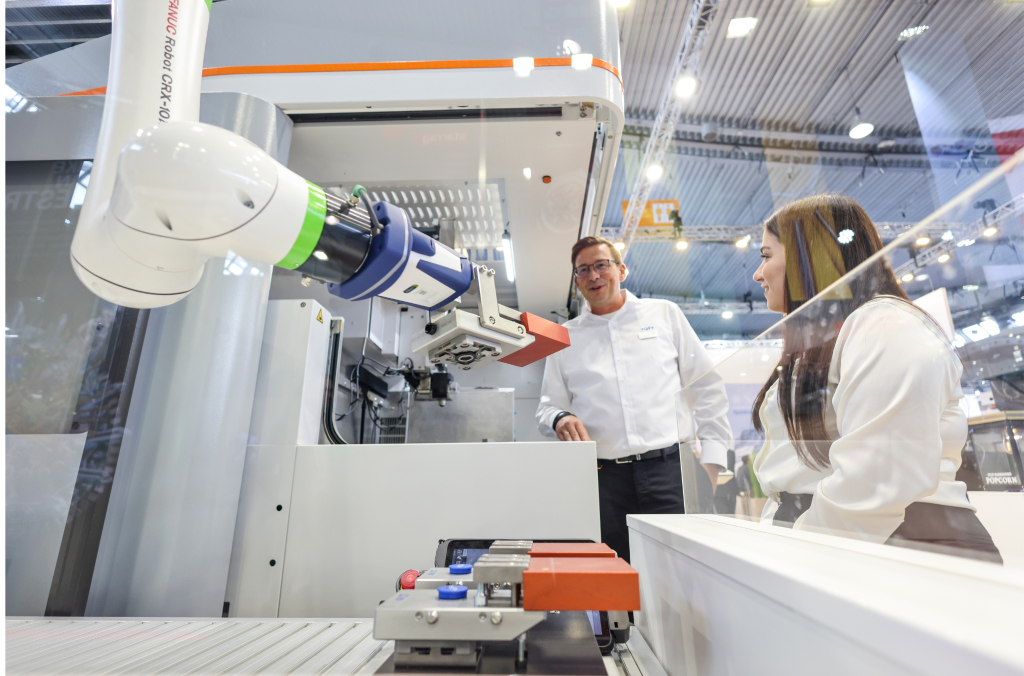
Patrick Schwarzkopf: Collaborative robots (cobots) have already established themselves well. In many applications, however, it is more about 'co-existence' – that is, operating without safety barriers – and thus about real, direct interaction. We are currently seeing a new level of close collaboration in humanoid robotics. Here, AI is making significant strides: It involves interpreting the environment and meaningful, independent action. Much pioneering work is still needed, but humanoid robots are increasingly leaving research labs and entering initial test applications in the industry. It is a longer path to widespread application maturity – at the same time, humanoid robotics is driving close interaction between humans and machines forward, for example, through the ability to talk to robots.
AMB: Many of these developments can be best evaluated live. AMB brings together the entire spectrum of metal machining under one roof in September in Stuttgart – from manufacturers to users to research. What can this unique constellation achieve to advance collaborative automation broadly – and why is a visit essential for anyone considering automation in metal machining?
Patrick Schwarzkopf: A look at the numbers shows the relevance: According to the World Robotics Association IFR, 'Machine Tending' – that is, the automated loading and unloading of parts at machining machines – is one of the main applications of robotics: Within a decade, the annual new installations of robots for handling applications at machine tools increased from 14,500 units (2015) to 19,000 units (2024). Preliminary IFR figures indicate further significant growth in the double-digit percentage range for 2025. The use of cobots has also increased significantly in recent years: In 2024, around 65,000 collaborative robots were installed worldwide – representing 12 percent of all industrial robots. The largest growth is seen in mobile robotics, which flexibly networks machines – for example, through mobile manipulators, that is, mobile platforms with robotic arms. One rarely gets such a compact, industry-specific overview as at a trade fair: At AMB, one experiences automation for metal machining 'up close'.
AMB: Thank you for the conversation, Mr. Schwarzkopf.
Contact: