
In the processing of dental ceramics, nickel-bonded diamond grinding pins are predominantly used, whose production and use are associated with ecological and health challenges. The Institute for Manufacturing Technology and Machine Tools (IFW) at Leibniz University Hannover is developing a novel dental grinding tool based on a copper bond in collaboration with the company Philipp Persch Nachf. KG in the research project 'GreenDentalGrind'. The goal is to provide a more resource-efficient and biocompatible alternative with comparable performance.
Currently, galvanically nickel-bonded diamond grinding pins are predominantly used in the industrial processing of dental ceramics. Although this method is established, it is associated with significant ecological, health, and resource-related challenges. The treatment of nickel-containing process waste water incurs high technical costs. Additionally, nickel ions can be released during processing, which can promote contact allergies and pose health risks with prolonged exposure. Furthermore, potential residues in processed dental workpieces are critically discussed. From an economic perspective, the choice of material is gaining importance, as nickel is more expensive and less available compared to copper.
Against this background, alternative bonding systems based on copper are increasingly coming into focus in current development work. The aim is to avoid the disadvantages of nickel galvanization while providing a powerful grinding tool concept that exhibits comparable properties in industrial use. The significantly different material characteristics of the bonding systems present a central challenge: while nickel-based bonds are characterized by high strength and a strong affinity for diamond, copper exhibits a much more ductile behavior and a lower bonding effect compared to the grinding grains, which has immediate effects on grain retention and wear behavior.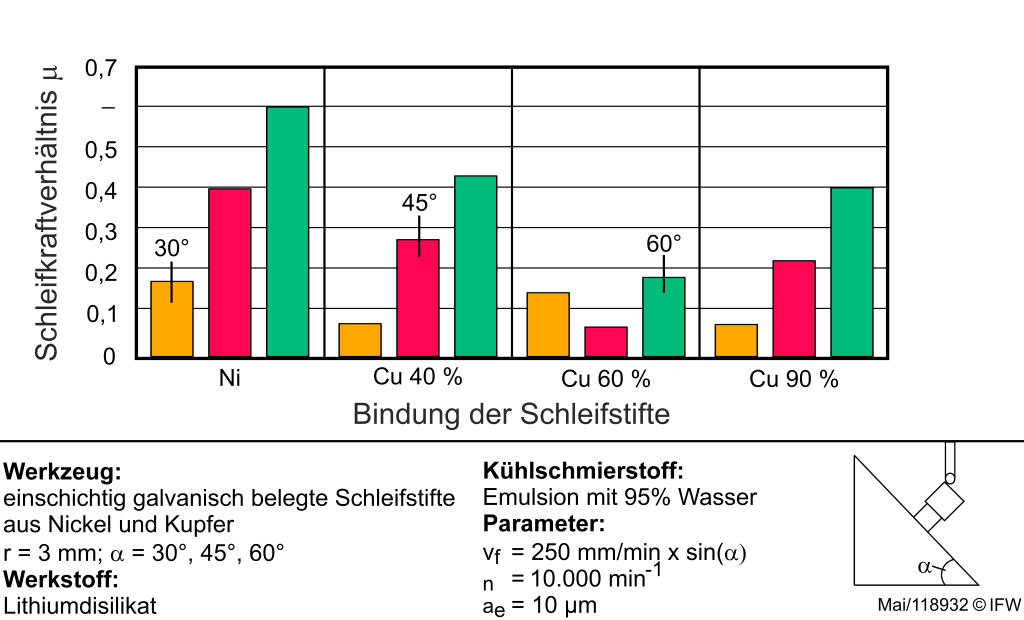
Carbide formation with effect (process-integrated carbide formation to improve grain retention strength)
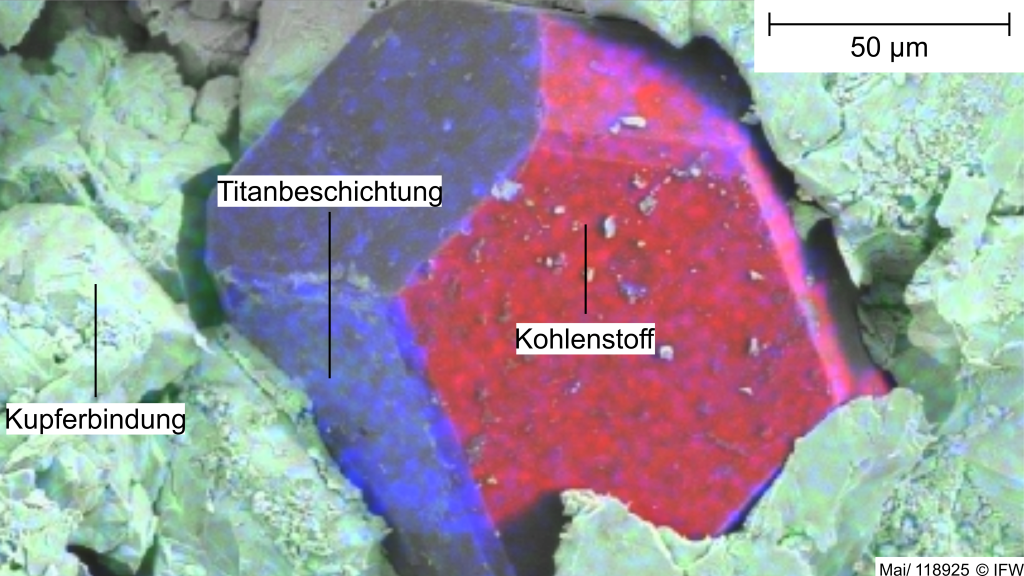
To compensate for the material-related disadvantages of the copper bond, titanium-coated diamond grains are used. Through targeted heat treatment, these react to titanium carbide (TiC), which acts as an adhesion promoter between diamond and metallic matrix and significantly increases the grain retention strength. For the investigations, flat steel samples were coated with titanium-coated diamonds in a copper electrolyte and galvanized. Subsequently, a heat treatment was carried out in the FAST-sintering press of type DSP510 from Dr. Fritsch Sondermaschinen GmbH under vacuum at temperatures from 800 °C to 900 °C for a holding time of 900 s. During this process, the carbon from the diamond reacts with the titanium coating and forms titanium carbide at the interface. Due to its mixed metallic-covalent bonding structure, titanium carbide can interact with both the diamond and the metallic copper matrix. The resulting TiC interface thus improves the bonding of the diamond grains to the copper bond and compensates for its ductile behavior. This leads to increased grain retention forces and lays the foundation for improved tool life and increased process productivity. To verify carbide formation, X-ray diffraction analysis (XRD) was conducted on previously decoppered samples. The evaluation of the diffractograms showed characteristic reflections of titanium carbide (TiC) at 2θ = 42.1° and 49° at both investigated temperatures. Thus, the formation of the TiC interface was experimentally confirmed.
Application studies of the novel grinding tools
To evaluate the newly developed grinding pins, grinding tests were conducted on lithium disilicate, a material typically used for dental ceramic applications. Nickel-bonded grinding pins served as a reference. The influence of grain overhang on grinding behavior was particularly investigated. The results of the preliminary investigations in the flat grinding process show that the copper-bonded grinding pins generate higher grinding forces than the nickel reference, while achieving comparable surface roughness. The lowest grinding forces within the copper-bonded tools were measured for the variants with 40% and 50% grain overhang.
In further investigations with ball-nosed grinding pins under practical 3+2-axis conditions, different angles of inclination of 30°, 45°, and 60° were considered. For the nickel reference, a grain overhang of 60% was used, while the copper-bonded grinding pins were examined with grain overhangs of 40%, 60%, and 90%. The process forces of the copper-bonded variant with 40% grain overhang were at a comparable level to the nickel reference. However, differences were observed in the grinding force ratio μ (see Figure 2), which was lower for the copper-bonded tools. A lower grinding force ratio indicates a higher proportion of normal force compared to tangential force and suggests reduced efficiency in chip formation as well as an increased share of bonding friction during the grinding process. At small angles of inclination, the area of the ball-nose radius is predominantly engaged. Due to the low local cutting speed there, friction and plowing processes occur more intensively, leading to comparatively high normal force shares. With increasing angle of inclination, the contact shifts towards the tool circumference, increasing the local cutting speed and promoting chip formation. As a result, the proportion of tangential force increases compared to normal force, which is reflected in an increasing grinding force ratio. The nickel reference exhibits the highest grinding force ratio, indicating a comparatively high proportion of tangential force and thus a more pronounced cutting effect in the grinding process. The copper bond with 40% grain overhang shows a lower grinding force ratio, but a similar trend across the examined angles of inclination. For the copper bonds with 60% and 90% grain overhang, even lower grinding force ratios were determined.
Scanning electron microscope investigations of the tool surfaces show that the titanium-coated diamonds of the copper-bonded grinding pins are currently not yet fully coated. In particular, there is a low grain concentration in the area of the ball-nose radius. This leads to altered engagement conditions at small angles of inclination compared to the fully coated nickel reference.
The investigations also clearly show optimization potential for the novel bonding concept. By targeted adjustments of the copper bond, for example through controlled brittleness of the matrix and a more homogeneous distribution of the diamond grains on the tool, particularly in the area of the ball-nose radius, competitive grinding pins can be realized. Overall, the results confirm the potential of copper-bonded dental grinding tools as a resource-efficient and biocompatible alternative to the classic nickel bond. In particular, the successful process-integrated formation of titanium carbide represents a promising approach to compensate for the material-related disadvantages of the copper bond and to enable the long-term substitution of nickel-bonded grinding tools.
Authors: Berend Denkena, Benjamin Bergmann, Michael Maier
Contact: