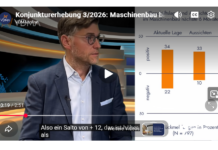

For machinery and plant engineering from Germany, April was a month with mixed messages. On one hand, companies showed resilience despite geopolitical crises and particularly the war in the Gulf region, managing to record 4 percent more orders from abroad compared to the previous year.
The strongest impulses came from non-Euro countries (up 8 percent), while orders from Euro countries were 5 percent below the previous year. Domestic business, on the other hand, remained weak, resulting in a 7 percent decrease in orders. 'Thus, in April, there was a stagnation of orders compared to the previous year,' says VDMA Chief Economist Dr. Johannes Gernandt.
This zero growth was shaped not only by geographical dispersion but also by different developments in the customer sectors of mechanical engineering. 'One can see from the example of data centers, which are also equipped by mechanical engineering, how individual areas can benefit from a special economic situation even in Germany. However, this does not compensate for the growing location problems of the industry, which can only be solved with rapid and profound structural reforms. There is still too much talk about measures to strengthen competitiveness and far too little implementation. We need lower corporate taxes, a more flexible labor market, genuine cost relief in bureaucracy, and a reform of social security systems,' demands the VDMA Chief Economist.
In the less volatile three-month period from February to April 2026, companies recorded an order increase of 5 percent in real terms. This is influenced by the strong reporting month of March, characterized by large orders and large plant business. Domestic orders fell by 2 percent in real terms, while 9 percent more orders were recorded from abroad. Euro countries showed zero growth, while non-Euro countries provided 12 percent more orders.
Contact: