
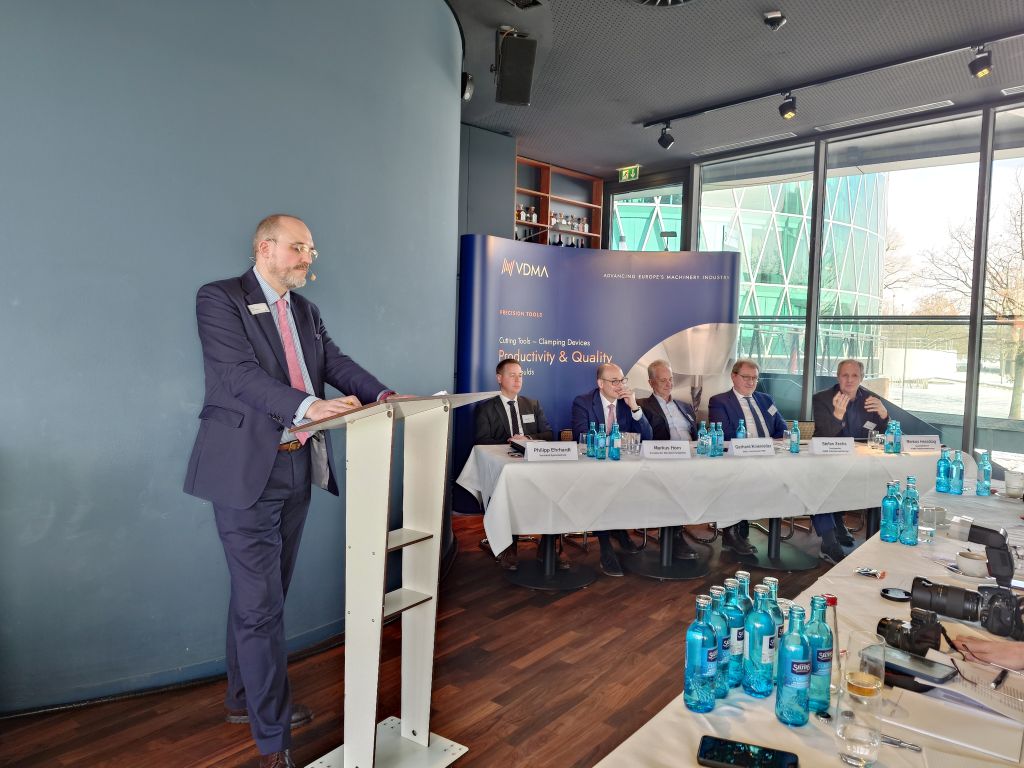
"We have had three difficult years behind us – but the bottom seems to have been reached." With these words, Stefan Zech, Chairman of the VDMA Precision Tools Association, describes the situation in the industry at the beginning of 2026. "Despite declining production and subdued demand, we are seeing the first signs of stabilization. However, the economy still struggles with location disadvantages. It is now crucial that politics finally ensures improved location conditions - through
streamlined processes, less bureaucracy, and a resilience-promoting digitalization."
Production again in the negative
The precision tool industry recorded a production decline of around 7 percent last year to about 8.5 billion euros. Many companies had to reduce staff and cut back on investments. The domestic market remained weak, particularly due to declining production in mechanical engineering and ongoing uncertainty in the automotive industry.
Although demand increased in aviation, medical technology, and the defense industry, these could not compensate for the losses.
In Europe, exports fell by 4 percent. China saw a significant decline of 9 percent, while the USA remained the most important foreign market with an increase of 2 percent despite trade risks. For 2026, the industry expects an overall consolidation at current levels, provided there are no major geopolitical upheavals.
Ruining bureaucratic pressure – uncertainties grow
The central challenges for manufacturers of precision tools remain significantly serious. Bureaucracy burdens companies considerably, especially due to the multitude of reporting obligations. Added to this are increasing geopolitical uncertainties and weak domestic customer sectors that delay or completely suspend investments. Zecha puts it clearly: "The companies are technologically well positioned, but finally need political decisions that create planning certainty and relief!"
Manufacturers of cutting tools had to accept mostly smaller revenue declines in 2025. Both domestic business and exports were 5 percent below the previous year. Companies struggled with high costs, weak demand, and increasingly critical raw material markets.
Carbide recycling in Europe
The tightening of tungsten restrictions in China was particularly noticeable, leading to shortages, precarious supply chains, and enormous cost increases. At the same time, recycling solutions are gaining importance: collection systems and processing of carbide in Europe as well as the efficient reprocessing of tools have been established for years. Zecha: "Therefore, we must do everything we can to keep carbide scrap in Europe. Every gram counts! Carbide in Europe secures
our sovereignty." For 2026, companies expect a gradual improvement over the course of the year and hope for slight revenue growth.
In clamping technology, the year 2025 also fell significantly short of expectations. Revenues declined in the high single digits, particularly in workpiece clamping, which is closely linked to investments in new machines. The foreign business developed negatively.
The only notable bright spot was India with an increase of 10 percent, which for the first time entered the top ten largest sales markets. For the year 2026, the industry expects a slight recovery, but overall again a slightly declining revenue.
Toolmaking fights for survival
Toolmaking faced significant production declines again in 2025. Many companies had to file for bankruptcy. Particularly, domestic business remained weak, while Chinese suppliers exerted significant pressure on German providers with massively intensified competition.
At the same time, the framework conditions along the entire value chain deteriorated. At least the export business remained stable.
The event calendar of the precision tool industry features key dates this year, including the European Cutting Tools Conference (ECTC), which will take place from May 7 to 9, 2026, in Graz, bringing together leading experts, decision-makers, and companies from across Europe.
And the AMB trade fair from September 15 to 19, 2026, in Stuttgart, which sets central impulses for trends and investments in manufacturing technology as the most important German leading trade fair for precision tools and machine tools this year.
Source:
VDMA Precision Tools Association