
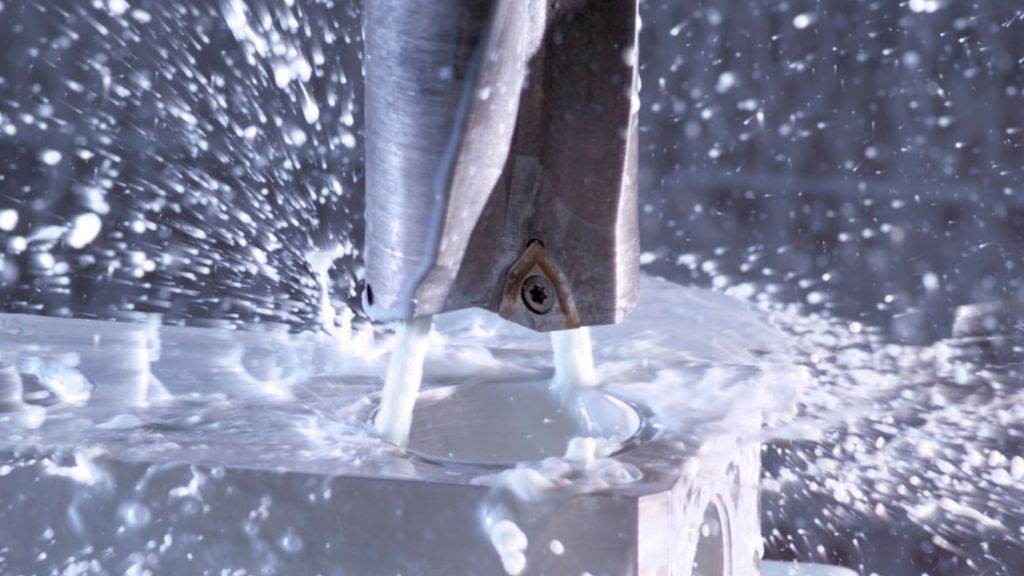
Together with Kennametal Inc. and DMG MORI, a method was developed that derives the coolant volume flow directly from the CAM planning based on the time cutting volume and integrates it into the NC code. The adaptive supply of coolant (KSS) programmed in hyperMILL achieved energy savings of around 82 percent.
The study developed a method for cycle time-based, tool-specific coolant demand planning directly in the CAM system with output of an adapted NC code for milling and drilling processes. This could build on the existing technology of adaptive coolant supply from DMG MORI in practical execution. The project included coolant demand modeling, integration into the CAM software hyperMILL, and validation on the DMG MORI DMU 40 eVo linear machine tool.
Modeling
The modeling of the coolant demand was based on the consideration that with increasing time cutting volume, the amount of heat and chips that need to be removed from the contact zone typically also increases. This simplifying assumption allowed for a robust and tool-specific scalable calculation of the coolant demand based on generally available CAM data. The reference data for the maximum time cutting volume per tool was provided by Kennametal. Pressure, volume flow, and electrical power consumption of the coolant pump were recorded, and characteristic curves for the different hydraulic situations depending on the tool were created.
Programming
To implement the adjustment of the volume flow along the tool path in the CAM software, the Python API (Application Programming Interface) of hyperMILL was used. In the removal simulation of the CAM system, the cutting parameters are analyzed for each processing line, and the time cutting volume is calculated from this in combination with the tool-specific metadata. From this, the volume flow is derived in a module of the IFW, with smoothing before the expansion of the NC data with the command set for volume flow control ensuring that abrupt changes are avoided.
Verification
For validation, a demonstrator made from the material 11SMn30+C was processed with typical industrial operations such as milling, drilling, threading, and shaping on a DMG MORI DMU 40 eVo linear. Instead of using line-by-line control, an averaged volume flow per processing step was used, which proved effective. The energy consumption of the pump was recorded via the frequency converter. The comparison with conventional processing showed a saving of around 82 percent while maintaining the same quality of the processing results. The CAM-based solution proves to be very flexible. It offers the possibility to specifically deactivate the adaptive mode, for example, when drilling, where the mechanical effect of the coolant is needed for effective chip removal. The method is now to be further developed and researched and made available for other tool types, processing methods, and materials.
The results of this study were published by Prof. Dr.-Ing. Berend Denkena, Dr.-Ing. habil. Marc-André Dittrich, Dr.-Ing. Klaas Maximilian Heide, Dr.-Ing. Alexander Krödel-Worbes, Andreas Lieber, Dipl.-Ing. (FH), as well as Talash Malek, M. Sc. and Martin Winkler, Dipl.-Ing. (FH) under the title 'Coolant Demand Planning Directly from the CAM System' in issue 09/2025 of the journal VDI-Z.
Contact:
www.openmind-tech.com