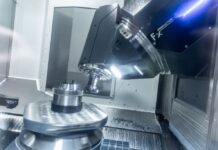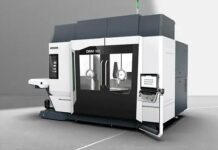

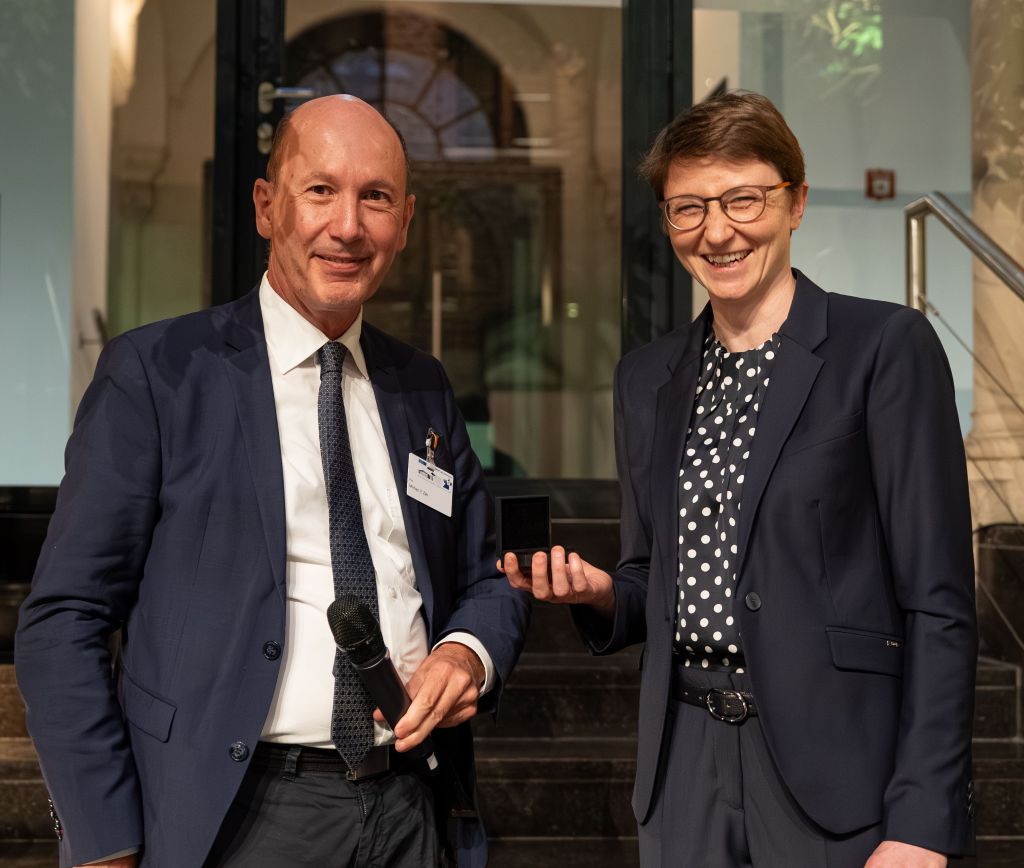
At the very beginning of her studies, Dr. Monika Kipp – this year's awardee of the Otto Kienzle Memorial Prize from WGP – discovered her passion for machining and particularly for grinding technology during an internship. Throughout her activities at the Institute for Machining Manufacturing (ISF) at TU Dortmund, this enthusiasm led to solid international research projects that significantly advanced grinding technology, especially in tool grinding. She investigated the fine machining of hard metal using elastically bonded diamond grinding tools. Additionally, compliant diamond tools, which can also be used to rework structured surfaces without compromising their profile, play a significant role in her work. She researches surface fine machining with diamond-coated foams. “With Monika Kipp, we have been able to honor a young scientist who has already made a name for herself internationally in her research area at a very early stage,” says Prof. Michael Zäh, President of WGP. “Her determination and commitment are exemplary.”
A scholarship brought the aspiring industrial engineer into close contact with companies very early on. Later at ISF, she was able to intensify collaboration with industry as part of her research activities at ISF Dortmund in industrial collective research. “I greatly appreciate that I was able to benefit from the experiences of established industry representatives as a young person and build a network,” she reports. The young talent grew up in the Tecklenburger Land, between Münster and Osnabrück. She still lives there and drives about 100 km to Dortmund to the university every morning. Although the Ruhr area is known for its traffic congestion, it often runs better than one might think, she says. She adds, “However, today there was traffic due to an accident,” which is why she is conducting the interview from a rest area in her car. However, this is not something that could unsettle Monika Kipp to the point where she couldn't rave about the fine machining of hard metal tools or the influence of preparation for the same.
Good preparation is important in grinding
The latter is very exciting, especially since she can further develop her doctoral topic with it, the 35-year-old is pleased. She initiated it in cooperation with colleagues in Gothenburg, Sweden, at Chalmers University of Technology. The Rudolf Chaudoire Prize from TU Dortmund enabled her to undertake this research stay last spring. “The stay there was extremely educational and rewarding,” raves the Saerbecker. “We were able to advance fundamental knowledge on the preparation of diamond fine grinding wheels and the interactions with material separation in the surface fine machining of hard metal.”
In this project – as well as in others she is involved in – the young scientist appreciates the collaborations with other research disciplines, such as materials science and physics, but also with industry.
Fine machining like with a kitchen sponge
In addition to her research on tool grinding and tool preparation, Monika Kipp cites the finishing of surfaces with diamond-coated foam as one of her central research topics – work that has also attracted great interest at international congresses. “This material allows for efficient processing of complex surfaces. At the same time, it behaves as flexibly as a kitchen sponge, allowing it to adapt to shapes and structures. This enables even structured surfaces to be finely reworked and micro-defects removed without compromising the profile. Thus, the process has great potential for many industries, from hard metal machining to medical technology,” explains the young scientist. She also wants to continue researching in this direction with the team at ISF and initiate a follow-up project.
Mentor for Students and Employees
Her determined research has already taken the awardee far early on. Even before her doctorate, she was given the opportunity to lead the Grinding Technology Department at ISF at TU Dortmund in 2020 – just five years after she started as a research assistant. “I was very happy to accept the offer and immediately agreed because it is an incredibly great opportunity for personal development.” She means this not only in relation to grinding technology but also with regard to “background topics” such as leading her current 18-member team, organization, and collaborations.
In addition to her role as department head, teaching courses is also part of her responsibilities at ISF. “I want to not only pass on knowledge but also inspire enthusiasm for grinding technology. I try to do this by linking theory with practical applications – and with a look into the future. When young students know where technologies could develop, they can relate it more to their own future. This makes the topics more tangible.” Monika Kipp sees herself as a mentor for students and her employees. “I want to accompany them not only in their professional development but also pass on my own experiences, act as a sparring partner in discussions, so that young people can also develop personally. This can only happen with open, equal exchanges.”
Sport as a Balance
But how can the extraordinary commitment at the university be reconciled with private life? “I am a very active person,” says the young talent about herself. She practices athletics, volleyball, and rides motorcycles. “With sports, especially athletics, I create a balance for myself.” Until 2009, the grinding technician even competed in middle-distance and steeplechase as a competitive sport. “Today, I am just a joyful hobby runner.” In addition to physical activity, she is also active in her club SV Teuto Riesenbeck e.V., among other things as a judge. “This way, I keep in touch with competitions. And since I can schedule my volunteer work myself, I manage it well alongside my work at ISF. If I didn’t do this, I would miss something.”
Contact:
wgp.de