
At the automotive supplier Schabmüller, MAPAL has been responsible for tool management for some time. Now, the tool manufacturer from Aalen has also taken over the CAD/CAM programming of the components, including simulation. With increasing demands on aluminum processing, the manufacturer appreciates this complete service.
Schabmüller Automotive Technology GmbH (SMI) in Großmehring near Ingolstadt has been active as an automotive supplier since 1988 and has increasingly specialized in the efficient production of large series. The parts are used in vehicles from Mercedes, Porsche, Audi, BMW, and Jaguar, among others. SMI primarily acts as a Tier 2 supplier. Major customers include Aludyne and Strojmetal, which are direct suppliers to the automotive industry as aluminum foundries and forges.
Until a few years ago, Schabmüller produced cylinder head covers for the VW 3.0-liter V-conglomerate engine in annual quantities of up to 320,000. The components, for which Schabmüller also takes over assembly, are still manufactured, although the volume has already decreased. However, other large orders have come in that make the company less dependent on the combustion engine.
“In the meantime, the production of chassis parts has started. This gives us the opportunity to diversify in this direction,” says Managing Director Helmut Häckl. “Our company has developed and specifically aimed for this goal.” However, the new components also bring challenges for Schabmüller.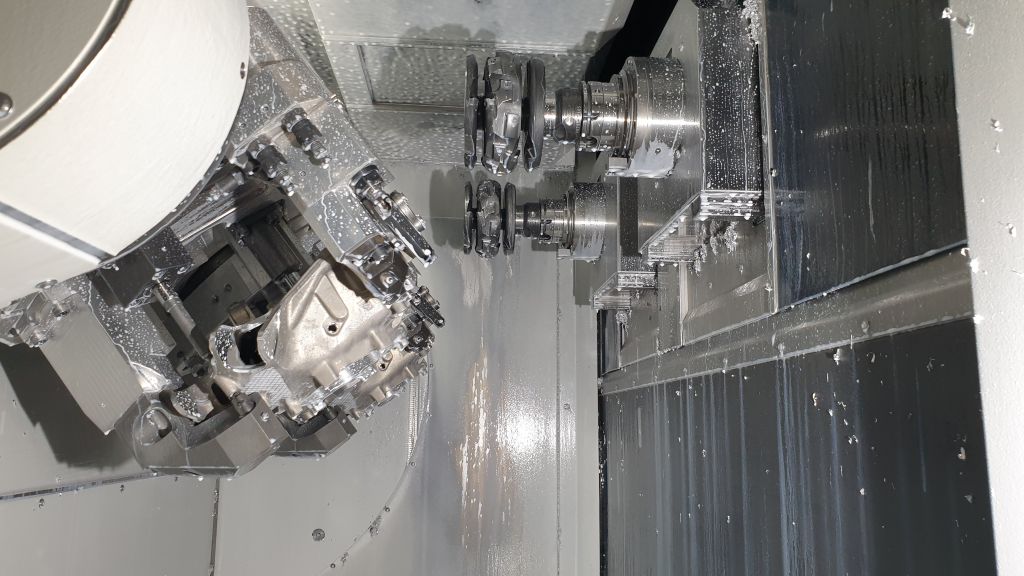
In entering the production of chassis parts, Schabmüller has gained entirely new experiences. Especially with components for electric vehicles, projects are sometimes postponed, originally planned quantities are not reached, or there are last-minute changes before series production starts. Helmut Häckl knows the background: “The OEMs gather experiences in load tests for the increasingly heavier vehicles due to battery weights until the end.”
This leads to certain components being designed more robustly to cover every limit situation.” Stephan Streck, Technical Consultant at MAPAL, illustrates this with an example of a wheel carrier. Because problems with stiffness had arisen during operation, an additional surface to be processed and a stiffening rib were added at the last minute.
Schabmüller must already plan the facilities and prices for the components before it is clear how they will look in detail, which repeatedly poses challenges for the manufacturer. “To get an order, the cycle time is the decisive factor,” says Helmut Häckl.
MAPAL involved from the very beginning
To better manage such short-term changes and further optimize the entire production, Schabmüller decided to involve MAPAL right from the CAD/CAM programming. “We maintain a very cooperative collaboration with MAPAL and appreciate the quick response times,” explains Häckl. “Therefore, we felt good about extending the cooperation to CNC programming and simulation.”
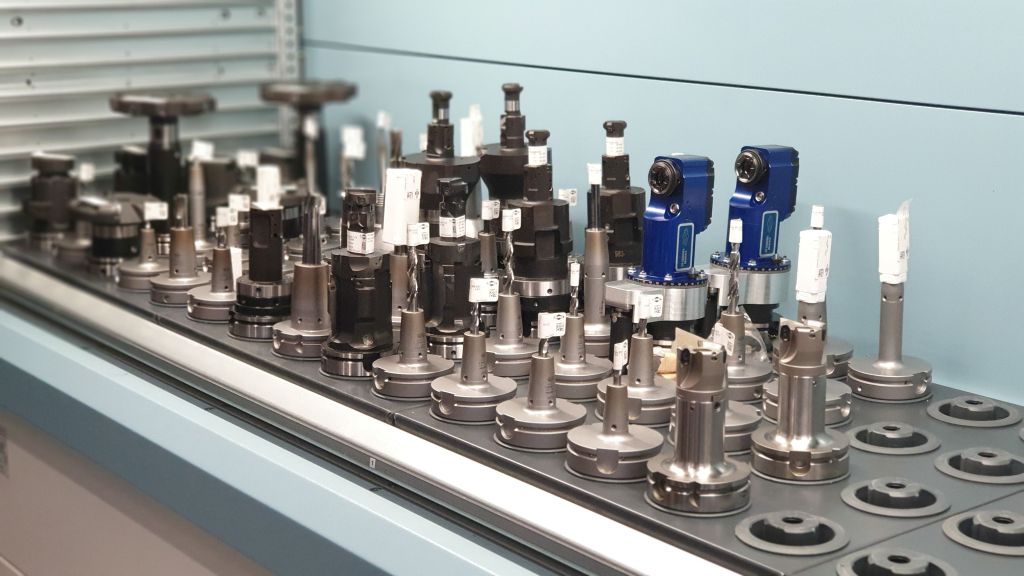
MAPAL has already been involved in tool design for new projects and is responsible for tool management. These services are tailored to the customer's needs. This has already included the scheduling of tools, their presetting, issuing and reconditioning, technical support for series production, and optimization of tool and cycle times as well as tool life.
Since 2018, Schabmüller has not programmed itself anymore. “For CAD/CAM, we need specialists who master this topic,” says Häckl. “If we only tackle two to four new projects a year, one employee cannot be proficient in this.” In the meantime, Schabmüller partially used services from the machine manufacturer for programming. However, there was no possibility for 3D simulations, which made the manufacturer aware that not all possibilities were utilized to optimize cycle times.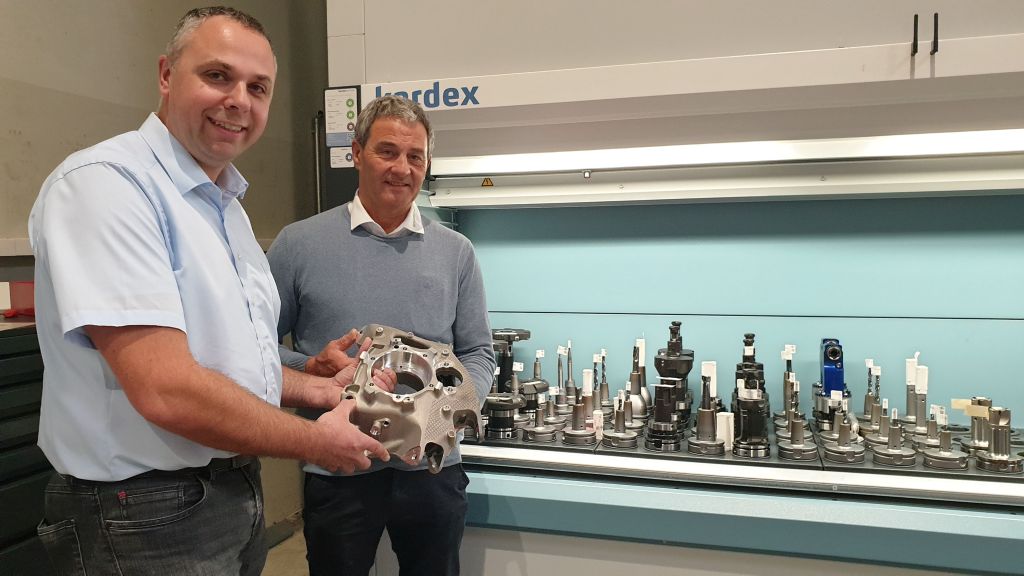
Since MAPAL has been involved from the very beginning, this has changed. NC programming, simulation, and tool management now work perfectly together. For example, simulation data is integrated into tool design, allowing potential collisions to be detected early. Changes to components by the OEMs before production starts can be reacted to immediately. Modifications are still made in the 3D simulations before the tools are finished. “If significant changes are not caught in time, costs in the five-figure range can arise,” explains Stephan Streck the importance of simulation.
For optimizing processing, simulation also plays a crucial role. It shows, for example, entry angles that can improve material removal. The wrapping of a tool can also be reduced with data from the computer. “Such details are much better recognized in the simulation than if you look through the window into the machine,” says Streck.
Forged parts instead of aluminum castings
With the chassis parts, there is a shift in the raw material from aluminum die casting to forged aluminum. Forged components have significantly higher load ratings than cast parts. The higher stability is especially required in electromobility. However, this also increases the demands on machining to achieve the required cycle time. The material removal and thus the volume to be machined are significantly higher here, which requires adjusted milling strategies.
Furthermore, the material properties have changed, as Stephan Streck explains: “Compared to aluminum die casting, the forged material has a significantly reduced silicon content. This results in the chips not breaking well, long chips are produced during machining, and we deal with built-up edges. To find solutions here, the entire competence of MAPAL in aluminum machining is required.” Schabmüller is currently manufacturing part of the wheel carriers, swivel bearings, and camber struts produced in Großmehring from forged aluminum.
High-volume milling cutter NeoMill-Alu-QBig used before market introduction
Improving processes also includes that MAPAL incorporates new tools as soon as they become available and promise advantages. As application technician Eugen Bien reports, the new indexable insert milling cutter NeoMill-Alu-QBig was used at Schabmüller even before it was officially launched on the market.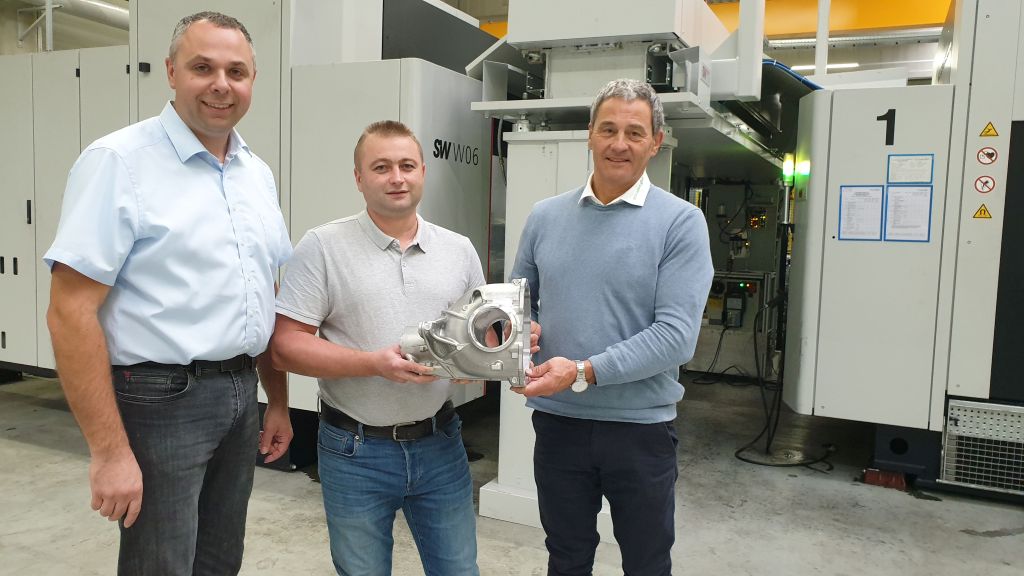
This new indexable insert milling cutter from MAPAL stands for top performance in high-volume milling of aluminum. To achieve the largest possible material removal rates, it is designed for use at speeds of up to 35,000 rpm. Screws with increased tensile strength ensure a secure fit despite high centrifugal forces, keeping the indexable inserts firmly in the prismatic seat. MAPAL has equipped the main body with a fine balancing system to protect the machine spindle and achieve the highest possible surface qualities. Additionally, the focus during development was on low cutting forces and highly precise indexable inserts.
Among the three available coatings, MAPAL technicians chose a diamond layer for the machining of die-cast parts at Schabmüller. In operation, the machine operator rotates the indexable inserts with their two cutting edges directly at the machine, while MAPAL takes care of the retooling of the cutters in the setting room. A benefit is shown by the tougher carbide cutting edges of the NeoMill-Alu-QBig compared to the previously used cutters with soldered PCD cutting edges: they break less quickly under sand residue conditions from the casting mold on the raw part.
However, something else is crucial for the user, as Helmut Häckl confirms: 'In production, we have achieved shorter cycle times with the NeoMill-Alu-QBig because we can operate at higher values for cutting speed and feed rate. For that, we would even accept lower tool lives.'
The switch to the NeoMill-Alu-QBig has resulted in a different milling strategy and a higher center density due to the tool. The values measured by MAPAL confirm the success achieved. The implemented adjustments with higher cutting parameters, the transition from circular milling to helical milling, and the resulting improved machining conditions resulted in a cycle time saving of 54 percent for this processing. With the new tool, the tooth feed could be increased from an average of 14 mm to 32 mm.
In the extensive tool set for machining a wheel carrier, the NeoMill-Alu-QBig is one of the few standard tools, but it plays a crucial role in cycle time, as Eugen Bien states: 'The use of the NeoMill-Alu-QBig accounts for about 30 percent of the total processing time.' The focus is on roughing the component, but the tool also produces surfaces in finished part quality.
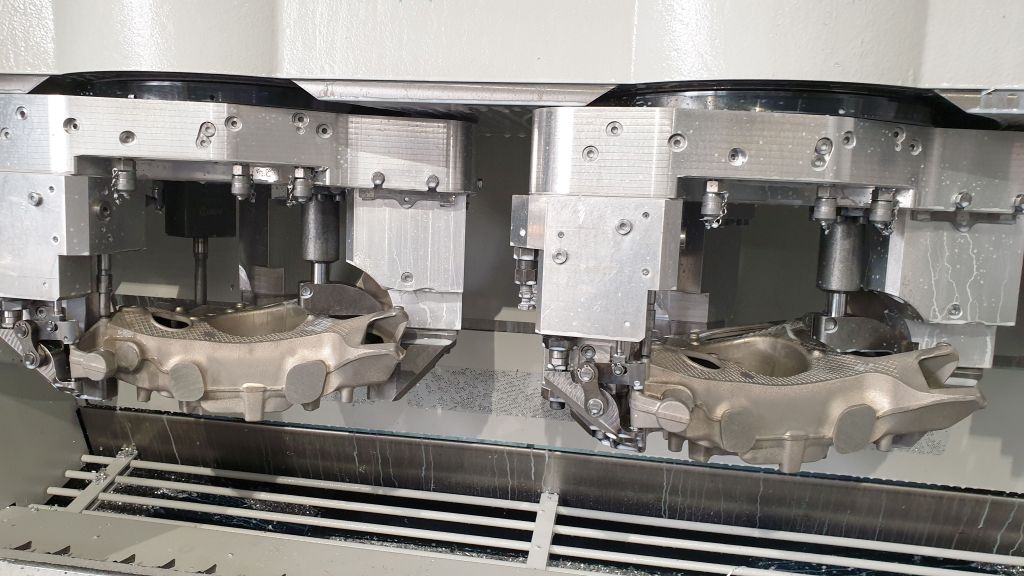
Wheel carriers place high demands on the machining strategy. For Porsche and AMG, Schabmüller manufactures about 97,000 pieces annually from cast or forged parts, for which a cycle time of six minutes is required for two components on the twin-spindle machine. The tool sets for this include 45 to 55 tools. The majority of these are customer-specific special tools. Most of them, such as drills, step drills, or fine drilling tools, are only used briefly for one or two operations. The task of the simulation is to keep the non-productive times as short as possible with the multitude of tools and ideally to approach each operation only once.
Room for future growth
Schabmüller currently has around 150 employees and is steadily growing. Recently, a third hall was completed. Originally designed for the production of cylinder head covers for VW in large quantities, part of the double hall is currently being used for other purposes. To manufacture head plates for batteries of electric vehicles, Schabmüller machines a large part of the raw material. In a second project, rear axle housings are being produced for another automotive manufacturer.
Contact: