
Their development of a cold-formable, copper-alloyed austenitic steel casting with TRIP/TWIP properties marks a milestone in materials science and opens entirely new perspectives for safety-critical applications. The new alloy offers an unprecedented combination of strength and ductility: it is highly load-bearing and can still deform plastically.
The Secret of the TRIP/TWIP Effect
The core of this innovation lies in the so-called TRIP/TWIP effect, which gives the new steel casting its extraordinary properties. TRIP stands for 'Transformation-Induced Plasticity' and TWIP for 'Twin-Induced Plasticity'. These mechanisms cause the microstructure of the material to change under load, leading to a significant increase in strength and ductility.
TRIP Effect: Under mechanical stress, part of the austenite, a soft and tough microstructural phase, transforms into martensite, a hard and solid phase. This transformation leads to a local hardening of the material and increases its resistance to cracks.
TWIP Effect: Here, so-called deformation twins form in the austenite, which also contribute to hardening and increasing the toughness of the material.
Both effects enhance the tensile strength of the material and its ability to absorb mechanical energy:
"By combining these two effects, the strength of the material is significantly increased and component failure under dynamic load is delayed. Additionally, the forming ability and energy absorption capacity in the event of an impact are greatly improved," explains Nadine Lehnert, who has taken over project management at Fraunhofer IWU for the DFG-funded research project 'Cold Forming of Steel Casting'.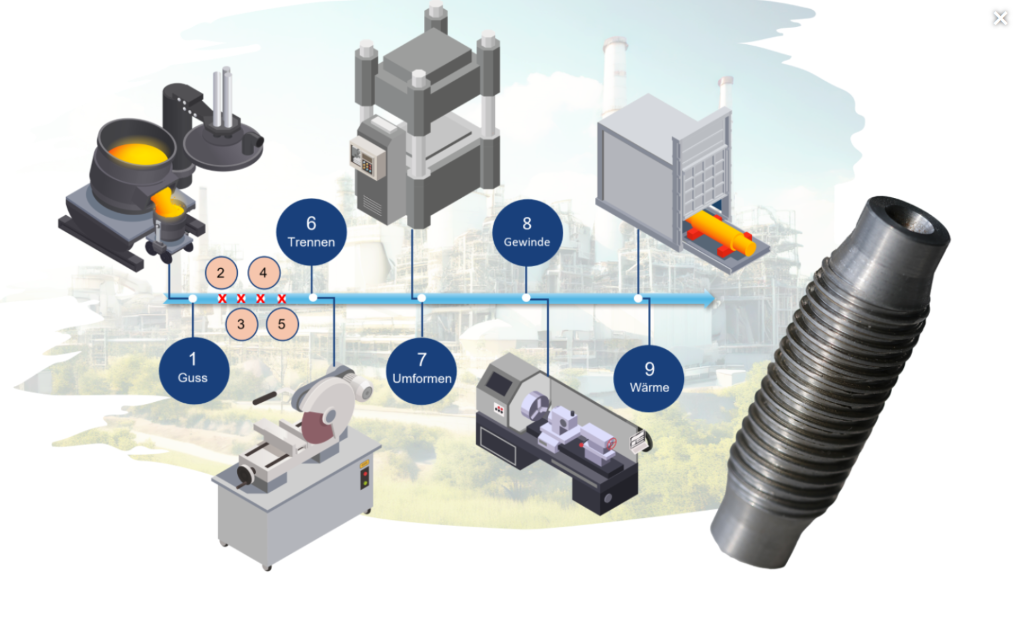
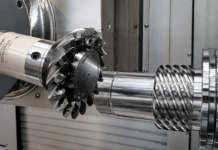
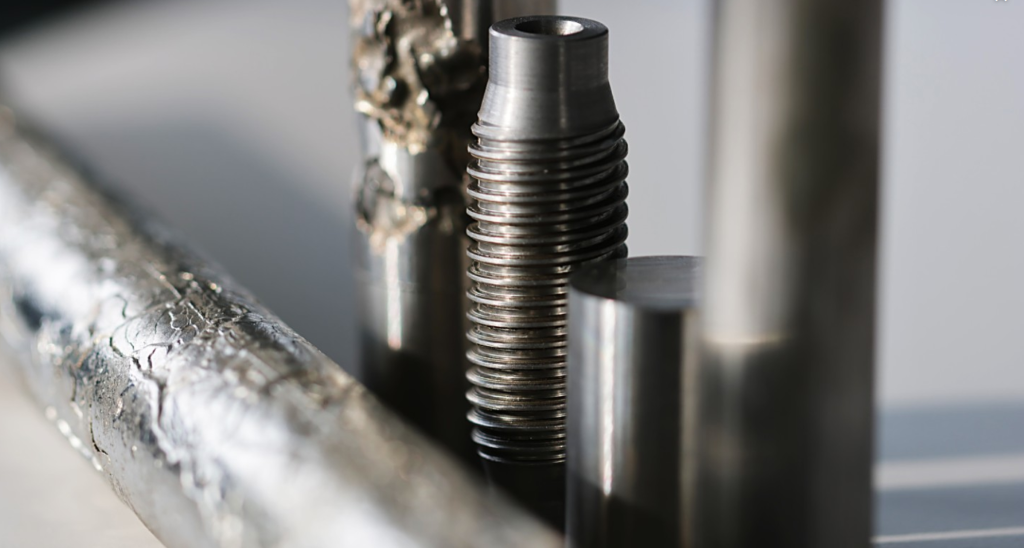
And this is how it works: The initial shape from the examined steel casting alloy is transformed through cold bulk forming into a product with a fine-grained, re-transformed austenitic microstructure. The manufacturing route begins with a coarse-grained austenitic structure. The workpiece is first reduced in diameter in a flow forming die. This mechanical load leads to a partially martensitic microstructure due to the TRIP/TWIP effect. The subsequent heat treatment in the oven results in a reduction of grain size (fine grain) in the component, thanks to the re-transformation of martensite into austenite.
Under high load, a crack may occur in the component, specifically in the austenitic microstructure, which, however, does not lead to failure but is stopped by a martensitic transformation of the microstructure. The subsequent hardening (martensite) even increases the load-bearing capacity of the material.
Application areas with high safety potential
The unique properties of the new steel casting predestine it for use in safety-critical applications where the highest demands are placed on strength, toughness, and reliability.
- Automotive: Screws, chassis components, crash absorbers, and body structures benefit from the high energy absorption and crash safety of the material.
- Aerospace: Structural components and fastening elements can be designed lighter and more resistant with the new steel casting.
- Medical Technology: Implants and surgical instruments can be optimized due to the high biocompatibility and strength of the material.
Construction and Infrastructure: Mountain anchors and fastening elements for bridges and tunnels can be made safer due to the high crack resistance of the material. The alloy shows its advantages where durability under extreme loads is essential.
Energy-efficient cold forming as a key technology
Another crucial advantage of the new steel casting is its suitability for cold bulk forming. This process allows for the production of components at room temperature, making energy-intensive processes like hot rolling unnecessary. "The process chain of cold forming is significantly shorter and more efficient. We start with a pre-cast workpiece that is then directly formed. This eliminates numerous energy-intensive steps such as heating, rolling, and pickling that are required in hot forming," explains Lehnert.
Sustainability and Economic Efficiency in Focus
In addition to the technical advantages, the development of the new steel casting also contributes to sustainability and economic efficiency.
Resource conservation, health aspects: The partial replacement of nickel with copper reduces the use of expensive and scarce resources as well as health hazards during processing.
Energy savings: Cold forming consumes significantly less energy than hot forming, leading to a reduction in CO2 emissions.
Cost efficiency: The simplified process chain, lower material usage, and reduced gas consumption (cold bulk forming) lower production costs.
A Look into the Future
The research results of the team form the basis for a targeted use of the TRIP/TWIP effect for safety-critical applications. Future research at Fraunhofer IWU will focus on optimizing the forming process and specifically adjusting material properties. "Our goal is to fully exploit the potentials of the TRIP/TWIP effect and enable the economical production of high-performance components for a variety of applications," says Lehnert.
Register: