
Variety of variants, complex components, skilled labor shortages, demanding manufacturing resources, high quality requirements, increasing cost pressure, distributed partners and organizations, as well as evolved system landscapes are typical challenges faced by manufacturing companies today. At the same time, automation, digital networking, and artificial intelligence open up new opportunities to sustainably improve productivity, speed, and cost-effectiveness.
The real challenge usually lies not in the individual factors, but in their interplay. They typically occur simultaneously and reinforce each other. It is precisely these interactions that determine whether complexity becomes a success factor or a competitive disadvantage.
Under the guiding principle of 'Decoding Complexity', Tebis demonstrated at AMB 2026 how manufacturing companies can tackle the challenges of increasing complexity and create the foundation for future-proof and scalable manufacturing processes.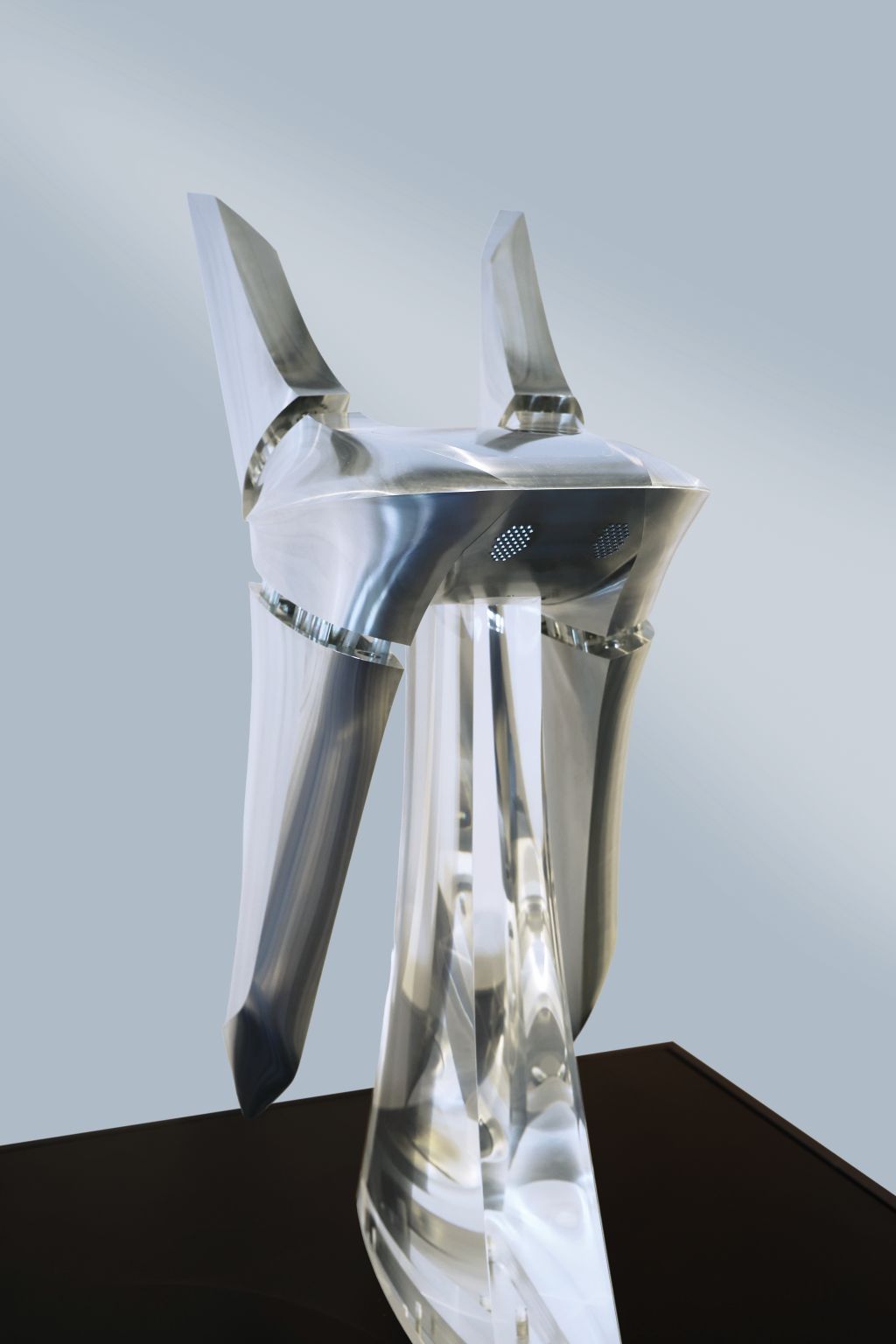
As Jens Lüdtke, Chief Strategy Officer (CSO) and board member of Tebis AG, explains: 'The discussion in the industry is currently heavily focused on artificial intelligence. We are convinced: The central question is no longer which technologies are used, but how companies manage their increasing complexity and translate it into efficient processes. That’s why we pursue a clear Process-First approach. We help companies connect knowledge, processes, data, and existing systems consistently and make better use of existing investments instead of replacing them. This creates the prerequisites for more productivity, higher speed, and lower operating costs. Only on this basis can automation and artificial intelligence realize their full potential.'
The process supplier as an answer to growing complexity
For more than 40 years, Tebis has supported manufacturing companies in standardizing, digitizing, and continuously developing their manufacturing processes. From this experience, an approach has emerged that helps companies manage increasing complexity step by step.
As a process supplier, Tebis accompanies its customers from the analysis of the initial situation through the design and implementation of new processes to continuous optimization.
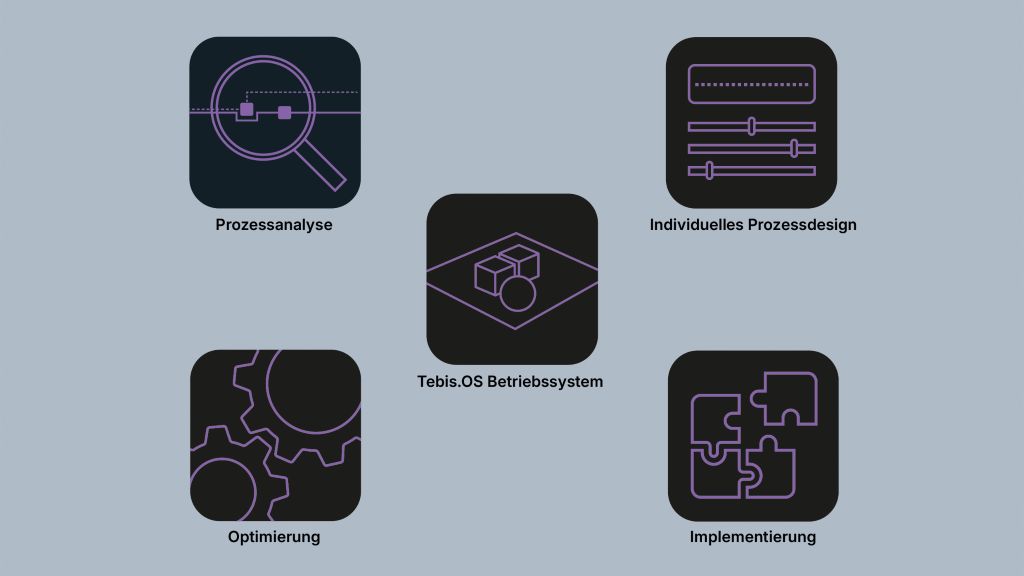
The foundation consists of five coordinated building blocks:
• Process analysis
• Tebis operating system Tebis.OS
• Individual process design
• Implementation
• Optimization
The Tebis solution is flexible enough to start with a specific process and scalable enough to grow step by step with the company's requirements.
Tebis.OS connects systems instead of replacing them
With Tebis.OS, the Tebis operating system, Tebis provides insights into the next development stage of this approach for the first time at AMB.
Tebis.OS connects systems, data, and processes end-to-end and across manufacturers into a common digital process landscape. Existing applications and investments are retained. CAD/CAM, ERP, MES, PLM, QMS, and other systems are gradually integrated and networked.
Thus, Tebis.OS does not stand for the replacement of existing solutions, but for their intelligent connection. At the same time, Tebis.OS creates the foundation for the use of new technologies. Tebis sees artificial intelligence as an enabler for seamless processes.
With this approach, AI supports companies in,
• reducing non-value-adding activities,
• making knowledge available faster,
• preparing decisions,
• better utilizing automation potentials, and
• continuously developing processes.
NEXT40 makes the future visible
With the research project NEXT40, Tebis exemplifies how new technologies, automation, and digital networking can be thought together in future manufacturing environments. The project thus symbolizes the guiding principle of 'Decoding Complexity' and provides a glimpse into the manufacturing of tomorrow.
Making processes tangible
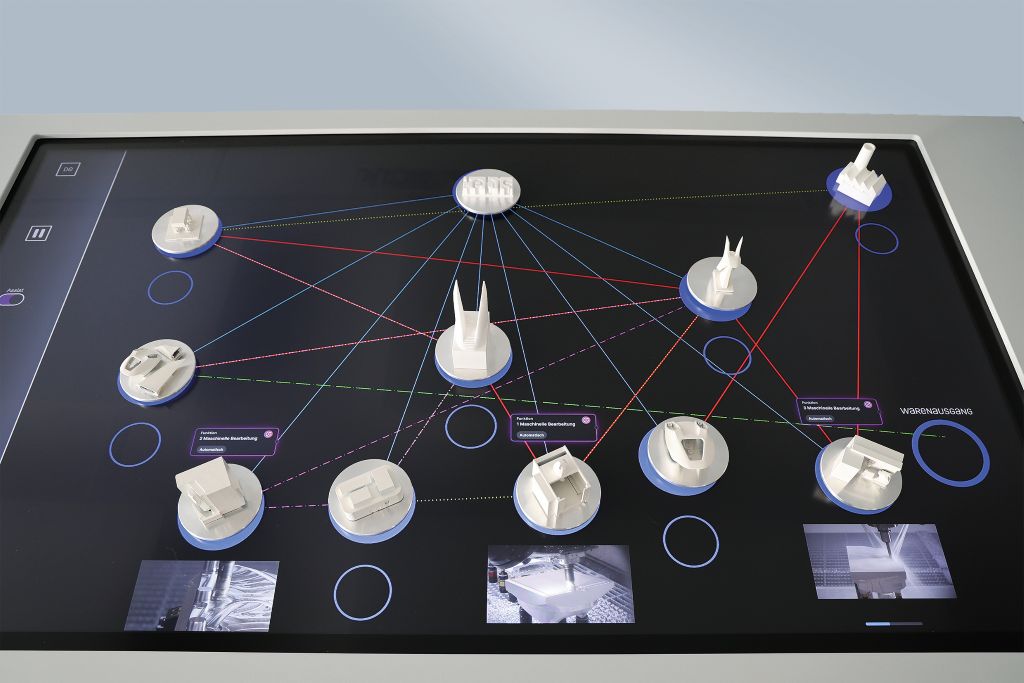
How complexity arises in modern manufacturing companies and how it can be managed was additionally demonstrated by Tebis at an interactive trade fair table.
Visitors can trace how information, decisions, systems, and processes interact and what influence standardization, networking, and automation have on a company's performance. This makes the concept of the process supplier immediately tangible.
Shaping the future together
At AMB, Tebis took the opportunity to discuss future use cases and pilot projects with selected companies.
The goal is to develop new solutions together with customers and to incorporate practical experiences early into further development.
Contact: