

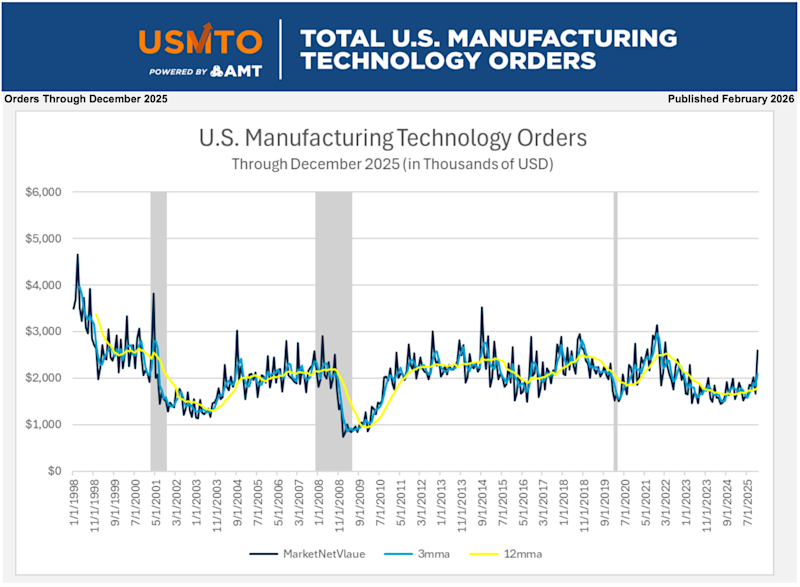
According to the U.S. Manufacturing Technology Orders Report published by AMT – The Association For Manufacturing Technology, orders for metalworking machines amounted to a total of $814.3 million in December 2025, achieving the highest monthly value ever recorded. The order value increased by 86.7% in December 2025 compared to November 2025 and by 59.9% compared to December 2024. By November 2025, the total annual value had already exceeded the value of all orders in 2024 by 5.1%. With the orders in December, the total value of machine orders for 2025 rose to $5.74 billion, surpassing the year 2024 by 22.5%.
While demand for manufacturing technology quickly recovered after the COVID-19 recession in 2020 and rose by more than half in 2021, it was followed by a three-year decline that reached its lowest point in the summer of 2024. In September 2024, the industry began to recover after IMTS – The International Manufacturing Technology Show. This demand surge at the end of 2024 was further amplified in 2025 by a less restrictive interest rate environment, the reduction of uncertainty that prevailed in mid-year, and the passage of tax provisions that facilitated capital investments.
By 2025, the value of investments in manufacturing technology followed a relatively linear upward trend, while the number of ordered units fluctuated somewhat: January recorded the lowest order value of the year, while the quantities from May to August showed a slight decline. These diverging trends suggest that the increased uncertainty following the announcement of tariffs in April may have delayed some orders, but that large, long-term investments remained unaffected by the growing uncertainty and political unrest.
The decline in orders between May and August 2025 was slightly attributed to the increased uncertainty during that time, but it also continued a longer-lasting trend that began in the second half of 2021: the weaker correlation between the number of ordered machines and their value. Instances where two data series deviate from a normally correlated trajectory have occurred so frequently in economic data analysis that a December 2025 article in the New York Times posed the question: 'When did everything become K-shaped?' These bifurcated trends in machine orders are largely attributed to the increased demand for automation and differing purchasing patterns across various customer sectors.
Orders from contract manufacturers, the largest customers of manufacturing technology, increased by 19.1% in 2025. This sector is a strong driver of quantity growth, so its underperformance compared to the overall market growth of 22.5% has contributed to an increasing divergence between dollar value and quantity trends. Conversely, the aerospace industry typically purchases high-value machines that drive dollar value growth without significantly impacting quantities like other customer sectors. The rising factory deliveries in 2025, along with ongoing capacity constraints, led to a 45.1% growth in manufacturing technology orders from aerospace manufacturers compared to 2024.
Investments by automotive manufacturers in manufacturing technology have fluctuated significantly in recent years, as the industry made headlines with its entry into electric vehicle production and similarly made a public retreat, necessitating further retooling of production lines. This response to consumer preferences led to a 22.2% increase in machine investments in 2024. The fastest-growing sector in 2025 was the industry for commercial and service machinery, which increased by 121.5% compared to 2024. In addition to other equipment used throughout the service sector, this industry also manufactures inspection devices that are intensively used in chip factories.
The forces driving investments in manufacturing technology to a new level at the end of 2025 will continue to propel the market in 2026, with single-digit annual growth expected. The race to build AI capabilities is creating opportunities for further revenues in the sectors supporting power generation and distribution. Amid a global decline in steel production, the United States stands out with rising production. Coupled with high investments from primary metal producers in machinery, this could indicate further demand for production capacities in the coming months and years. The machines ordered in 2025 will arrive in manufacturing halls in the first quarter of 2026 and are expected to increase the consumption of cutting tools in 2026 by nearly 5% in conjunction with the growing industrial activity.
The sustained consumer demand and increased investments in manufacturing technology support the Federal Reserve's assertion that interest rates are approaching the neutral rate, if not already reached, as supply and demand in the economy increasingly align. If these factors persist as expected, a reasonably rationally optimistic manufacturing sector will gather from September 14 to 19 in Chicago when IMTS – The International Manufacturing Technology Show – opens its doors.
Contact: