
With the successful project Green Factory of the Future, Ford Motor Company, in collaboration with the Machine Tool Laboratory WZL of RWTH Aachen, has created a scientific approach for a more sustainable vehicle production of the future. The goal of the project was to shape the transition of production towards battery electric vehicles in a technically and ecologically responsible manner and to support it in the long term. For this purpose, a dedicated assessment model was developed that creates transparency regarding the sustainability transformation towards the 'Positive Impact Factory'. The 'Positive Impact Factory' describes a factory with a demonstrably positive impact on the environment and society. The following central areas of action are addressed:
- Digitalization – more efficient and transparent design of processes
- Circularity – resource conservation
- Integration of industrial production sites into the local environment – strengthening the socio-economic impact
With this approach, the project Green Factory of the Future connects sustainability and digitalization into a comprehensive transformation that can serve as a blueprint for future-proof production sites.
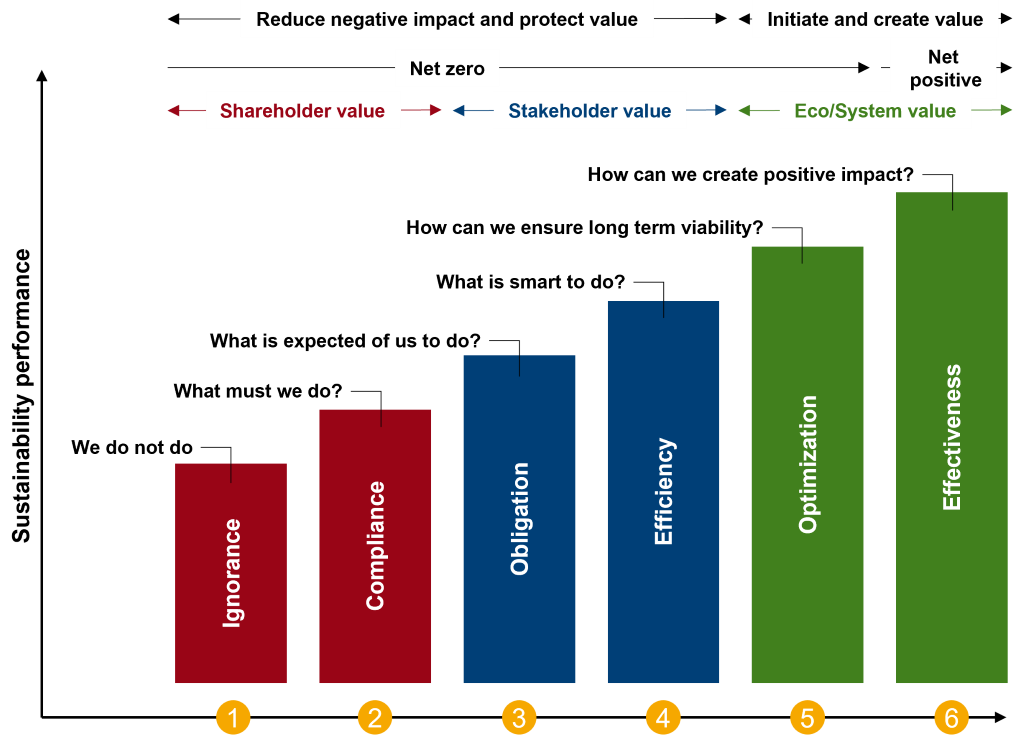
At the pilot location Köln-Niehl, based on a comprehensive analysis of the ecological performance of the existing production environment, measures for the transformation from a linear economy to a value-adding circular economy were identified and evaluated. The focus was on reuse and preservation of value of packaging and production resources. To systematically assess the status quo and derive a roadmap for corresponding improvements, a maturity model specifically developed for Ford Motor Company, the Ford Positive Impact Maturity Model (FPIMM), was used. The scientifically derived maturity model includes a total of 194 indicators and six maturity levels, integrating, expanding, and relating to existing solutions of Ford Motor Company.
The highest maturity level describes effectiveness as the successful linking of digitalization and sustainability – the central goal of the twin transformation. The validation of the maturity model shows an above-average sustainability level for the pilot location Köln-Niehl, including its surrounding area. Particularly noteworthy: The highest maturity level effectiveness describes an industrial future vision that is currently only visible in approaches across the board. The assessment, which confirms the success of long-standing environmental initiatives at the Köln site and honors the commitment of the Köln team around Sylvia Hansen, Stefan Baumeister, and Maira Magnani, is all the more significant. The team of plant environmental protection plays an important role as a driver and sparring partner in the transformation to the Positive Impact Factory.
Contact: