
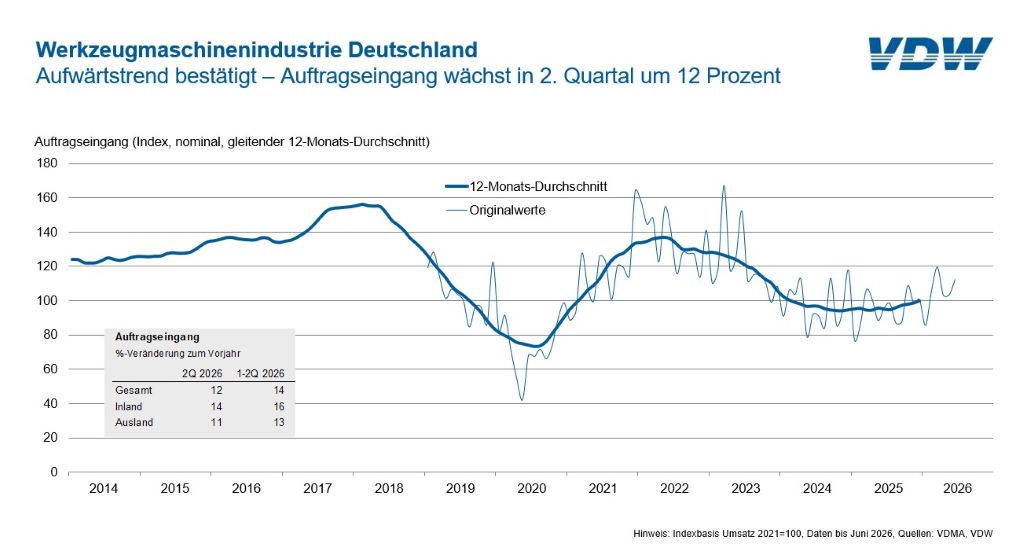
The recovery in the German machine tool industry is gaining shape. In the second quarter of 2026, order intake increased by 12 percent compared to the same period last year. Following a 15 percent increase in the first quarter, the total growth for the first half of the year amounts to 14 percent. Domestic orders rose by 16 percent, while orders from abroad increased by 13 percent.
Two consecutive quarters with double-digit order growth are an encouraging signal. The low point is behind us, and the upward development is solidifying,” comments Bernhard Geis, Head of Economics and Statistics at VDW (Association of German Machine Tool Manufacturers), on the figures. “However, it is still too early to sound the all-clear. We are coming from a low starting level, and the project business continues to contribute significantly to growth. Therefore, we can only speak of a limited recovery in demand.”
Aerospace and defense drive demand
The development continues to differ significantly by customer sectors. Aerospace and defense are showing particularly dynamic growth. The demand from the electronics industry and medical technology is also viewed positively. The situation remains more difficult in metalworking and mechanical engineering. The greatest challenges continue to lie in the automotive and supplier industries. Their share of total sales in the German machine tool industry fell to 23 percent in 2025. The largest customer remains mechanical engineering with 27 percent. In contrast, the aerospace industry has significantly increased its share: it rose by five percentage points to 11 percent within two years.
Improved order situation has not yet reached production
In production, the recovery has not yet arrived. In the second quarter, it was estimated to be 6 percent below the previous year's level. In the first half of the year, production overall fell by 7 percent to around 5.9 billion euros. However, the improved order situation is expected to increasingly manifest in production as the year progresses.
In the export business, at least a trend towards stabilization is emerging. In the second quarter, exports were still 4 percent below the previous year. Thus, the decline compared to the first quarter has significantly weakened. The USA remains a crucial support for the industry as the largest sales market. Deliveries there increased by 8 percent in the first half of the year. In contrast, exports to China, the second-largest sales market, fell by 24 percent. However, companies have recently reported stabilization and slight revival of Chinese demand. Given the intense price competition, the principle of 'Local for Local' is gaining further importance for German manufacturers with local production.
In Europe, German machine tool exports fell by 6 percent in the first half of the year. France developed positively with an increase of 25 percent and moved up to third place among the most important sales markets. Poland and the Czech Republic also provided positive impulses. India continues its growth trajectory and is now the fourth largest sales market in the industry.
Domestic orders increase
The development in the domestic market remains tense. Domestic sales were 10 percent below the previous year's value in the first half of the year. However, positive signals are coming from the increased domestic orders. Currently, economic indicators such as the ifo business climate and the purchasing manager index also indicate improved sentiment in the industry. Imports performed better than domestic sales with a decrease of two percent. In particular, Japanese and South Korean manufacturers were able to increase their sales in Germany. Overall, domestic consumption fell by 6 percent, indicating that the investment weakness in the German market has not yet been overcome.
Capacity utilization has recently stabilized at around 75 percent. At the same time, the structural adjustment process in the industry continues. In June, companies employed around 60,000 people, which is about 6 percent less than a year ago. Production is now roughly one-third below the peak levels of previous years. Bernhard Geis summarizes: 'Overall, order intake has been moving in the right direction for half a year now. It is crucial that this leads to a sustainable recovery.'
Contact: