

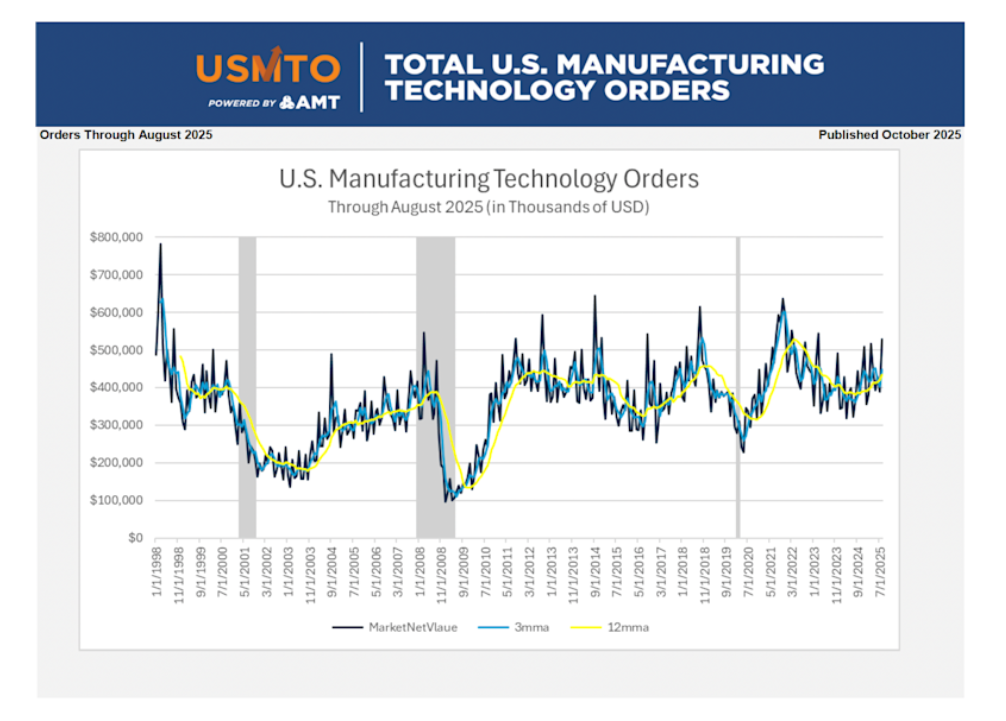
The order intake for metalworking machines, measured by the U.S. Manufacturing Technology Orders Report published by AMT - The Association For Manufacturing Technology, amounted to a total of $529.4 million in August 2025.
This represents an increase of 36.2% compared to July 2025 and nearly 45% compared to August 2024. Machine orders totaled $3.44 billion by August 2025, reflecting an increase of 18.3% compared to the first eight months of 2024.
Since January 1998, only 29 months have exceeded the $500 million mark, with almost half of those (44.8%) occurring since June 2021. This underscores the strength of the manufacturing sector following the COVID recession in 2020 despite high uncertainty and numerous headwinds.
The order value in August 2025 from contract shops, the largest customers of manufacturing technology, was the highest since March 2023, but the number of units ordered could not surpass the level from March of this year. As a result, the average order value, a general indicator of the degree of automation or complexity, was the highest among contract shop orders since August 2011.
Orders from aerospace manufacturers decreased by 20% compared to July 2025. Unlike previous strikes in the aerospace industry, the recent strike by Boeing machinists may have led to a slight decline in investments. Despite the monthly decline, the value of order intake was still 23% above the average monthly order value since January 2021.
Construction equipment manufacturers placed their largest orders for manufacturing technology since September 2012. Despite the decline compared to the peaks of 2024, construction spending on manufacturing facilities remains at an extraordinarily high level. Additionally, manufacturers of ventilation, heating, air conditioning, and commercial refrigeration systems, an industry typically correlated with construction activity, recorded an increase in orders in August 2025 to a level nearly 50% above their average monthly order value.
Although machine orders have remained stable despite several economic headwinds until August, there are still several uncertainties that could hinder additional investments later in the year. Several infrastructure projects were halted following the start of the federal government shutdown on October 1. For manufacturers reliant on government-funded projects, investments in additional machinery may be delayed until the reliability of these projects is ensured. Furthermore, the inclusion of manufacturing technology in the recently published list of dutiable products could hinder additional investments in technologies necessary for the expansion and improvement of the American industrial base.
Contact: