
Charging the electric car while driving on the highway may sound utopian. However, this is already being tested on a one-kilometer-long test track in the Upper Palatinate. 'Inductive energy transfer while driving can eliminate the range limitation for electric cars, reduce the space and investment needs for ultra-fast charging systems, and long-term mitigate the dependence of German OEMs on Chinese battery supplies,' emphasizes Jörg Franke, head of FAPS (Chair of Manufacturing Automation and Production Systems) at the University of Erlangen-Nuremberg. The WGP professor (Scientific Society for Production Technology) is the intellectual father of the southern German project for the electrification of highways. 'The IPT technology reduces resource consumption compared to large batteries and can provide the German industry with a significant global competitive advantage - if it is consistently utilized.'
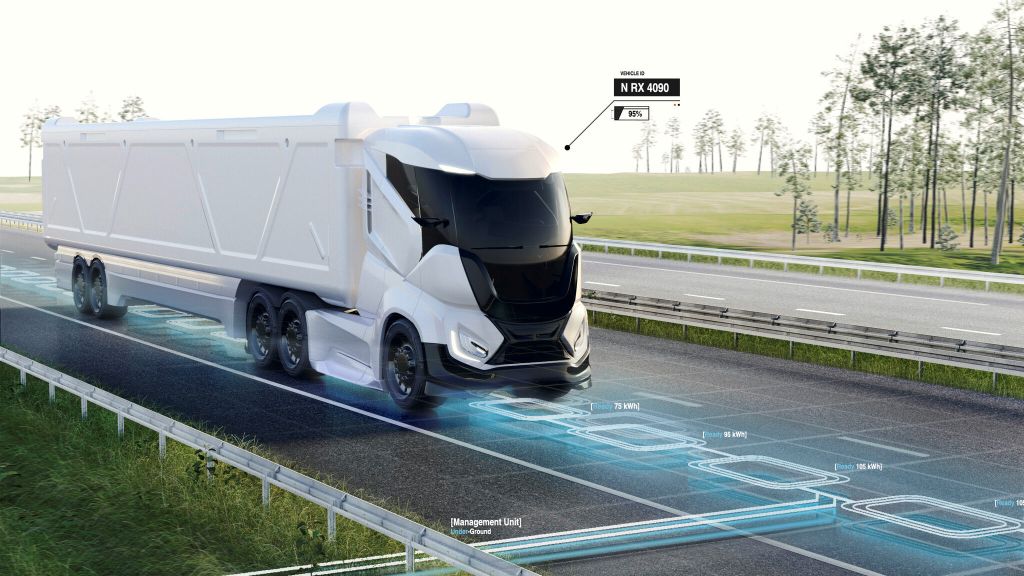
Induction coils have been embedded in the asphalt surface on the A6 between Nuremberg and Amberg, and for several months, tests have been conducted with specially equipped test vehicles.
'In the fall, we will organize an official test drive with different types of vehicles,' reports Prof. Florian Risch, project manager at FAPS. Risch is also head of the E|Road Center opened in April of this year in Hallstadt. In this technology center of Fraunhofer IISB (Integrated Systems and Component Technology) and FAPS, contactless energy transfer systems (IPT, Inductive Power Transfer) for static applications, such as in parking lots, semi-dynamic, like in taxi stands or bus stops, as well as dynamic inductive energy transfer on roads are being researched.
'The center is unique worldwide,' says Risch, 'because for the first time, flexible production environments, development laboratories, and test systems are combined under one roof.'
Simple principle can be implemented relatively quickly
Jörg Franke has been enthusiastic about the topic since he drove an inductively charged e-bus in Korea in 2010. 'The possibility of contactless energy transfer was already impressively demonstrated by Nikola Tesla at the end of the 19th century,' reports the Erlangen professor. 'In about 15 years, inductive energy transfer has been optimized using modern power electronics and perfectly tuned oscillating circuits.' Induction coils are embedded into the road surface of the highway. They generate an alternating magnetic field, which in turn induces voltage in coils in the undercarriage of the test vehicles when they drive over it. In this way, energy is transferred from the coils in the road to the car. The coils for the test track were developed and supplied by the startup Seamless Energy Technology from Nuremberg, a spin-off of FAPS. Also involved are the Israeli company Electreon Wireless and the road construction company Eurovia. The project started in 2022 - funded by the Federal Ministry for Economic Affairs.
While driving on the highway, the battery charge level is stabilized at least through a maintenance charge; depending on the available charging power, the state of charge (SoC) can even be increased. This way, sufficient energy for purely electric driving is available for the final stretch to the destination. 'It is therefore not necessary to electrify the entire road system of Germany; the main traffic axes are sufficient,' says Franke.
The whole thing could also be implemented in a relatively short period, as 'the asphalt surfaces need to be renewed every ten years anyway.' At this opportunity, the induction coils could be integrated.
Synergies for autonomous driving
The efficient energy supply could not only boost the struggling e-mobility but also autonomous driving. 'In China and the USA, larger fleets of autonomous robotaxis and shuttle systems are already in regular operation and achieve significant productivity gains through optimized time and resource use,' reports Risch. 'In Europe, there is still a significant backlog, not least in light of the growing shortage of skilled workers. And looking to the future, it is obvious that autonomously driving electric vehicles will organize their energy supply independently, without a human needing to manually plug them into a charging station.' Also, driverless transport vehicles in the industry have long been able to operate and be charged using inductive energy transfer.
Costs significantly lower than current trends
The costs for IPT technology are comparatively low compared to solutions like the Megawatt Charging System (MCS) and in-house battery production. We estimate an investment of around one million euros per kilometer and lane,' calculates Franke. 'With around 13,000 km of highways and electrified lanes in both directions, we would arrive at a total of around 30 billion euros. That would be just three percent of the infrastructure package of 1000 billion euros,' says the WGP researcher. 'Spread over the renovation cycle of the road surfaces of ten years, about 3 billion euros would need to be raised each year for the electrification of the highways.'
This amount could be financed through an infrastructure fee of 20 cents on each of the approximately 15 billion truck kilometers driven annually on German highways, which would correspond to the truck toll fees. Since fleet operators could save about 20 cents in energy costs per kilometer when switching to electric drive, this measure would not only be a powerful driver for electric heavy-duty transport but also a significant opportunity to improve the competitiveness of German freight forwarders and truck OEMs in international competition.
Geopolitical autonomy instead of dependencies
Heavier than the costs are the geopolitical uncertainties. 'The crucial question is whether we want to strategically use the necessary renewal of our infrastructure to simultaneously reduce dependence on Asian battery producers,' says Risch. 'In cell manufacturing, these suppliers have already achieved significant economies of scale and technological advantages that result in permanently lower production costs. A catch-up race in price competition therefore seems hardly realistic; rather, the difference is likely to increase. At the same time, more and more different battery materials are needed, while the batteries themselves are becoming larger. This not only increases the demand for raw materials - especially lithium, cobalt, and nickel - but also the dependence on global supply chains and thus the vulnerability of the entire European value creation system.' For the induction coils, more accessible and cheaper materials like copper and aluminum are needed.
Last but not least, this technology also offers Germany the chance to take on an international pioneering role. 'Relevant projects are currently being initiated and continuously developed throughout Europe. There is already a high level of interest, especially in Sweden and France,' says Risch. 'The broad interest in several European countries is ideal, as this initiative must be a pan-European approach from the very beginning, aimed at long-term knowledge transfer and technology diffusion.'
Contact: