
Due to increasing regulatory requirements, production technology providers worldwide face the challenge of integrating high-performance and environmentally friendly materials. Solutions that already exist will be showcased at EMO Hannover 2025, the world's leading trade fair for production technology, from September 22 to 26. In particular, metal foams and substitutes for per- and polyfluorinated alkyl substances (PFAS) are coming into focus.
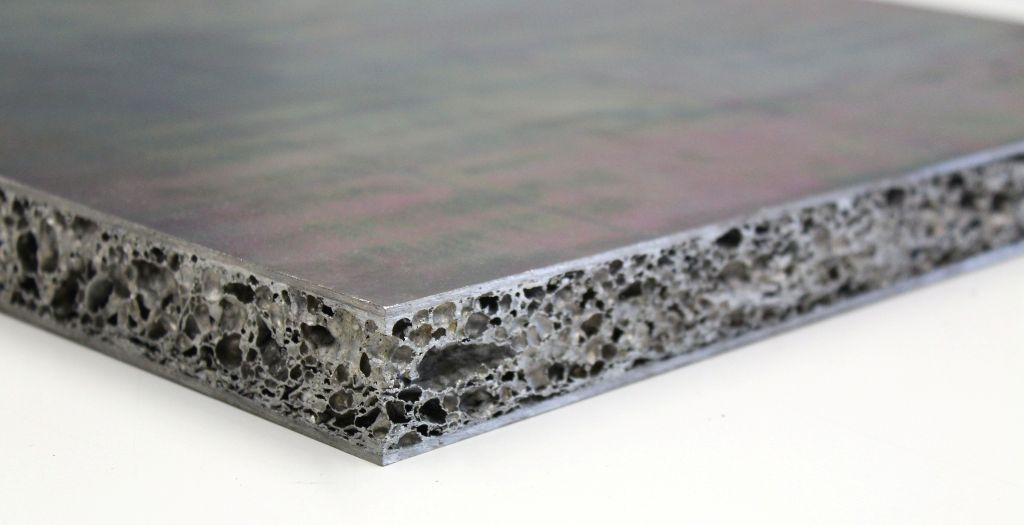
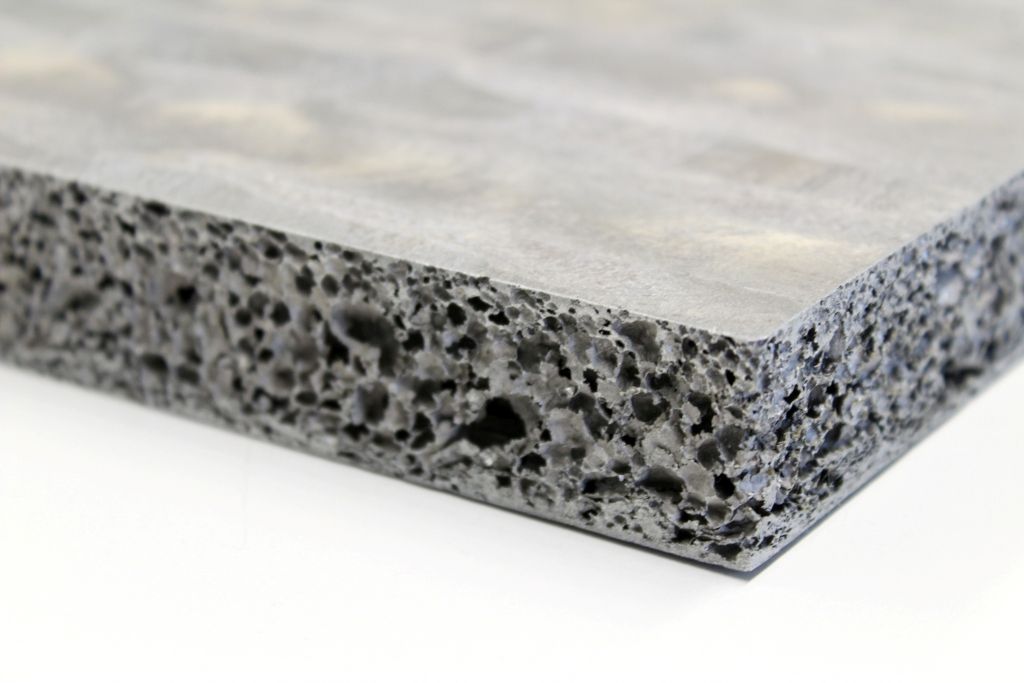
Metal foams help to design machines more efficiently, lighter, and at the same time more stable. The highly porous material has a cellular structure, similar to its natural counterparts like bone or wood, which can absorb energy in the form of vibrations, impacts, or sound.
Like baking bread
Aluminum foam can be produced in a process that essentially runs similarly to baking bread. Take powder, blowing agents, and heat, and the aluminum foam is ready. However, the production of this high-tech material is somewhat more complex in detail. 'For the production of aluminum foams, an aluminum alloy powder and a blowing agent powder are mixed together, usually pre-compacted by axial pressing, and then compressed into foamable strands by extrusion,' explains Carsten Lies, head of the Functional Integrated Lightweight Construction department at the Fraunhofer Institute for Machine Tools and Forming Technology (IWU) in Chemnitz. 'For the production of aluminum foam sandwiches, cut foamable aluminum strands are placed between two cover sheets positioned at a distance from each other,' the engineer further describes the production process.
In the subsequent heat treatment, the foamable aluminum expands many times over. The resulting foam connects firmly with the two cover sheets to form a sandwich. After cooling, the sandwich is cut to the final dimensions. 'Metal foams, especially aluminum foams, are primarily used as core material in sandwiches,' explains Lies. The cover sheets are usually made of steel or aluminum. 'The cover layers absorb applied loads, while the core keeps the sheets at a constant distance,' explains the Fraunhofer researcher the special properties of the high-tech material. The bond between the cover layers and the core usually occurs in a metallic bond.
Airy, light, and stiff: Sandwich with foam filling

'Sandwiches exhibit very high bending stiffness depending on the design. This effect is utilized to make assemblies lighter while maintaining or even improving the stiffness of the assembly,' says Lies. They replace massive elements of the conventional assembly. Depending on the optimization criterion, according to the researcher, either significant weight savings can be achieved with the same stiffness (up to about 30 percent) or significant increases in stiffness can be achieved with the same weight. The specific advantages of using metal foam in machines regarding efficiency and sustainability are thus 'significantly improved damping due to the foam core and significant weight savings through the use of sandwiches,' according to Lies.
Positively for the environmental balance is also that metal foams can be easily recycled. 'Since no adhesive is used for sandwich production, the material can be integrated into existing cycles for the processing of metal scrap from steel and aluminum,' says the researcher from Chemnitz.
Precisely from the 3D printer
Components made from metal foam – or more precisely, components made from hybrid porous (HyPo) materials – can also be produced using 3D printing. The advantage of additively manufactured metal foam: The air chambers can be arranged accurately. Components produced in this way can be optimized for specific applications, as the graded adjustment of the pore structure inside the component allows for more options than air bubbles in the metal, as they form during foaming through gas. Thus, in the 3D printer, machine components can be produced precisely and with exactly defined properties.
'A graded adjustment of pore structures and property profiles is difficult or even impossible in a monolithically produced material, as either the manufacturing process or further processing up to the final component geometry does not match the final requirements of the load,' explains Thomas Hassel from the Institute for Materials Science at Leibniz University Hannover (LUH). The additive manufacturing, as the PhD engineer emphasizes, achieves a 'near-net-shape production' of components while simultaneously incorporating the gradation in such a way that it is positioned exactly in the requirement profile.
What specific applications exist in machine tool construction and how the innovative material can help increase efficiency and sustainability in factories is the subject of research. The focus is on components of a machine tool (tool changers, tool holders, spindle slides) concerning their stiffness, damping, thermoelastic behavior, imbalance, as well as their hardness and surface quality, explains Hassel. By implementing HyPo components, for example, in a milling machine, research is being conducted into the advantages that arise from the graded components. 'The operational behavior during machining is to be analyzed, as milling encompasses a wide range of different load cases,' says Hassel. 'This makes it possible to determine the influence of the HyPo component on the mechanical and thermal machine properties and significantly improve the performance of such machines.'
Substitute for forever chemicals
More sustainability through lightweight materials is one of many approaches to improving the environmental balance in industrial production. Environmentally friendly alternatives for so-called forever chemicals are also coming into focus. In particular, environmentally harmful per- and polyfluorinated alkyl substances (PFAS), which are used in production, especially where extreme conditions prevail: high temperatures, strong abrasion, or aggressive chemical conditions. PFAS are found, among other things, in seals, pipes, or fittings.
Whether a substitution of PFAS is possible should be evaluated "individually depending on the application case and cannot be answered in general terms," says Frank Schönberger, head of the synthesis and formulation department at the Fraunhofer Institute for Structural Durability and System Reliability LBF in Darmstadt. "A 1:1 replacement of fluoropolymers is usually not possible, but always depends on the individual requirements of the respective application."
There are cases where a fluoropolymer can be replaced by another high-performance polymer (such as PEEK, PEI, or PPS) depending on the requirements, for example, when temperature and media requirements are moderate or in the area of tribological compounds. "But there are also application areas where the complex requirements – as of today – cannot be met by any other material," the researcher clarifies. "Fluoropolymers have a largely universal chemical resistance and high temperature resistance. In applications where this is required, such as in pumps or systems that must withstand different media under various conditions, fluoropolymers have not yet been replaceable," summarizes Schönberger and adds: "Opportunities may arise in applications where the full potential of fluoropolymers is not required and in situations where, for example, a redesign is possible."
PFAS substitution also relevant for the USA
According to Schönberger, the PFAS replacement is also relevant for markets outside Europe, especially in the USA. Furthermore, there are regulations in the United States that depend on the respective state. This also shows: More sustainability in production technology is a global challenge that must be addressed in factories in all industrial nations.
Author: Daniel Schauber
Contact: