
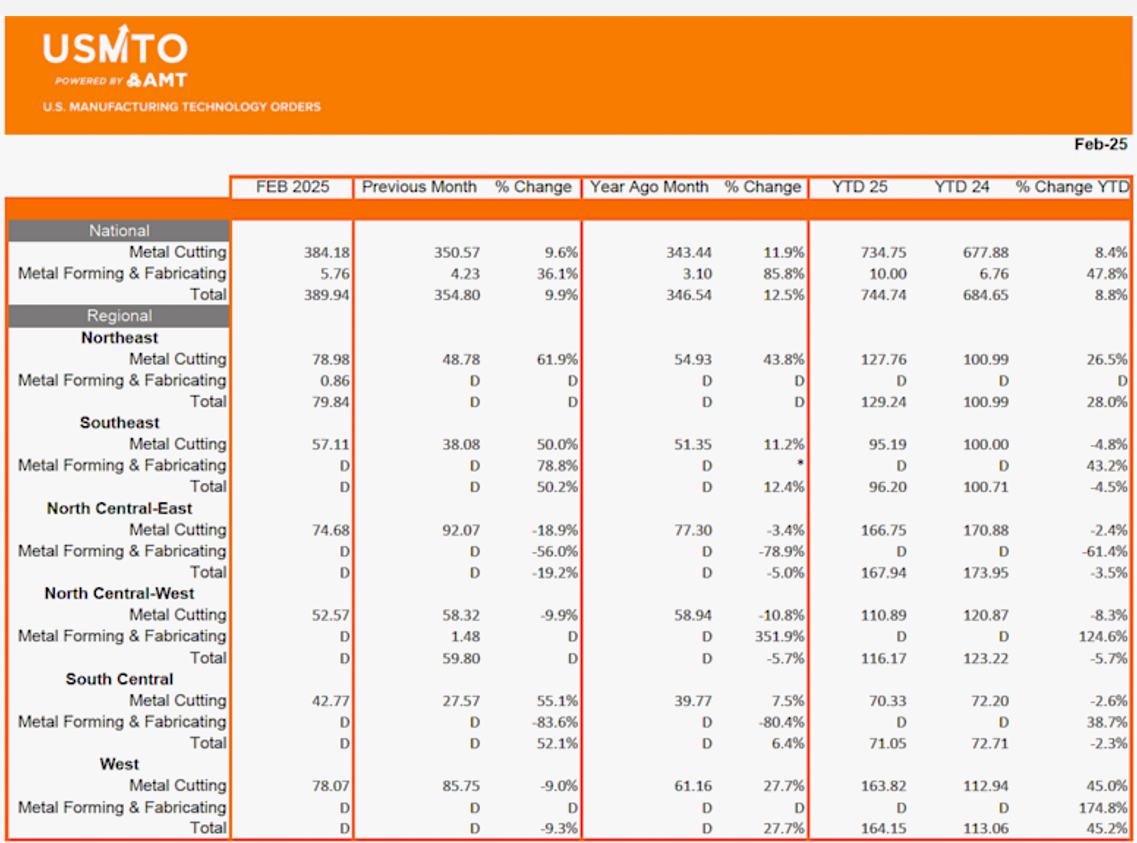
In the first two months of the year, orders amounted to a total of $744.74 million, representing an increase of 8.8% compared to the first two months of 2024.
In the first two months of 2025, the optimistic forecast for machine tool orders seems to be coming true. Not only has the value of the ordered machines increased, but the number of units has also recovered in 2025. For much of 2024, the growth in sold units lagged behind the increase in the total value of orders. This trend has reversed in 2025: The number of ordered units was 9.6% higher than in the first two months of 2024.
- The contract manufacturing companies, the largest consumers of manufacturing technology, recorded an increase in orders of almost 25% compared to January, but remained below the level reached in 2024.
- The value of orders placed by manufacturers in the aerospace industry fell sharply from January to February, but the number of units ordered has slightly increased. This suggests that the industry is purchasing machines to overcome capacity constraints. This is confirmed by the fact that capacity utilization in aerospace and other transportation sectors exceeded the level prior to the strike of machine builders at Boeing for the first time in February 2025.
- The value of machine orders placed by manufacturers of electrical equipment remained roughly the same from January to February, but the number of units ordered has nearly doubled. While the order situation remains high due to the ongoing transformer shortage, it could be jeopardized if the recent plans to halt the development of data centers expand.
In response to the new tariffs announced by the Trump administration in early April, many forecasters have revised their growth expectations for 2025 downward as uncertainty increased. In this environment, many major stock indices recorded declines. Since the stock market reflects expectations for future corporate profitability, the observed declines could be interpreted as waning confidence in future consumer demand. Another interpretation suggests that companies may not be able to pass on the full costs of production inputs to customers after a prolonged period of inflation has increased the price sensitivity of businesses and consumers. In this scenario, manufacturers investing in newer, more efficient technologies could recoup some of the lost profit margins through cost-saving process improvements.
Contact: