
While the share of titanium components accounts for only about 14 percent of the weight of a typical passenger aircraft, their share of machining time is around two-thirds of the total machining time for metal components. This is because, compared to aluminum machining, the achievable material removal rates (cm3/min) in titanium machining are very low. Those who manage to reduce machining times for a titanium component or significantly improve the tool life of machining tools can greatly increase the efficiency and cost-effectiveness of their processes. With the new easy-cutting M5250 squirrel cutter, the machining specialist Walter has made a significant step in close collaboration with the coolant expert Blaser Swisslube and the premium machine manufacturer Makino.
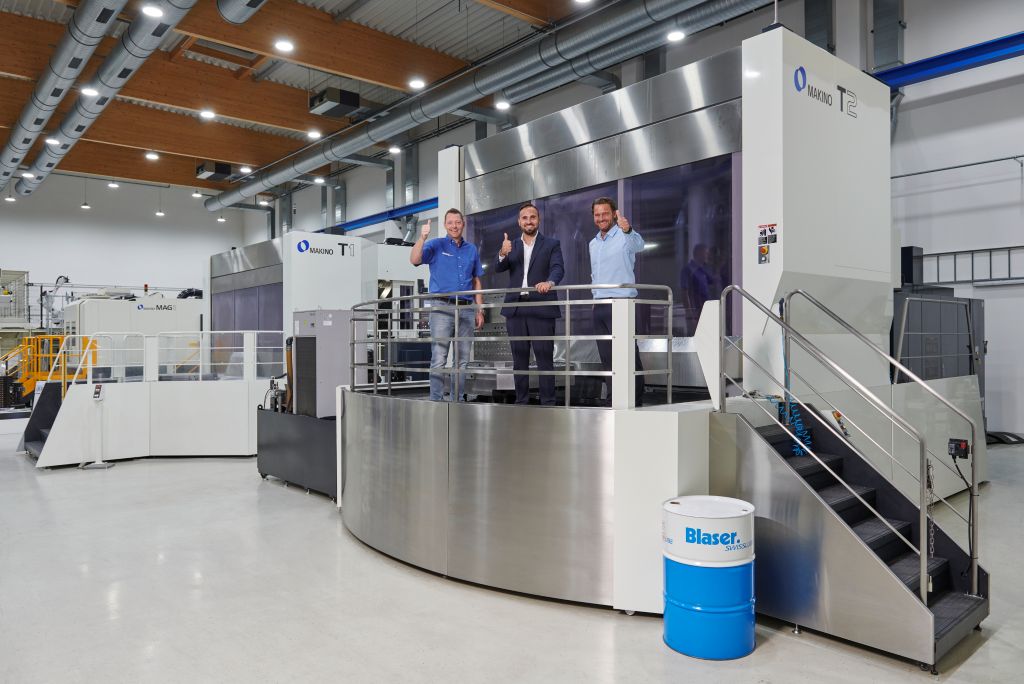
Machining processes, especially when it comes to machining demanding materials like titanium, require teamwork. The potential of a high-end machine developed for milling titanium alloys, such as the Makino T2, can be fully realized when working with appropriately optimized cutting tools and coolants. The opposite is also true: The new Walter M5250 squirrel cutter shows its best performance when roughing titanium components on machines like the Makino T2, which provides optimal working conditions for the cutter with an active damping system, a rigid construction, a high-performance spindle with high torque, and a powerful high-pressure coolant system.
High thermal stress for tools and spindle
Titanium and titanium alloys have low thermal conductivity, which poses a real challenge for machining. While about 80 percent of the thermal load generated during steel machining is dissipated through the chips, only 20 percent is the case for titanium. This means that cutting tools and spindles must absorb massive heat. Extreme temperature stresses occur at the cutting edge of the insert. Without countermeasures, the cutting edge would wear out extremely quickly in contact with the workpiece: it practically evaporates. Special cutting edge geometries and coatings, along with the use of coolants, are employed to slow down and somewhat control this inevitable wear process. To be truly safe regarding machining quality, many production managers also replace the inserts significantly before deep wear marks appear.
Coolant and machine in harmony
Daniel Schär, Senior Segment Manager at Blaser Swisslube AG, explains Blaser's role in the project: 'In machining titanium, controlling the heat development at the tool and machine plays a central role. Here, a coolant optimized for use under these special conditions can significantly impact tool life and material removal rates. Accordingly, our development team has worked intensively on the vision of the ideal coolant. With Vasco Skytec H 600, we are very close to that.'
In comparative tests with 22 coolants from competitors and five of its own products conducted by Blaser Swisslube in its in-house technology center in Switzerland, the innovative coolant clearly ranks at the top.
The innovative coolant Vasco Skytec H 600 developed by Blaser Swisslube has a significantly higher efficiency in machining than conventional coolants. This allows for higher tool life in existing processes. Andrea Biscardi, Product Manager at Makino Europe GmbH, explains the effects of the new coolant on a machine like the T2: 'One of the most important features of the Makino T2 is its powerful 7MPa with 200L/min high-pressure coolant system. This means that even with conventional lubricants, we achieve a very decent cooling rate at the workpiece. When we use Vasco Skytec H 600, you can notice a significant difference. The limiting factor then remains, in a certain sense, the cutting tool. Or you use a part optimized for titanium machining like the Walter squirrel cutter. You can already see what it can do in terms of machine runtimes and the cutting data you can achieve.'
Stay cool where it's needed: Walter M5250 squirrel cutter
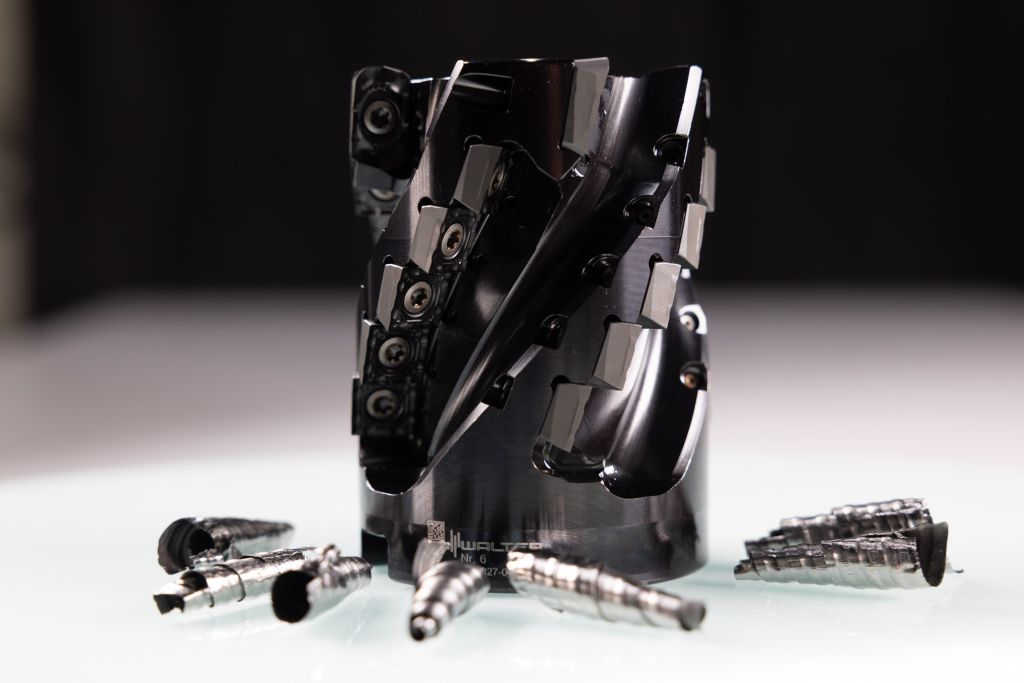
Machining titanium has been one of the focus topics of product development at Walter for years. With the BLAXX squirrel cutter M3255, the machining specialists from Tübingen already have something like a classic for titanium machining in their program. In 2022, Walter launched a new generation of inserts whose cutting edge, with innovative WaveCut geometry, allows for significant tool life advantages over conventional solutions. Dirk Masur, segment manager aerospace at Walter, explains: 'We are constantly working to offer customers even better solutions for their processes. Projects like this collaboration with Makino and Blaser Swisslube are an important opportunity to test and further develop new tool concepts under ideal but still real, concrete conditions. The new Walter M5250 squirrel cutter has greatly benefited from this.'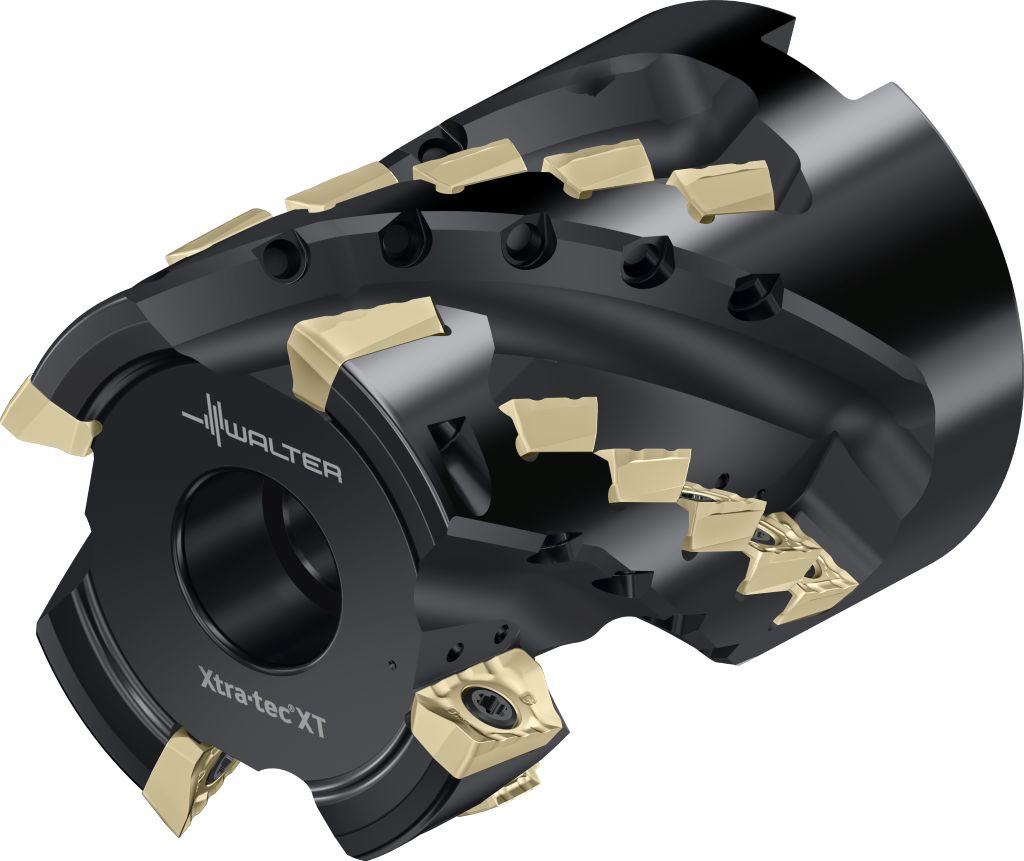
The main goal for Walter was to significantly increase the material removal rate or tool life of the inserts when roughing titanium components compared to previous solutions. With the WaveCut inserts, an important building block of an optimal roughing strategy is already in place: By changing the cutting edge geometry from a straight to a 'wavy' edge, the forces acting on the tool and the component during milling change. The edges enter the material much more gently, resulting in less vibration and enabling low-vibration machining depths of up to 5xD in high-performance machining.
The thermal load acting on the indexable insert, tool, and spindle is already reduced by the WaveCut geometry. By supplying the coolant as directly as possible to the indexable inserts, the heat generation at the cutting edges can be significantly reduced. In the new Walter M5250 end mill, the development team utilized the advantages of the WaveCut cutting edges, which enter the cut relatively softly, to equip the end plates with two cooling channels each. The cooling channels in the tool body are optimally designed to supply the individual cutting edges with coolant as well as in the bore cross-section, so that the performance of the coolant pump and the offered flow rate can be fully utilized. The coolant acts directly at the cutting edge entry in the material according to the thermal requirements. The overall stability of the tool body is not compromised during roughing, and the improved cooling at critical points significantly increases machining stability.
Especially when the new Vasco Skytec H 600 from Blaser Swisslube is used: In the test configuration with parameters vc 60 m/min, fz 0.18 mm, vf 218 mm/min, ap 60 mm, ae 10 mm in a workpiece made of titanium grade 5 (Ti6Al4V) on a Makino T2, the new Walter M5250 end mill with Tiger·tec indexable inserts G55W WSM45X literally outperforms all other tested combinations of Walter end mills, indexable inserts, and coolants. With 110 minutes, the tool life per cutting edge is 162 percent above that in configurations with other coolants and cutting geometries. This is also reflected in the removal rate, which is at 130.9 m3 per minute.
Contact: